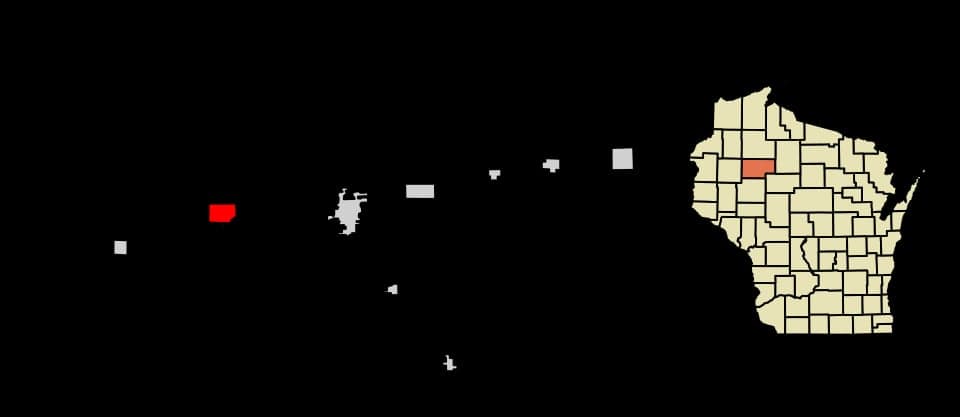
Photo: Wikipedia
Strategic Assessment of Bruce, WI
Workable tactical position. Some exposure to population density or targets, but generally defensible in a crisis.
What does the Strategic Assessment tell us?
Our Strategic Assessment grades tactical survivability of an area. Major population centers, military targets, fallout zones, natural disasters, and border exposure all drive risk — lower exposure means a more defensible position in a crisis.
This is heavily inspired by Joel Skousen's Strategic Relocation book. Highly recommended you checkout the book ($)What does this tell us?
Our Strategic Assessment grades tactical survivability of an area. Major population centers, military targets, fallout zones, natural disasters, and border exposure all drive risk — lower exposure means a more defensible position in a crisis.
This is heavily inspired by Joel Skousen's Strategic Relocation book. Highly recommended you checkout the book ($)Strategic Pillars

Key Distances
Regional Safe Places
Below is our recommended "safe zones" in Wisconsin and the surrounding area based on our strategic heuristics. For most people, it's unrealistic to live in a “safe zone” full-time due to work, family or other personal reasons. They tend to be more rural. However, many of these areas are perfect for second homes and retreat properties that double as a vacation home or even a short-term rental.
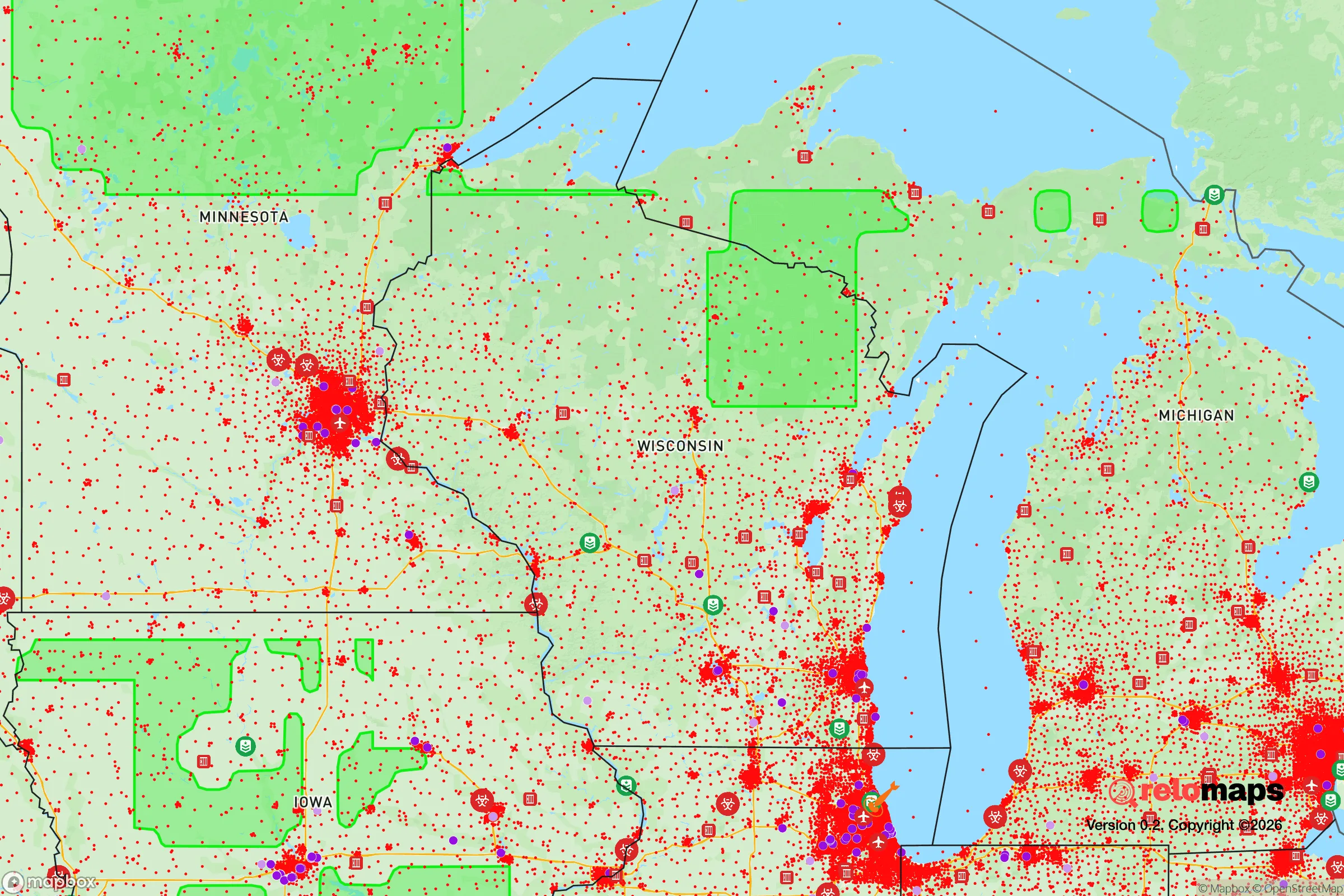
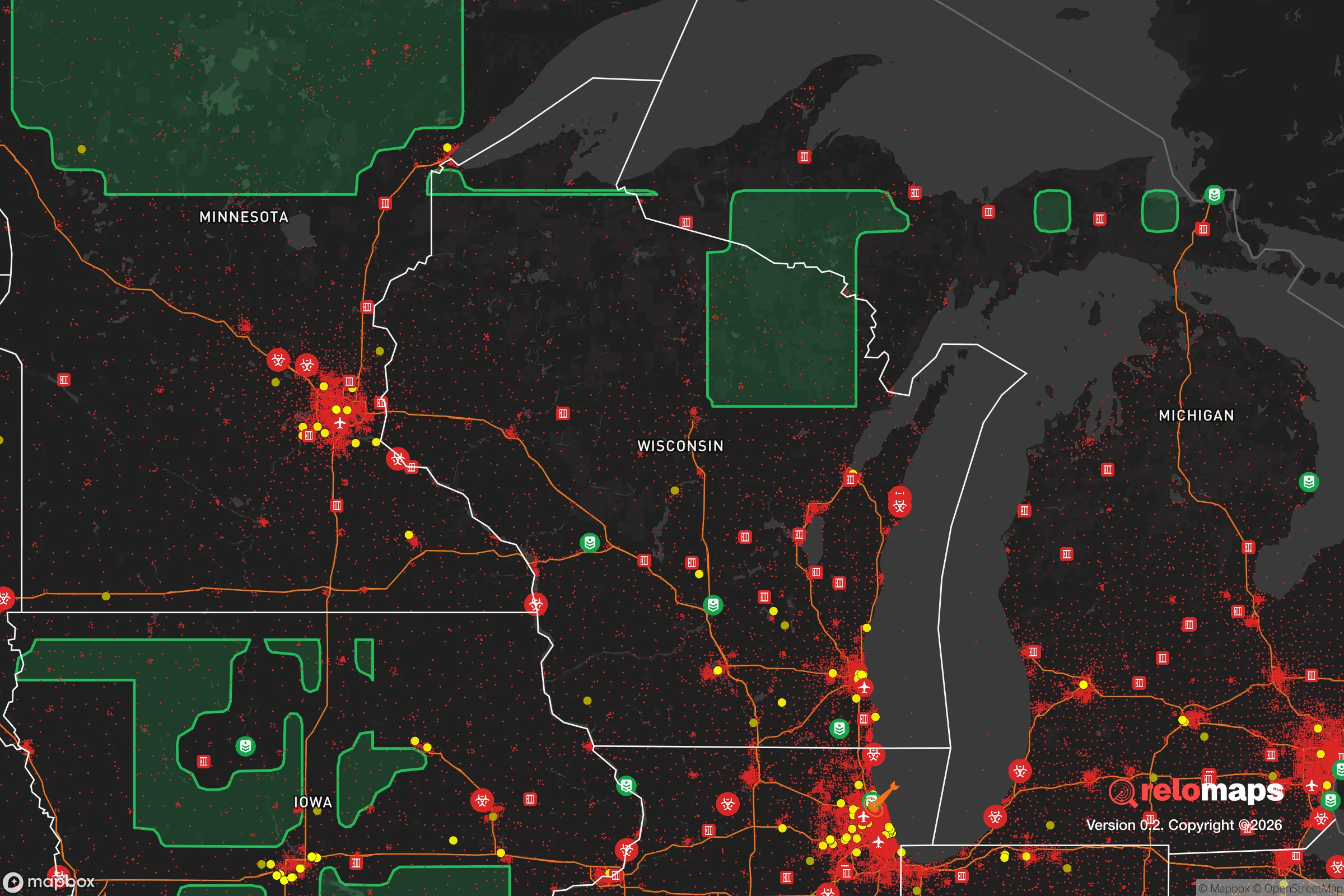


Important Note: For informational purposes only. This does not mean nothing bad ever happens in the green zones. Please use common sense. This is based on public data and modeled with AI. We tried to take a conservative approach but mistakes happen. We update this regularly as new information becomes available.
Solar Generator Recommendations
Backup power matters more here than in safer locations. We've picked three solar generators across budgets and capacity tiers — start with the budget unit if you only need a few essentials, or step up if you want to run a fridge and HVAC for days at a time.

Jackery Portable Power Station Explorer 300
Budget OptionPower on the Go: Weighing only 11 lbs, it's convenient to set up and store with book-sized foldable solar panels

BLUETTI Portable Power Station AC180
Designed for both indoor and outdoor scenarios, AC180 is highly capable as it has a robost capacity and continuous output power.

EF ECOFLOW DELTA Pro Ultra Power Station
Upgraded PickEcoFlow DELTA Pro Ultra is a whole-home energy system designed to grow with your family. Integrated with the Smart Home Panel 2, it scales to meet your evolving energy needs — keeping your home powered, intelligent, and secure through every stage of life.
We earn a commission, at no additional cost to you.
Strategic Assessment Analysis
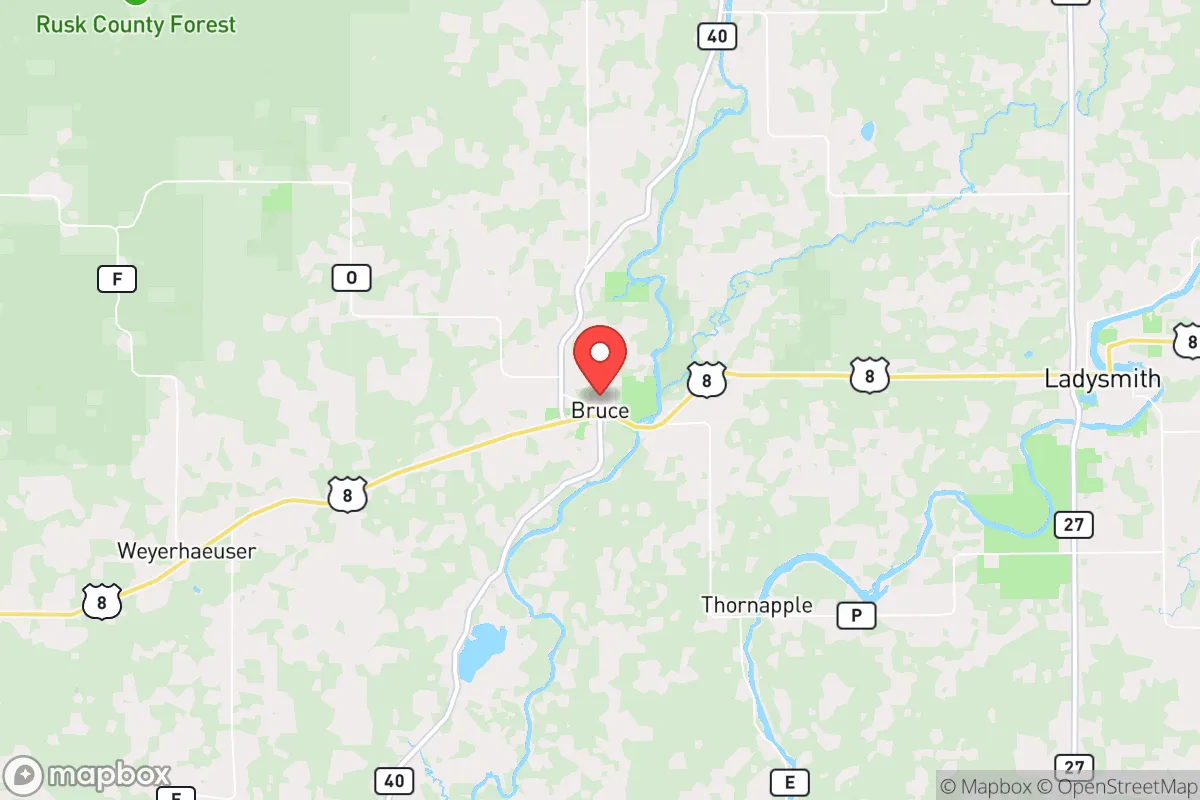
Bruce, Wisconsin, offers a compelling mix of resilience and vulnerability for the serious relocator. Situated in Rusk County, roughly 30 miles north of Ladysmith and 70 miles northeast of Eau Claire, this small community of about 800 people sits in a region that balances rural isolation with reasonable access to essential services. For someone weighing disaster readiness and self-sufficiency, Bruce presents a solid baseline—but the strategic picture requires a clear-eyed look at both its natural advantages and its exposure to risks, particularly from man-made threats and proximity to larger population centers.
Geographic position and natural advantages for long-term stability
Bruce’s location in northwestern Wisconsin places it in a zone with several inherent resilience benefits. The area is part of the Chippewa River Valley, which provides fertile soil and reliable water sources—critical for any self-sufficiency plan. The surrounding landscape is a mix of hardwood forests, low hills, and numerous small lakes, offering ample hunting, fishing, and foraging opportunities. The region’s climate is continental, with cold winters and moderate summers, which reduces the risk of extreme heat events and limits the spread of vector-borne diseases compared to southern states. The population density is extremely low—Rusk County averages about 14 people per square mile—which naturally reduces competition for local resources in a crisis. Bruce itself is far enough from major highways (U.S. 8 runs nearby, but not through town) to avoid the worst of evacuation traffic or transient populations during an emergency. The nearest city of any size, Eau Claire, is about 70 miles southwest, which is close enough for supply runs but far enough to buffer against urban collapse scenarios. For a relocator focused on long-term stability, the area’s combination of water availability, forest resources, and low population density is a strong foundation.
Risks, exposures, and proximity to fallout-relevant landmarks
No strategic assessment is complete without weighing the downsides, and Bruce has some notable exposures. The most significant risk comes from its proximity to potential man-made threats. The Twin Cities metro area (Minneapolis–St. Paul) lies about 120 miles to the southwest—close enough that a major event there, whether a nuclear detonation, industrial accident, or civil unrest, could send fallout, refugees, or supply chain disruptions northward. More directly, the Chippewa Falls area, about 60 miles southwest, hosts several industrial facilities, including a major hydroelectric dam and a large paper mill. A dam failure or chemical release on the Chippewa River could affect downstream water quality, though Bruce is far enough upstream to be partially insulated. Natural disaster risks are moderate: the region sees occasional severe thunderstorms and tornadoes (Rusk County averages 1-2 tornadoes per decade), but it’s not in a high-risk zone. Winter storms are the most consistent hazard, with heavy snow and ice storms capable of isolating the area for days. Flooding is a localized concern near the Chippewa River and its tributaries, but Bruce sits on higher ground, so this is manageable. The biggest strategic weakness is the lack of a robust local healthcare system—the nearest hospital is in Ladysmith (30 miles south), and serious trauma care requires a 70-mile drive to Eau Claire. For a relocator, this means medical self-sufficiency is a must, not a luxury.
Practical resilience for a relocator: food, water, energy, and defensibility
For someone serious about self-sufficiency, Bruce offers a workable but not effortless environment. Water is abundant: the area sits over the Cambrian Sandstone aquifer, which provides clean groundwater at moderate depths (typically 50-150 feet for a well). Surface water from the Chippewa River and nearby lakes is also available, though it requires treatment. Food production is viable: the growing season runs about 120-140 days, suitable for cold-hardy crops like potatoes, root vegetables, and grains. The surrounding forests support deer, turkey, and small game, and the lakes offer walleye, bass, and panfish. However, the soil is sandy and acidic in many spots, so raised beds or soil amendments are needed for serious gardening. Energy resilience is a mixed bag: the grid is rural and prone to outages during winter storms, but the area has good potential for off-grid solutions. Solar panels work well here (about 4.5 peak sun hours per day), and wood heating is the norm—most homes have wood stoves or boilers, and firewood is plentiful. Propane is widely used for backup heating and cooking. Defensibility is decent: the town’s layout is compact, with a few main roads and limited choke points, making it easier to monitor access. The surrounding forest provides cover but also concealment for unwanted visitors. The local population is generally self-reliant and community-oriented, which is a double-edged sword—outsiders may be viewed with suspicion, but those who integrate can count on strong mutual aid. The biggest practical challenge is supply chain distance: the nearest major grocery store is in Ladysmith (30 miles), and hardware or medical supplies require a similar drive. Pre-positioning at least a year’s worth of food, medicine, and ammunition is strongly advised for anyone serious about long-term resilience.
Overall, Bruce, Wisconsin, rates as a solid B-tier relocation choice for the disaster-conscious relocator. It offers genuine natural advantages—abundant water, low population density, and a productive landscape—that form a strong base for self-sufficiency. Its main weaknesses are the proximity to the Twin Cities corridor (a potential source of fallout and refugees) and the lack of local medical infrastructure. For a single individual or family willing to invest in off-grid systems, stockpile supplies, and integrate into the local community, Bruce provides a defensible, resource-rich environment that can sustain a long-term resilience strategy. The key is to treat it as a base camp, not a fortress—and to have a plan for the first 72 hours of any major event, because help from Eau Claire or Ladysmith will not arrive quickly. If you can handle the isolation and the winters, Bruce is a place where you can build a genuinely resilient life.

* Values derived from national, state, county, city and local statistics and may differ in a specific area. Last updated: 2026-09-01T03:41:48.000Z
Narrative content on this page is AI-generated and may contain mistakes. Verify any details that matter before acting on them.
ReloMaps may earn a commission from affiliate links at no extra cost to you.

