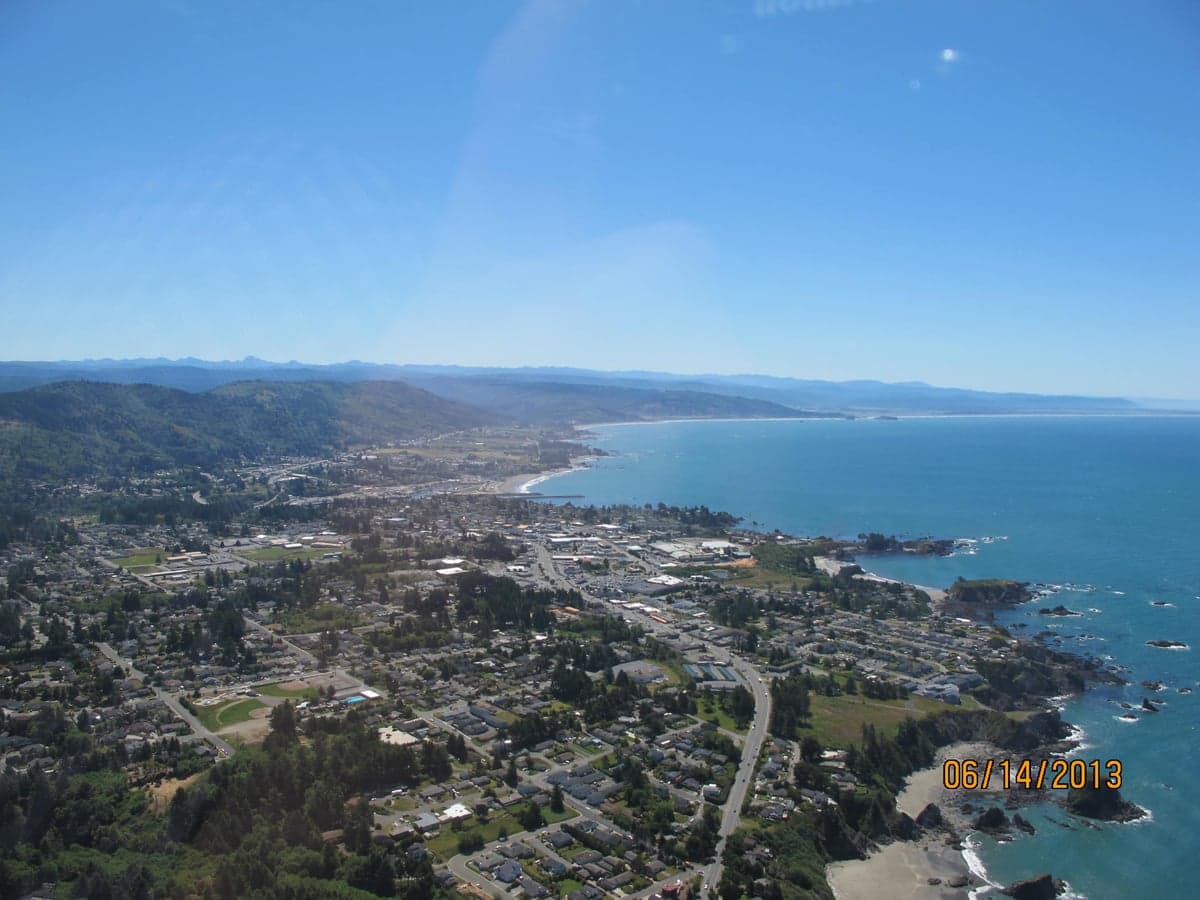
Photo: Wikipedia
Personal Sovereignty in Brookings, OR
Viable for self-reliance. Generally workable, though some barriers may limit total independence.
What does Personal Sovereignty tell us?
Personal Sovereignty measures your capacity for self-reliance and independence with minimal government friction. Higher scores mean fewer barriers between you and the way you want to live... but it assumes you have the space you need and good neighbors.
What does this tell us?
Personal Sovereignty measures your capacity for self-reliance and independence with minimal government friction. Higher scores mean fewer barriers between you and the way you want to live... but it assumes you have the space you need and good neighbors.
State Policy
Energy independence: Importer (35% of energy produced in-state)
Personal Liberty
Homesteading

Personal Liberty Analysis
Brookings, Oregon, offers a notably high degree of personal sovereignty relative to many coastal communities, driven by its rural character, limited local government footprint, and the state’s permissive self-defense laws. While Oregon’s state-level regulatory environment is more interventionist than neighboring states like Idaho or Nevada, the practical autonomy experienced in Brookings is shaped by a hands-off county government, low property crime rates, and a culture of self-reliance that predates the recent influx of out-of-state movers. For a single individual or family prioritizing independence, the trade-off is clear: you gain significant day-to-day freedom in land use and self-defense, but you operate within a state that imposes income taxes and land-use planning rules that are more restrictive than in, say, rural Texas or Arizona.
Tax burden and regulatory posture: what you actually pay and deal with
Oregon’s tax structure is a mixed bag for sovereignty-minded residents. The state has no sales tax, which is a clear win for daily purchasing freedom, but it imposes a progressive income tax that tops out at 9.9% for high earners. For a family earning $80,000–$120,000, the effective state income tax rate lands around 7–8%, which is moderate by West Coast standards but higher than in Washington (no income tax) or Nevada. Property taxes in Curry County, where Brookings sits, are relatively low: the average effective rate is about 0.85% of assessed value, compared to the national average of 1.1%. A $400,000 home would carry roughly $3,400 in annual property taxes. The regulatory posture at the local level is light. Brookings has no city-level income tax, no business license requirement for most home-based enterprises, and the Curry County planning department is known for being pragmatic rather than punitive. However, Oregon’s statewide land-use laws—specifically the Urban Growth Boundary (UGB) system—mean that building on rural parcels outside city limits requires a demonstrated need and can involve a 6–12 month permitting process. Inside city limits, building permits are straightforward for standard single-family homes, with typical review times of 2–4 weeks. The overall regulatory burden is best described as moderate: the state adds friction, but the county and city rarely add extra layers.
Self-defense and gun law specifics: what you can carry and where
Oregon is a “shall-issue” state for concealed handgun licenses, meaning that if you pass a background check and complete a safety course, the county sheriff must issue the permit. Curry County Sheriff John Ward has a reputation for efficient processing, with permits typically arriving in 30–45 days. Open carry is legal without a permit for anyone 18 or older who can legally possess a firearm, though it is restricted in public buildings and schools. There is no state-level magazine capacity limit, no “assault weapon” ban, and no waiting period for long gun purchases. The state does require a background check for all firearm transfers, including private sales, which is a point of friction for some libertarian-leaning residents. Stand-your-ground laws do not exist in Oregon; the state follows a “duty to retreat” standard in public spaces, though the Castle Doctrine applies inside your home and vehicle. In practice, this means that if you are in your home and an intruder enters, you have no duty to retreat and can use deadly force if you reasonably believe it is necessary to prevent imminent death or great bodily harm. Outside the home, you must attempt to retreat before using force. This is a meaningful distinction from states like Florida or Texas, but for most defensive scenarios—home defense, vehicle defense—the law is protective. The local gun culture in Brookings is strong; there are two gun shops in town, a shooting range at the Chetco Valley Gun Club, and the Curry County Sheriff’s Office is generally supportive of Second Amendment rights. For a family moving from a restrictive state like California or New York, the shift in legal posture will feel substantial and liberating.
Self-reliance and homesteading viability: lot sizes, zoning, and off-grid feasibility
Brookings is one of the most viable locations on the Oregon coast for homesteading and off-grid living. The city’s zoning code allows for residential lots as small as 5,000 square feet in standard subdivisions, but the real opportunity lies in the unincorporated areas of Curry County, where minimum lot sizes for rural residential zoning are 2.5 acres, and for farm/forest zoning, 10 acres. On these larger parcels, the county allows for a wide range of self-reliance activities: keeping chickens, goats, and up to two cows without a conditional use permit; beekeeping; and small-scale agriculture. Off-grid feasibility is high. The area receives about 80 inches of rain annually, so rainwater catchment is practical, and the county does not prohibit it. Solar power is viable, though the frequent coastal cloud cover means you will need a larger panel array and battery bank than in the inland valleys. The city of Brookings provides municipal water and sewer within the UGB, but outside it, private wells and septic systems are standard, and the county health department’s permitting process for wells is straightforward—typically a 2–3 week review. There is no county-level ban on composting toilets or graywater systems, though they must meet Oregon’s state plumbing code. The biggest regulatory hurdle for full off-grid living is Oregon’s building code, which requires that any habitable structure meet state energy efficiency standards, even if it is not connected to the grid. This means you cannot legally build a simple shack without insulation and double-pane windows. However, many residents work around this by building a “shop” or “shed” that is technically non-habitable and then living in it informally. The county does not actively enforce against this unless a complaint is filed. For a family serious about self-reliance, the Brookings area offers a realistic path to semi-off-grid living with minimal government interference, especially if you choose a parcel outside the city limits.
Personal liberties: parental rights, medical autonomy, speech, and property
Oregon’s state-level policies on personal liberties are a mixed bag for a conservative-leaning audience. On parental rights, Oregon is one of the most progressive states in the nation: it has no parental notification or consent requirement for minors seeking abortion, and it allows minors 15 and older to consent to mental health and substance abuse treatment without parental involvement. This is a significant concern for families moving from more traditional states. On the other hand, Oregon has strong school choice laws, including charter schools, online public schools, and a robust homeschooling statute that requires only a simple notice of intent and no standardized testing or curriculum approval. The Brookings-Harbor School District is accommodating to homeschoolers, allowing part-time enrollment in specific classes. Medical autonomy is limited: Oregon has legalized physician-assisted suicide (Death with Dignity Act) and has broad vaccine mandates for school attendance, though medical and religious exemptions are available. The state does not have a “right to try” law for experimental treatments beyond the federal standard. Free speech protections are strong; Oregon has no hate speech law that criminalizes speech, and the state’s public meeting laws are transparent. Property rights are where Brookings shines. Oregon’s property tax system includes a 3% annual cap on assessed value increases, meaning long-term homeowners pay significantly less than new buyers—a boon for stability but a frustration for newcomers who pay market-rate taxes. The state does not have a “right to farm” law that protects agricultural operations from nuisance lawsuits, but Curry County is generally pro-property-rights, and zoning enforcement is complaint-driven rather than proactive. For a family that values the ability to use their land as they see fit, Brookings offers a permissive environment compared to the Willamette Valley or Portland metro area.
Overall, Brookings ranks as a high-sovereignty location within Oregon, but it is not a libertarian paradise. The state’s income tax, duty-to-retreat self-defense law, and progressive parental rights policies will be deal-breakers for some. However, for a family that prioritizes low property taxes, permissive land use, a strong gun culture, and a community that values self-reliance, Brookings offers a level of personal autonomy that is rare on the West Coast. Compared to coastal towns in California or Washington, Brookings is significantly freer; compared to inland Idaho or Montana, it is more regulated but offers the trade-off of a mild climate and ocean access. The practical sovereignty you experience day-to-day is high, especially if you are willing to work within the state’s framework rather than fight it.

* Values derived from national, state, county, city and local statistics and may differ in a specific area. Last updated: 2026-10-05T17:11:09.000Z
Narrative content on this page is AI-generated and may contain mistakes. Verify any details that matter before acting on them.
ReloMaps may earn a commission from affiliate links at no extra cost to you.

