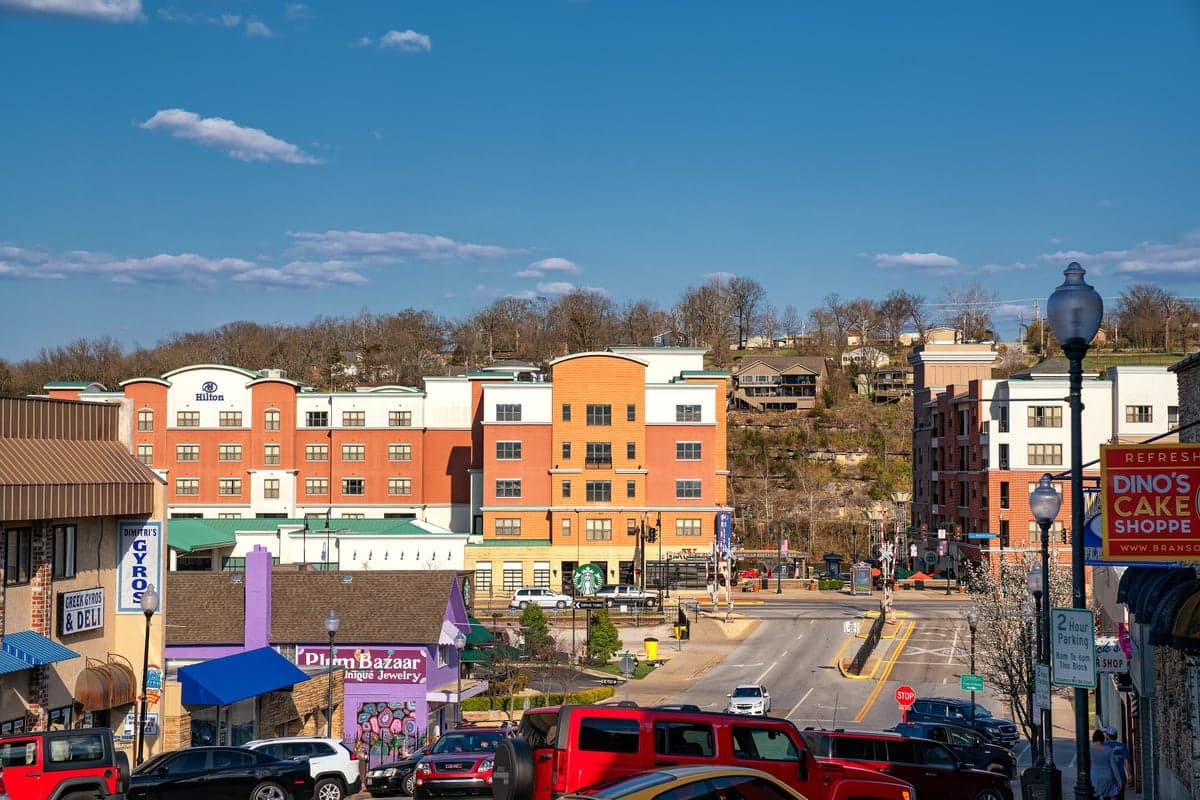
Photo: Wikipedia
Personal Sovereignty in Branson, MO
Strong independent fundamentals that actively favor personal liberty and low regulation.
What does Personal Sovereignty tell us?
Personal Sovereignty measures your capacity for self-reliance and independence with minimal government friction. Higher scores mean fewer barriers between you and the way you want to live... but it assumes you have the space you need and good neighbors.
What does this tell us?
Personal Sovereignty measures your capacity for self-reliance and independence with minimal government friction. Higher scores mean fewer barriers between you and the way you want to live... but it assumes you have the space you need and good neighbors.
State Policy
Energy independence: Importer (15% of energy produced in-state)
Personal Liberty
Homesteading

Personal Liberty Analysis
Branson, Missouri, offers a personal sovereignty environment that is among the most accommodating in the Midwest, driven by a state-level commitment to low taxes, expansive gun rights, and limited government interference in daily life. For individuals and families who prioritize autonomy—whether in financial decisions, self-defense, or lifestyle choices—the regulatory posture here is distinctly light-touch compared to neighboring states like Arkansas or Illinois. The city itself balances a tourism-driven economy with a deeply rooted local culture that values self-reliance, making it a practical destination for those seeking to maximize personal freedom without sacrificing access to modern amenities.
Tax burden and regulatory posture: how Missouri compares to surrounding states
Missouri’s tax structure is a clear draw for sovereignty-minded relocators. The state levies a flat personal income tax rate of 4.95% as of 2025, with ongoing legislative efforts to reduce it further. There is no state-level estate or inheritance tax, which protects wealth transfer for families. Property taxes in Taney County, where Branson sits, are among the lowest in the state—typically 0.7% to 0.9% of assessed value—meaning a $300,000 home carries an annual tax bill of roughly $2,100 to $2,700. Sales tax in Branson is higher, around 9.1% (combining state, county, and city rates), but this is partially offset by the absence of a tax on groceries or prescription drugs. Regulatory burden is minimal: Missouri is a right-to-work state (though the law was repealed in 2018, union membership remains low), and occupational licensing requirements are less onerous than in many coastal states. For small business owners or remote workers, the lack of a city-level income tax and the state’s relatively simple business registration process mean fewer bureaucratic hurdles. Compared to Kansas City or St. Louis, Branson’s local government is less inclined to impose additional fees or zoning overlays, keeping the cost of compliance low for both individuals and entrepreneurs.
Self-defense and gun law specifics: constitutional carry and castle doctrine in practice
Missouri is one of the most firearm-friendly states in the U.S., and Branson reflects that ethos fully. The state adopted constitutional carry (permitless carry) in 2017, meaning any law-abiding adult 19 or older (18 with military service) can carry a concealed firearm without a permit. Open carry is also legal without a license. For those who still want a permit for reciprocity in other states, Taney County issues concealed carry permits with a straightforward process—typically a background check and a short safety course. Missouri’s Castle Doctrine is broad: there is no duty to retreat in any place where a person has a lawful right to be, including vehicles and workplaces. Stand Your Ground protections apply, and the state’s self-defense immunity statute shields individuals from civil liability if they use force in a justified manner. Branson’s local law enforcement is generally supportive of gun rights; there are no city-level restrictions on magazine capacity or firearm types, and the city does not impose waiting periods beyond state law. For hunters, Missouri’s generous seasons and public land access (over 1,000 conservation areas within a two-hour drive) add another layer of self-reliance capability. The only notable restriction is that firearms are prohibited in certain federal buildings and schools, but these are standard limitations nationwide.
Self-reliance and homesteading viability: lot sizes, zoning, and off-grid feasibility
Branson’s zoning and land-use policies are notably permissive for those seeking a self-sufficient lifestyle. Within the city limits, residential lots typically range from 0.25 to 1 acre, but the surrounding Taney County areas—like Walnut Shade, Kirbyville, or the unincorporated stretches along Table Rock Lake—offer parcels of 2 to 10 acres at prices between $5,000 and $15,000 per acre. Zoning in unincorporated areas is minimal: there are no county-wide building codes for single-family homes, though septic and well permits are required. Off-grid living is feasible, as Missouri has no state law prohibiting rainwater collection, and solar panel installation is unrestricted. The city of Branson does require connection to municipal water and sewer within its limits, but outside the city, private wells and septic systems are standard. Chickens and small livestock (goats, rabbits) are allowed on lots of 1 acre or more in most county zones, and beekeeping is permitted without special permits. Gardening is unrestricted. For those wanting to hunt or fish for sustenance, the Missouri Department of Conservation offers affordable permits ($12 for a small-game hunting license, $8 for a fishing license), and Table Rock Lake provides abundant crappie, bass, and catfish. The growing season runs from April to October, supporting a robust vegetable garden. The main constraint is water: while rainfall averages 45 inches annually, drought periods can stress wells, so a backup storage system is advisable for serious homesteaders.
Personal liberties: parental rights, medical autonomy, speech, and property
Missouri has enacted several laws that strengthen personal liberties, particularly in areas of parental rights and medical choice. The Missouri Parental Rights Act (2022) affirms that parents have the fundamental right to direct the upbringing, education, and healthcare of their children, including the ability to opt out of school curricula or medical treatments they find objectionable. Homeschooling is lightly regulated: parents need only provide 1,000 hours of instruction per year, with no standardized testing or curriculum approval required. On medical autonomy, Missouri is a Second Amendment sanctuary state and also protects the right to refuse any medical treatment, including vaccines, for oneself and one’s children (with limited exceptions for school attendance). The state does not have a broad medical marijuana program (though it was legalized in 2018), and recreational cannabis is legal for adults 21+. Speech protections are robust: Missouri has no hate speech laws that criminalize expression, and the state’s public forum laws generally prevent local governments from restricting speech on sidewalks and parks. Property rights are strongly protected under Missouri’s eminent domain laws, which require a public use finding and just compensation, and the state has a “right to farm” constitutional amendment that shields agricultural operations from nuisance lawsuits. For homeowners, there are no state-level rent control laws, and landlord-tenant laws favor property owners. The main limitation on personal liberty is the city’s noise ordinance (quiet hours from 11 p.m. to 7 a.m.) and restrictions on short-term rentals in certain residential zones, which can affect those wanting to run an Airbnb from their home.
Overall, Branson ranks as one of the more sovereignty-friendly small cities in the central U.S., offering a combination of low taxes, permissive gun laws, and minimal regulatory interference that is rare even in the Midwest. While it does not match the extreme libertarian environments of rural Alaska or New Hampshire’s “Live Free or Die” counties, it provides a practical balance of freedom and infrastructure—good schools, healthcare, and entertainment—that makes self-reliance achievable without isolation. For a family or individual who values personal autonomy as a core relocation criterion, Branson’s legal and cultural environment supports a high degree of independence, particularly in financial and defensive matters, while still offering the safety net of a functioning community.

* Values derived from national, state, county, city and local statistics and may differ in a specific area. Last updated: 2026-10-21T02:43:55.000Z
Narrative content on this page is AI-generated and may contain mistakes. Verify any details that matter before acting on them.
ReloMaps may earn a commission from affiliate links at no extra cost to you.

