Photo: Wikipedia
Demographics of Branson, MO
Affluence Level in Branson, MO
A middle-class area roughly in line with national averages across income, home values, education, and employment.
People of Branson, MO
Branson, Missouri, is a city of 12,760 residents defined by its strong white majority (80.8%) and a small but growing Hispanic population (7.4%), reflecting its roots as a rural Ozarks settlement transformed by tourism. The city’s character is shaped by a blend of native-born families with multi-generational ties to the area and a steady influx of newcomers drawn to the entertainment industry and service economy. With a foreign-born share of just 1.5% and a college attainment rate of 29.4%, Branson remains less diverse and less formally educated than the national average, but its population is slowly shifting as new economic drivers attract a wider range of workers and residents.
How the city was settled and grew
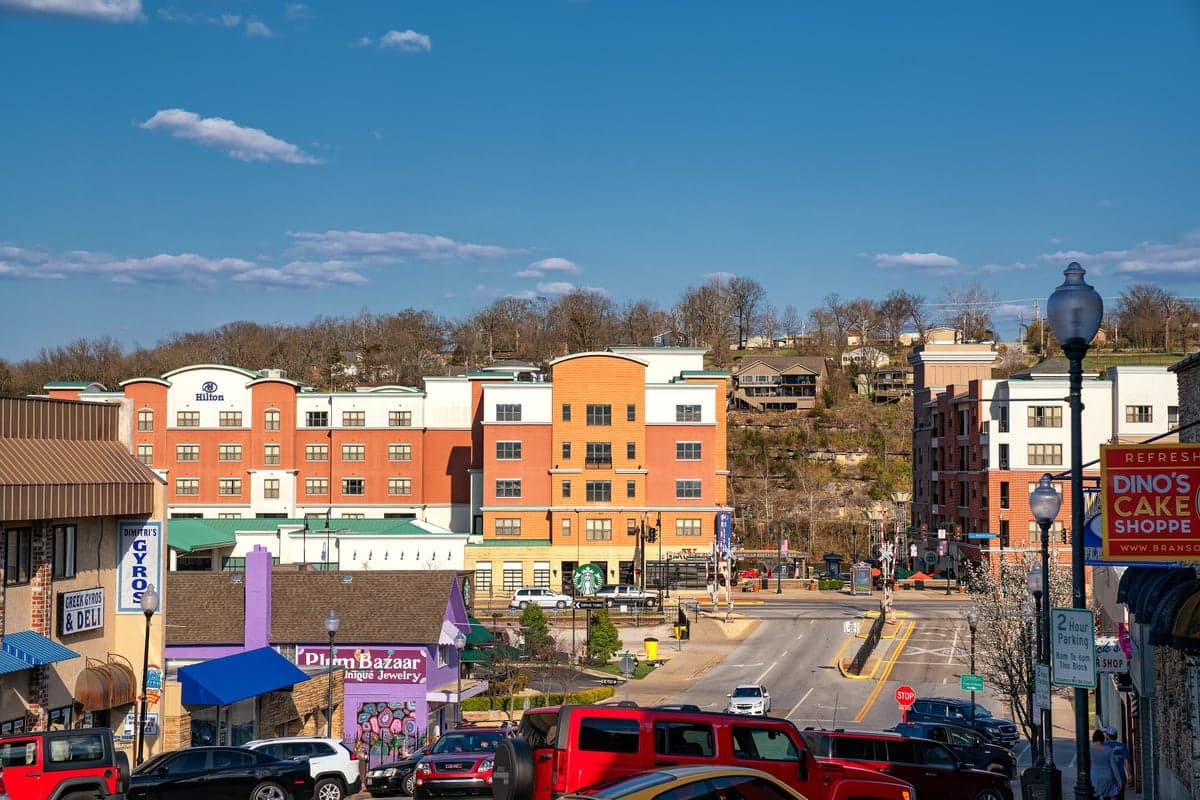
Branson’s original population was built by Anglo-American settlers moving into the Ozarks after the 1830s Indian removal, drawn by timber, subsistence farming, and later the railroad. The town was formally platted in 1903, but its early growth was modest, anchored by the Branson Mercantile Company and a handful of families who established homesteads along the White River. The construction of the Powersite Dam in 1913 created Lake Taneycomo, which began drawing fishermen and summer visitors, but the population remained under 1,000 through the 1940s. The historic Downtown Branson district, centered on Main Street, was the original commercial and residential hub, where the founding families—names like the Bransons, the Rosses, and the Snapps—built homes and businesses. The Branson Hills area, just north of downtown, was initially farmland settled by these same families, with small clusters of houses serving the agricultural economy. No significant wave of immigrant labor arrived during this period; the population was overwhelmingly native-born white, with a tiny Black community tied to railroad work and domestic service, concentrated in the “The Hollows” neighborhood near the railroad tracks.
Modern era (post-1965)
Branson’s modern population boom began in the 1980s and accelerated through the 1990s, driven entirely by domestic in-migration tied to the explosion of the live entertainment industry. The opening of the Moe Bandy Show in 1986 and the Branson Mall in 1987 signaled a shift from a sleepy resort town to a national tourism destination, drawing workers from across the Midwest and South. The Shepherd of the Hills Expressway corridor became the primary growth zone, with new subdivisions like Thousand Hills and Fall Creek filling with retirees, hospitality workers, and small business owners. The post-1965 immigration reforms had minimal impact on Branson; the foreign-born share remains at 1.5%, and the small East/Southeast Asian community (2.3%) is largely composed of Vietnamese and Filipino families who arrived in the 1990s to work in hotels and restaurants, settling in the Branson Meadows area near the entertainment district. The Indian subcontinent population (1.0%) is even smaller, primarily professionals in healthcare and IT, with no distinct neighborhood concentration. The Hispanic population (7.4%) is the fastest-growing minority group, driven by Mexican and Central American workers in construction, landscaping, and hospitality, with a visible presence in the Branson West area and along Highway 76 (the “Strip”). The Black population (4.0%) remains small and dispersed, with no historically Black neighborhood, though the Branson Hills area has seen modest diversification since 2010.
The future
Branson’s population is projected to grow slowly, reaching roughly 14,000 by 2035, with the Hispanic share likely rising to 10-12% as service-sector jobs continue to attract immigrant labor. The white majority will shrink gradually, but Branson will remain a predominantly white, native-born city for the foreseeable future. The East/Southeast Asian and Indian populations are expected to remain small, as the city lacks the professional job base or university presence that drives larger Asian communities in Springfield or Kansas City. New residential development is concentrating in the Branson Creek area and along Highway 248, where master-planned subdivisions are attracting retirees and remote workers from the Midwest. The cultural identity of Branson is evolving slowly: the city’s conservative, family-oriented character remains dominant, but the growing Hispanic population is adding new festivals, restaurants, and bilingual services, particularly in the Branson West corridor. The next decade will likely see continued diversification of the workforce, but the city’s residential patterns will remain largely segregated by income and ethnicity, with most new minority residents concentrated in lower-cost areas near the Strip.
For someone moving to Branson now, the city offers a stable, low-crime environment with a strong sense of community, but the population is aging and the economy is heavily dependent on tourism. The demographic future is one of slow, incremental change rather than rapid transformation, with the Hispanic community becoming a more visible part of the social fabric while the white majority remains firmly in place. New residents should expect a place where traditional values still hold sway, but where the faces in the service industry are increasingly diverse.

* Values derived from national, state, county, city and local statistics and may differ in a specific area. Last updated: 2026-10-21T02:43:55.000Z
Narrative content on this page is AI-generated and may contain mistakes. Verify any details that matter before acting on them.
ReloMaps may earn a commission from affiliate links at no extra cost to you.

