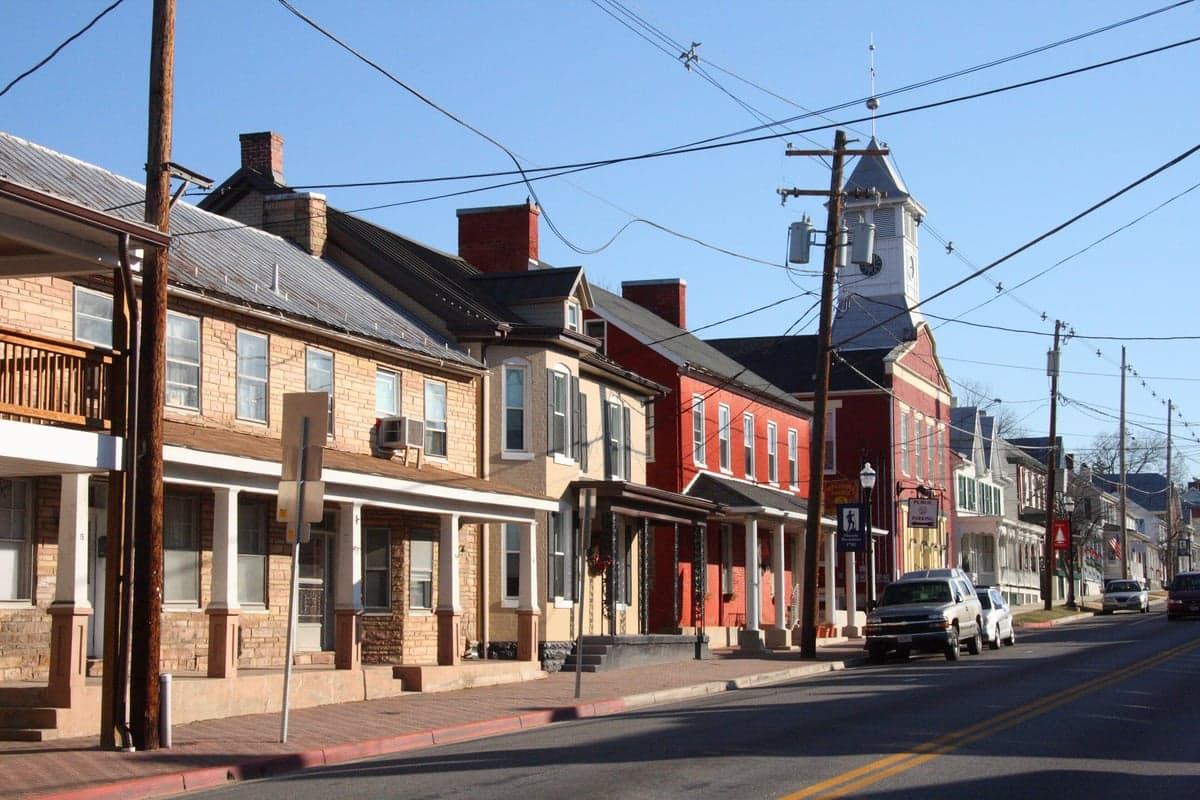
Photo: Wikipedia
Strategic Assessment of Boonsboro, MD
Meaningful friction. Expect exposure to either population pressure, blast zones, or natural disaster risk. Consider buying a retreat property.
What does the Strategic Assessment tell us?
Our Strategic Assessment grades tactical survivability of an area. Major population centers, military targets, fallout zones, natural disasters, and border exposure all drive risk — lower exposure means a more defensible position in a crisis.
This is heavily inspired by Joel Skousen's Strategic Relocation book. Highly recommended you checkout the book ($)What does this tell us?
Our Strategic Assessment grades tactical survivability of an area. Major population centers, military targets, fallout zones, natural disasters, and border exposure all drive risk — lower exposure means a more defensible position in a crisis.
This is heavily inspired by Joel Skousen's Strategic Relocation book. Highly recommended you checkout the book ($)Strategic Pillars

Key Distances
Regional Safe Places
Below is our recommended "safe zones" in Maryland and the surrounding area based on our strategic heuristics. For most people, it's unrealistic to live in a “safe zone” full-time due to work, family or other personal reasons. They tend to be more rural. However, many of these areas are perfect for second homes and retreat properties that double as a vacation home or even a short-term rental.
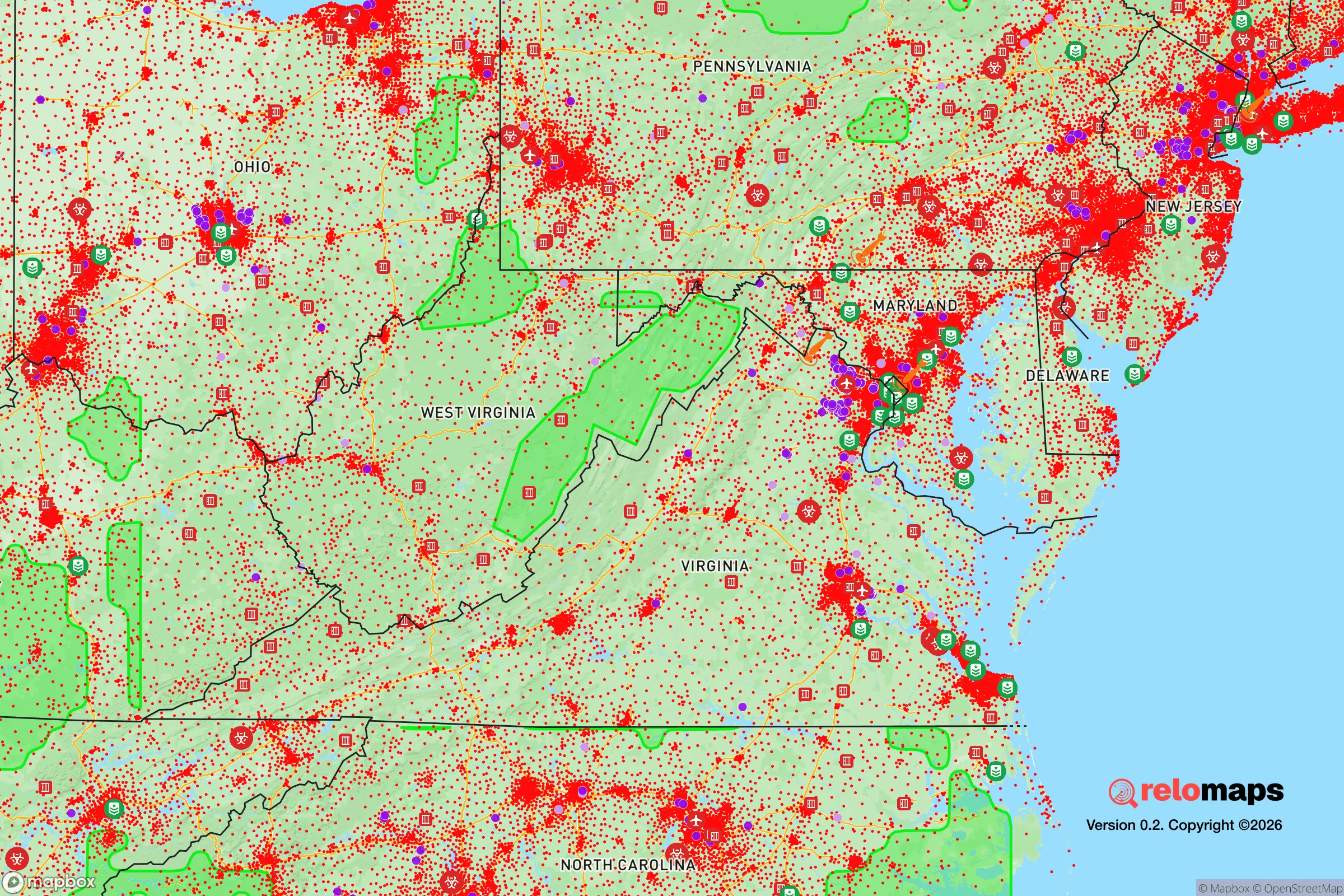
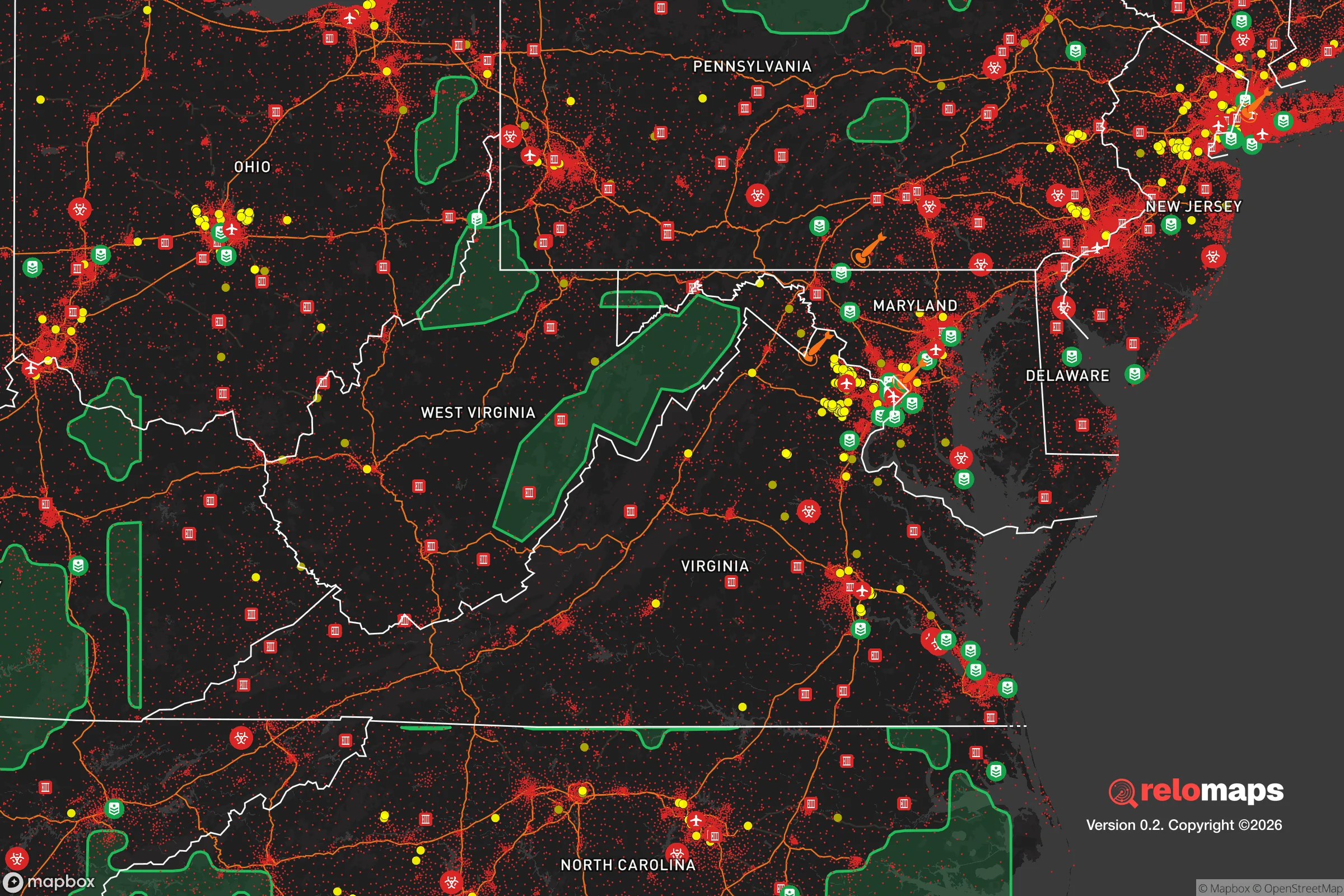


Important Note: For informational purposes only. This does not mean nothing bad ever happens in the green zones. Please use common sense. This is based on public data and modeled with AI. We tried to take a conservative approach but mistakes happen. We update this regularly as new information becomes available.
Solar Generator Recommendations
Backup power matters more here than in safer locations. We've picked three solar generators across budgets and capacity tiers — start with the budget unit if you only need a few essentials, or step up if you want to run a fridge and HVAC for days at a time.

Jackery Portable Power Station Explorer 300
Budget OptionPower on the Go: Weighing only 11 lbs, it's convenient to set up and store with book-sized foldable solar panels

BLUETTI Portable Power Station AC180
Designed for both indoor and outdoor scenarios, AC180 is highly capable as it has a robost capacity and continuous output power.

EF ECOFLOW DELTA Pro Ultra Power Station
Upgraded PickEcoFlow DELTA Pro Ultra is a whole-home energy system designed to grow with your family. Integrated with the Smart Home Panel 2, it scales to meet your evolving energy needs — keeping your home powered, intelligent, and secure through every stage of life.
We earn a commission, at no additional cost to you.
Strategic Assessment Analysis
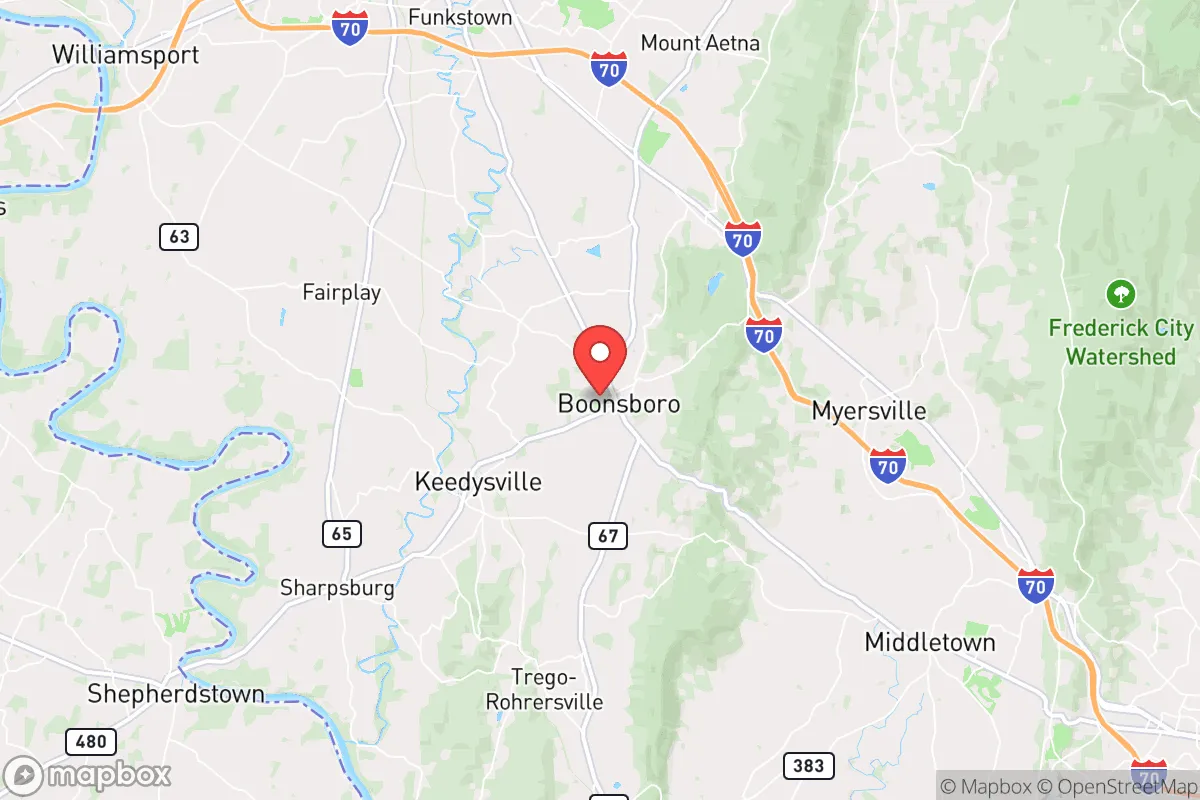
Boonsboro, Maryland, occupies a strategic niche in the tri-state area that balances rural self-sufficiency with manageable access to critical infrastructure, making it a serious contender for those prioritizing disaster readiness and long-term resilience. Nestled in the foothills of South Mountain in Washington County, the town benefits from a topography that naturally buffers against many of the risks associated with denser urban corridors, while its position along the I-70 and US-40 corridors provides a lifeline for supply chains and evacuation routes. For a relocator weighing the trade-offs between isolation and access, Boonsboro offers a defensible, resource-rich environment that is neither a remote bunker nor a vulnerable suburb—it is a calculated middle ground.
Geographic position and natural defensive advantages
Boonsboro’s primary resilience asset is its location along the eastern flank of South Mountain, part of the Blue Ridge range, which creates a natural barrier against weather systems and provides elevated vantage points. The town sits at roughly 600 feet above sea level, with the Appalachian Trail running directly through it, offering immediate access to rugged terrain for retreat or supply routes if roads become impassable. The surrounding Washington County is a patchwork of agricultural land, state forests (notably Greenbrier State Park and South Mountain State Battlefield), and low-density residential zones, which means a relocator here is not hemmed in by continuous suburban sprawl. The Potomac River lies about 10 miles to the south, providing a major water source, while the numerous creeks and springs in the area—such as Little Antietam Creek—offer decentralized water options. This geography also mitigates flood risk: the town’s elevation and the mountain’s rain shadow effect mean that while flash flooding can occur in low-lying areas, Boonsboro is not in a FEMA-designated high-risk flood zone. For a reader thinking about self-sufficiency, the ability to move into the mountains on foot, tap into natural water sources, and farm the fertile valley soils is a concrete advantage that few Mid-Atlantic towns of this size can match.
Exposure to natural hazards and man-made risks
No location is immune to risk, and Boonsboro’s proximity to the Washington, D.C.-Baltimore corridor (about 70 miles east) is the most significant vulnerability in a strategic assessment. While the town is far enough to avoid the immediate blast and thermal effects of a nuclear detonation in the capital, it lies within the fallout plume zone for a major event, particularly if prevailing winds blow from the east. The nearby Fort Detrick in Frederick (25 miles east) and the Raven Rock Mountain Complex (about 20 miles north, near Blue Ridge Summit) are both potential secondary targets or sources of electromagnetic pulse (EMP) effects. On the natural hazard side, the area is in a moderate seismic zone—the 2011 Mineral, Virginia earthquake was felt here—but major quakes are rare. Severe thunderstorms and occasional tornadoes (EF-1 or EF-2) are the primary weather risk, with the mountain terrain sometimes funneling storms. Wildfire risk is low but not zero, especially in dry summers along the mountain slopes. The real man-made risk is less dramatic: a prolonged grid failure or cyberattack on the I-70 corridor could disrupt supply chains for fuel, food, and medical supplies, as the town relies on a single major road (US-40 Alt) for most commercial traffic. For the relocator, this means that while Boonsboro is not a high-probability target, it is close enough to high-value assets that a worst-case scenario requires serious prepping—not paranoia, but practical stockpiling and route planning.
Practical resilience for daily life: food, water, energy, and defensibility
Boonsboro’s practical resilience is where it truly shines for a self-sufficiency-minded relocator. The town is surrounded by working farms—Washington County has over 1,200 farms covering 140,000 acres—so local food production is robust, with farmers’ markets in Boonsboro itself and nearby Hagerstown. The soil is fertile limestone-based loam, ideal for vegetable gardens and small orchards, and the growing season runs from April to October. Water is accessible via private wells (common in outlying properties) and the town’s municipal supply, which draws from the Potomac River via the Hagerstown Water System; a backup well field exists at the Boonsboro Water Treatment Plant. For off-grid energy, the area has good solar potential (about 4.5 peak sun hours per day) and ample wood for heating from the surrounding forests—South Mountain alone has thousands of acres of hardwood. The town’s defensibility is aided by its layout: the historic core is compact, with narrow streets and stone buildings that could be secured, while the surrounding hills provide natural chokepoints on US-40 Alt and MD-67. The local population is roughly 3,500, small enough to foster community cohesion but large enough to have a volunteer fire department, a small police force, and a medical clinic (Meritus Health operates a primary care center). For a family, the Boonsboro High School (part of Washington County Public Schools) has a strong academic reputation and could serve as a community gathering point in a crisis. The biggest practical gap is the lack of a major hospital within 15 minutes—Meritus Medical Center in Hagerstown is 20 minutes away—and the town’s reliance on a single grocery store (Weis Markets) for daily supplies, which could be depleted quickly in a panic event.
Overall, Boonsboro presents a compelling strategic picture for the relocator who wants a balance of natural defense, resource availability, and community scale without the isolation of deep rural areas. It is not a fortress—it is a working town with real vulnerabilities, particularly its proximity to the D.C. fallout zone and its dependence on external supply chains for fuel and medical care. But for a family or individual willing to invest in solar panels, a well, a wood stove, and a year’s worth of food storage, the area offers a foundation that is far more resilient than 90% of the Mid-Atlantic’s suburbs. The key is to treat Boonsboro as a base camp, not a final redoubt: its strength lies in its ability to sustain daily life through most disruptions while keeping you close enough to the mountains to retreat if the worst happens. For the conservative-leaning reader who values preparedness, community, and a slower pace, this is a place where the math works in your favor.

* Values derived from national, state, county, city and local statistics and may differ in a specific area. Last updated: 2026-07-22T02:15:17.000Z
Narrative content on this page is AI-generated and may contain mistakes. Verify any details that matter before acting on them.
ReloMaps may earn a commission from affiliate links at no extra cost to you.

