
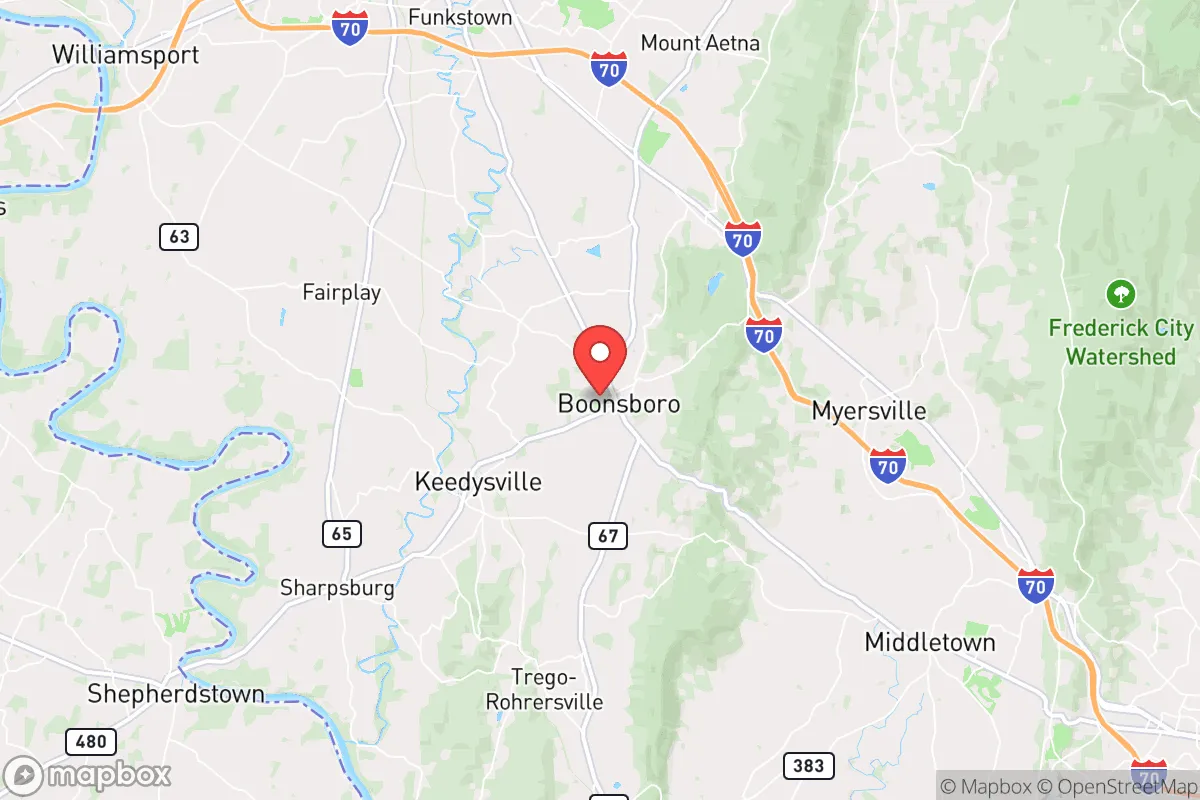
Photo: Wikipedia
Personal Sovereignty in Boonsboro, MD
Viable for self-reliance. Generally workable, though some barriers may limit total independence.
What does Personal Sovereignty tell us?
Personal Sovereignty measures your capacity for self-reliance and independence with minimal government friction. Higher scores mean fewer barriers between you and the way you want to live... but it assumes you have the space you need and good neighbors.
What does this tell us?
Personal Sovereignty measures your capacity for self-reliance and independence with minimal government friction. Higher scores mean fewer barriers between you and the way you want to live... but it assumes you have the space you need and good neighbors.
State Policy
Energy independence: Importer (8% of energy produced in-state)
Personal Liberty
Homesteading

Personal Liberty Analysis
Boonsboro, Maryland, offers a notably mixed environment for personal sovereignty, where a strong small-town culture of self-reliance coexists with a state-level regulatory and tax framework that leans interventionist. For individuals and families prioritizing autonomy, the key is understanding that local conditions in Washington County often provide more breathing room than the state's overall posture suggests. While Maryland is not a low-regulation state, Boonsboro's rural character, proximity to the Appalachian foothills, and community ethos create pockets of genuine independence for those who navigate the legal landscape carefully.
Tax burden and regulatory posture in Washington County
Maryland's tax burden is among the highest in the nation, and Boonsboro residents are subject to that reality. The state imposes a progressive income tax with rates from 2% to 5.75%, and Washington County adds a local income tax of 2.8% — the maximum allowed by state law. Property taxes are moderate by Maryland standards: the county rate is roughly $0.948 per $100 of assessed value, and Boonsboro's town tax adds about $0.24, bringing the combined rate to approximately $1.19 per $100. For a $300,000 home, that's roughly $3,570 annually. The state's 6% sales tax applies to most goods, though groceries and prescription drugs are exempt. Maryland's regulatory environment is notably heavy on environmental and land-use controls, including the Chesapeake Bay Critical Area law, which restricts development within 1,000 feet of tidal waters — though Boonsboro's location along the Potomac's non-tidal upper reaches means this has limited direct impact. The state also mandates a $15 minimum wage (as of 2026, indexed to inflation), which affects small businesses and service costs. For a relocation audience, the takeaway is clear: Maryland's tax and regulatory posture is not libertarian-friendly, but Washington County's more rural orientation means fewer local overlay regulations than in the D.C. suburbs. Business licensing is straightforward, and there is no county-level business income tax, though the state's corporate income tax of 8.25% applies.
Self-defense and gun law specifics in Maryland
Maryland's firearm laws are among the most restrictive in the nation, and Boonsboro residents must comply with them fully. The state requires a Handgun Qualification License (HQL) to purchase a handgun, which involves a background check, fingerprinting, and a four-hour training course. Long gun purchases require a 7-day waiting period and a background check through the Maryland State Police. The state bans "assault weapons" by name and feature, including AR-15 pattern rifles, and magazine capacity is limited to 10 rounds for both handguns and long guns. Concealed carry is permitted, but Maryland is a "may issue" state with a "good and substantial reason" standard — though the 2022 Supreme Court decision in NYSRPA v. Bruen has led to a more permissive application, with the Maryland State Police now processing applications under a "shall issue" framework for those who meet training and background requirements. Washington County's Sheriff's Office is generally considered more supportive of Second Amendment rights than departments in the D.C. suburbs, and local gun culture is strong, with several shooting ranges and gun shops in the area. However, state law preempts local firearm ordinances, so Boonsboro's town government cannot loosen these restrictions. For self-defense, the legal environment is constrained: stand-your-ground is not codified in Maryland, though the common law "castle doctrine" applies to one's home. Use of deadly force outside the home requires a duty to retreat if safe to do so. For a sovereignty-minded individual, Maryland's gun laws are a significant limitation, but the local culture in Washington County is far more aligned with firearm ownership than the state's legal framework suggests.
Self-reliance and homesteading viability in Boonsboro
Boonsboro's rural setting offers genuine opportunities for self-reliance, but zoning and land-use rules impose boundaries. Most residential lots in the town proper are 0.25 to 0.5 acres, limiting large-scale homesteading. However, the surrounding unincorporated areas of Washington County — particularly along routes 67, 34, and 40 — offer parcels of 2 to 10 acres at prices ranging from $15,000 to $30,000 per acre. County zoning in Agricultural (A) and Rural Residential (RR) districts permits keeping chickens, goats, and up to two horses per acre without special permits. Beekeeping is allowed on parcels of 0.5 acres or more, and the county's Right to Farm law protects agricultural operations from nuisance complaints. Off-grid living is legally challenging: Maryland requires all dwellings to be connected to the electrical grid or have a permitted alternative energy system (solar with battery storage is common), and water must come from a permitted well or municipal supply. Composting toilets are allowed with a state-approved system, but full off-grid septic is rare. Rainwater collection is legal but limited to 500 gallons per property without a permit. Washington County's building code follows the 2021 International Residential Code, with amendments for energy efficiency, meaning owner-built homes require licensed contractors for electrical and plumbing. For a family seeking a small homestead with garden, livestock, and solar panels, Boonsboro's outskirts are viable — but full independence from utilities and county oversight is not realistic under current law.
Personal liberties in Boonsboro: parental rights, medical autonomy, and property
Maryland's legal framework for personal liberties is a mixed bag, with some areas offering strong protections and others imposing significant constraints. Parental rights in education are a point of tension: Maryland law requires public schools to adopt comprehensive sex education that includes LGBTQ+ content, and parents cannot opt their children out of specific lessons — only the entire program. However, homeschooling is relatively straightforward, requiring a simple notification to the local school board and submission of a portfolio review annually. The state does not require standardized testing for homeschoolers. Medical autonomy is limited: Maryland has a vaccine mandate for school attendance (with medical and religious exemptions available, though religious exemptions have been challenged in court), and the state's COVID-19 emergency orders have set a precedent for broad executive power during health crises. Property rights are generally respected, with Washington County's zoning enforcement being complaint-driven rather than proactive. The county does not have a rental registration or inspection program for single-family homes, and short-term rentals (Airbnb/VRBO) are permitted in most residential zones with a simple license. Speech and assembly rights are protected under the First Amendment, and Boonsboro's town council meetings are open to public comment. However, Maryland's hate crime laws and public accommodation statutes are broad, and the state attorney general has taken an active role in enforcing them. For a conservative-leaning audience, the key is that local enforcement in Washington County tends to be less aggressive than in the D.C. suburbs, but state law provides a floor that cannot be avoided.
Overall, Boonsboro offers a sovereignty profile that is best described as "constrained independence." The state's tax burden, gun laws, and regulatory reach are real limitations, but the local culture of self-reliance, the availability of affordable rural land, and the relatively light touch of Washington County's government create a livable environment for those who prioritize personal freedom. Compared to nearby areas in West Virginia or Pennsylvania, Boonsboro's regulatory environment is heavier, but it is significantly lighter than Montgomery or Howard counties in Maryland. For a family willing to navigate state-level restrictions — particularly on firearms and education — Boonsboro provides a genuine small-town autonomy experience with access to the economic opportunities of the I-70 corridor. The trade-off is clear: you accept Maryland's framework in exchange for a community that values independence, a lower cost of land than the D.C. suburbs, and a pace of life that respects personal space.

* Values derived from national, state, county, city and local statistics and may differ in a specific area. Last updated: 2026-07-22T02:15:17.000Z
Narrative content on this page is AI-generated and may contain mistakes. Verify any details that matter before acting on them.
ReloMaps may earn a commission from affiliate links at no extra cost to you.

