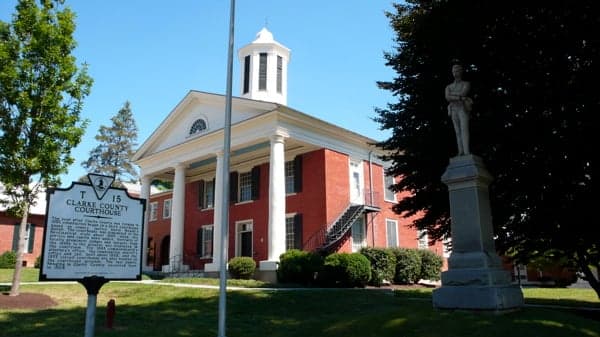
Photo: Wikipedia
Political ClimatePolitical Climate in Berryville, VA
District shown is the primary district for this city’s centroid. Cities may span multiple districts.
Inherited from parent county — no local data available.
* Lean and PVI are calculated from Berryville, VA’s own 2020 presidential results (precinct returns summed to the city), with 2024 estimated from the surrounding county’s 2020–2024 shift, Cook-style. Sources: state election offices; VEST 2020 precinct results (CC BY 4.0).
Political rankings in Virginia
- Most Conservative Cities in Virginia
- Most Liberal Cities in Virginia
- Best Liberal-Leaning Towns in the South
- Best Liberal-Leaning Towns in Appalachia
- Best Conservative-Leaning Towns in the Mid-Atlantic
- Safest Liberal-Leaning Towns in the South
- Safest Conservative-Leaning Towns in the South
- Safest Conservative-Leaning Towns on the East Coast
- Most Conservative Counties in Virginia
- Most Liberal Counties in Virginia
Local Political AnalysisPolitical Analysis of Berryville, VA
Berryville is a reliably conservative town in a reliably conservative county, and that hasn't changed much in the last decade. The Cook Partisan Voting Index (PVI) for the area is R+12, meaning it votes about 12 points more Republican than the national average. That’s a solid red rating, and it reflects the reality on the ground: local elections are usually decided in the Republican primary, and Democratic candidates rarely crack 40% in a countywide race. The trajectory is stable, not shifting. While the broader state of Virginia has swung left in recent cycles—now sitting at D+4—Berryville and Clarke County have held firm. You don’t see the same suburban drift here that you do in Loudoun or Fairfax. The town’s politics are rooted in agriculture, small business, and a strong sense of local autonomy, and that hasn’t budged.
How it compares
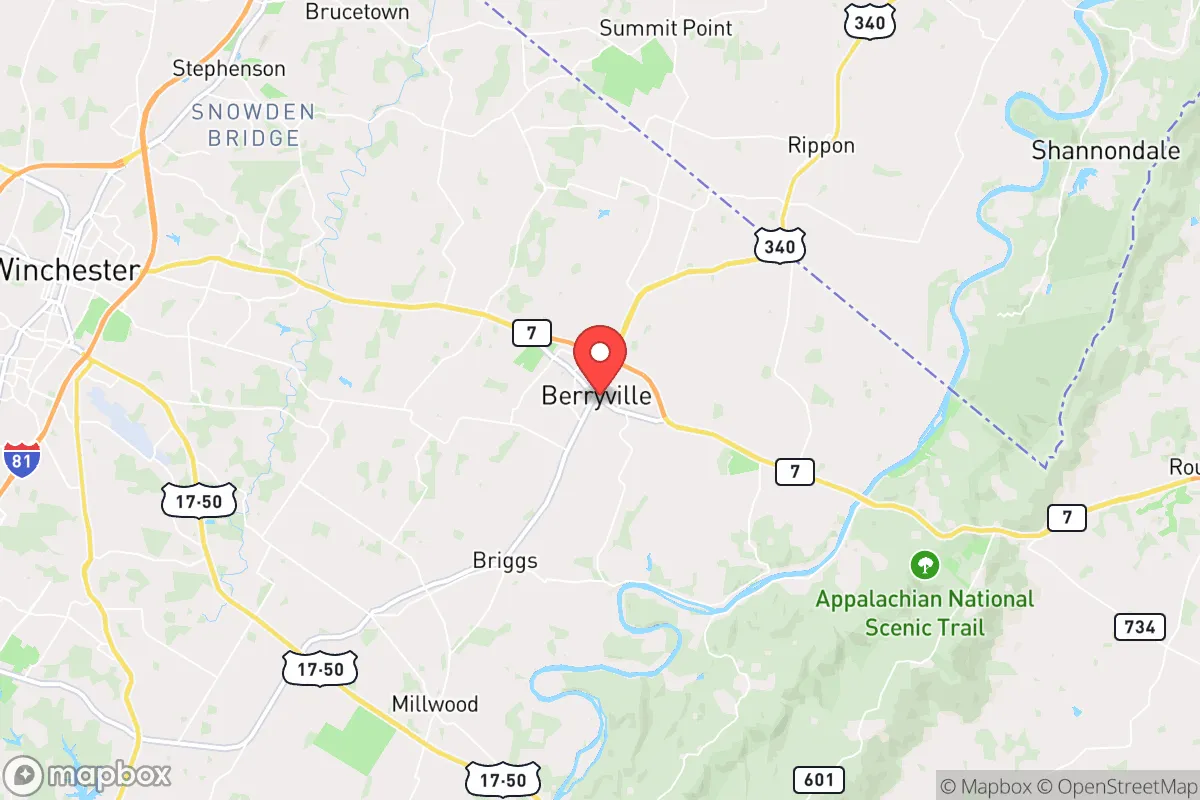
The contrast with the rest of Virginia is stark. The state as a whole has a Cook PVI of D+4, driven by the massive Democratic margins in Northern Virginia’s urban crescent—places like Arlington, Alexandria, and the closer-in parts of Fairfax County. Berryville, by contrast, sits just 15 miles from the West Virginia line and feels a world away from that world. Drive 20 minutes east to Purcellville in Loudoun County, and you’ll find a more purple environment—Loudoun as a whole is now a D+5 county, though its western end still leans red. Head 30 minutes south to Front Royal in Warren County, and you’re in similar R+12 territory. The real political shock comes when you go 45 minutes east to Leesburg, where the county board is firmly Democratic and the local discourse is dominated by growth, transit, and school overcrowding. Berryville’s politics are closer to what you’d find in rural West Virginia than in the D.C. suburbs, and that’s a deliberate choice by the people who live here.
What this means for residents
For conservative residents, Berryville is a comfortable place to live. Local government is generally pro-business, taxes are kept low, and the Second Amendment is respected without much debate. You’ll find Republican candidates at every level of the ballot, and the local party is active but not extreme. For liberal residents, the reality is more nuanced. You won’t be ostracized, but you’ll be in a clear minority. There’s no local Democratic infrastructure to speak of, and your vote in local elections will rarely be competitive. That said, the town is small enough that personal relationships matter more than party labels. A liberal neighbor who volunteers at the food bank or coaches Little League will be judged on that, not their bumper stickers. The biggest practical difference is in policy: you won’t see the same investment in public transit or affordable housing that you’d find in a blue-leaning town, and the school board tends to be more traditional in its approach. But the trade-off is a slower pace of life, lower cost of living, and a community where people know each other.
One cultural distinction worth noting: Berryville is part of the Shenandoah Valley, which has a long tradition of political independence. Even within the Republican majority, there’s a libertarian streak—people here don’t like being told what to do by Richmond or D.C. That means you’ll find support for local control over land use, schools, and law enforcement, regardless of party. The town’s annual Apple Blossom Festival and its historic downtown are points of pride that transcend politics. Looking ahead, the biggest wildcard is growth. If the D.C. exurban sprawl pushes further west, Berryville could see an influx of newcomers who bring different voting habits. But for now, the political climate remains steady: reliably red, neighborly, and resistant to change.

State Political ClimatePolitical Climate in Virginia
State Political AnalysisPolitical Environment in the State
Virginia has shifted from a reliably purple swing state to a solidly Democratic-leaning one over the past two decades, with a Cook PVI of D+4. The transformation is driven by explosive growth in the Washington, D.C. suburbs, particularly in Northern Virginia, which now dominates state elections. While the state still elects Republican governors in off-years (Glenn Youngkin won in 2021), the legislature has been under Democratic control for most of the last decade, and the state has not voted for a Republican presidential candidate since 2004. For a conservative relocator, the key takeaway is that your vote will carry more weight in local and state-level races than in presidential ones, but the overall policy direction is increasingly progressive.
Urban vs. rural divide
The political map of Virginia is a textbook case of urban-rural polarization. The Democratic stronghold is the crescent from Northern Virginia (Arlington, Alexandria, Fairfax County) down through Richmond and into Hampton Roads (Norfolk, Virginia Beach). These three regions together account for roughly two-thirds of the state’s population. Northern Virginia alone, with its high-income, highly educated, and increasingly diverse population, is the engine of Democratic victories — Fairfax County alone has more people than the entire western half of the state. In contrast, rural and exurban areas — Southside Virginia (Danville, Martinsville), the Shenandoah Valley (Harrisonburg, Staunton), and Southwest Virginia (Bristol, Roanoke) — vote overwhelmingly Republican. A notable exception is Virginia Beach, a military-heavy city that has trended purple but still leans slightly right of the state as a whole. The divide is stark: in 2024, Fairfax County voted +35 Democratic, while rural counties like Lee and Wise in the far southwest voted +50 Republican. This means a conservative moving to rural Virginia will find a deeply red environment, while one moving to a suburb of D.C. or Richmond will be in a blue bubble.
Policy environment
Virginia’s policy environment is a mixed bag for conservatives. The state has a relatively low flat income tax rate of 5.75%, and no state-level sales tax on groceries or prescription drugs. Property taxes are set locally and vary widely — Loudoun County’s rates are about double those of rural Pittsylvania County. The regulatory posture is moderate overall, but leans left on environmental issues; Virginia is part of the Regional Greenhouse Gas Initiative (RGGI), though Governor Youngkin attempted to withdraw from it. Education policy is a major flashpoint: the state has seen a surge in school choice options, including charter schools and lab schools, but public school funding remains heavily tilted toward wealthy Northern Virginia districts. Healthcare is broadly accessible, with Medicaid expansion under the Affordable Care Act in place since 2019. Election laws are relatively liberal: no-excuse absentee voting, same-day voter registration, and early voting are all available. For a conservative, the policy environment is tolerable but trending left, particularly on social issues and education.
Recent policy direction
The last five years have seen a clear progressive shift on several fronts. On gun and self-defense law, the 2020 Democratic trifecta passed a package of bills including universal background checks, a red flag law (extreme risk protective orders), and a one-handgun-per-month limit. These laws remain in effect despite Republican efforts to repeal them. On parental and education rights, the 2023 "Parents' Bill of Rights" (SB 1297) requires school boards to notify parents of instructional materials involving sexually explicit content, but it is weaker than similar laws in Florida or Texas. On speech and privacy, Virginia passed the Consumer Data Protection Act (CDPA) in 2021, one of the strongest state-level privacy laws in the country, giving residents control over how companies use their personal data. On medical and bodily autonomy, the state has codified abortion access up to the third trimester, and in 2024 passed a constitutional amendment to protect reproductive rights. On property rights, Virginia has relatively weak eminent domain protections compared to states like Texas, and local zoning battles are common in growing areas. On taxation, the state has not cut income tax rates since 2019, and the sales tax was expanded to include digital goods in 2023. On voting and ballot access, the state has expanded early voting and no-excuse absentee voting, and in 2024 passed a law requiring automatic voter registration through the DMV. The overall direction is clearly toward more regulation and more government services, funded by a stable tax base.
Civil unrest & political movements
Virginia has been a flashpoint for national political movements. The 2017 "Unite the Right" rally in Charlottesville, which turned violent, put the state on the map for far-right activism and led to a statewide ban on carrying firearms at public demonstrations. In 2020, Richmond saw massive Black Lives Matter protests, including the toppling of Confederate statues on Monument Avenue. The state has also been a battleground for immigration politics: while Virginia has no formal "sanctuary" law, several cities including Richmond and Alexandria have declared themselves sanctuary cities, and the state limits cooperation between local law enforcement and ICE. Election integrity has been a persistent issue: the 2020 election saw Trump’s legal team challenge Virginia’s results, and in 2024, the state’s new voter ID law (requiring a photo ID for in-person voting) was a compromise between parties. For a new resident, the most visible political movement is likely the ongoing debate over Confederate memorials and school names, which remains active in cities like Richmond and Norfolk. The overall atmosphere is one of active, organized activism on both sides, but the left is more dominant in the media and in local government.
Projection
Over the next 5-10 years, Virginia will likely continue its leftward drift, driven by demographic trends. Northern Virginia’s population is growing faster than the rest of the state, and its voters are becoming more Democratic with each cycle. The Hispanic and Asian populations, both growing rapidly, lean Democratic. Rural Virginia is shrinking and aging, which reduces its electoral weight. However, the state’s off-year gubernatorial elections (2025, 2029) will remain competitive — Republicans can win by turning out their base in rural areas and winning over moderate suburbanites on economic issues. The most likely scenario is a state that is D+5 or D+6 by 2030, with a legislature that is narrowly Democratic and a governorship that flips between parties. For a conservative moving in now, the practical implication is that you will be in a state where your values are increasingly in the minority at the state level, but where local control in red counties and cities remains strong. You can still find a deeply conservative community in places like Bedford County or the Shenandoah Valley, but the state government in Richmond will continue to push progressive policies on guns, abortion, and education.
Bottom line for a new resident: Virginia offers a high quality of life, strong schools in many areas, and a diverse economy, but it is not a conservative haven. If you are a conservative who values low taxes, gun rights, and local control, you will find a welcoming home in rural Virginia or in exurban counties like Loudoun or Prince William (though these are trending blue). If you are a liberal, you will feel at home in Northern Virginia or Richmond. The state’s political trajectory is clear: it is becoming more Democratic, more regulated, and more socially progressive. Plan accordingly, and understand that your vote will matter most in local races and in the governor’s race, not in presidential elections.
* Values derived from national, state, county, city and local statistics and may differ in a specific area. Last updated: 2026-11-09T14:50:48.000Z
Narrative content on this page is AI-generated and may contain mistakes. Verify any details that matter before acting on them.
ReloMaps may earn a commission from affiliate links at no extra cost to you.

