 Popular
Photo: Wikipedia
Demographics of Berkeley Lake, GA
Affluence Level in Berkeley Lake, GA
A wealthy area with high-earning, well-educated households. Incomes, home values, and educational attainment meaningfully outpace national averages.
People of Berkeley Lake, GA
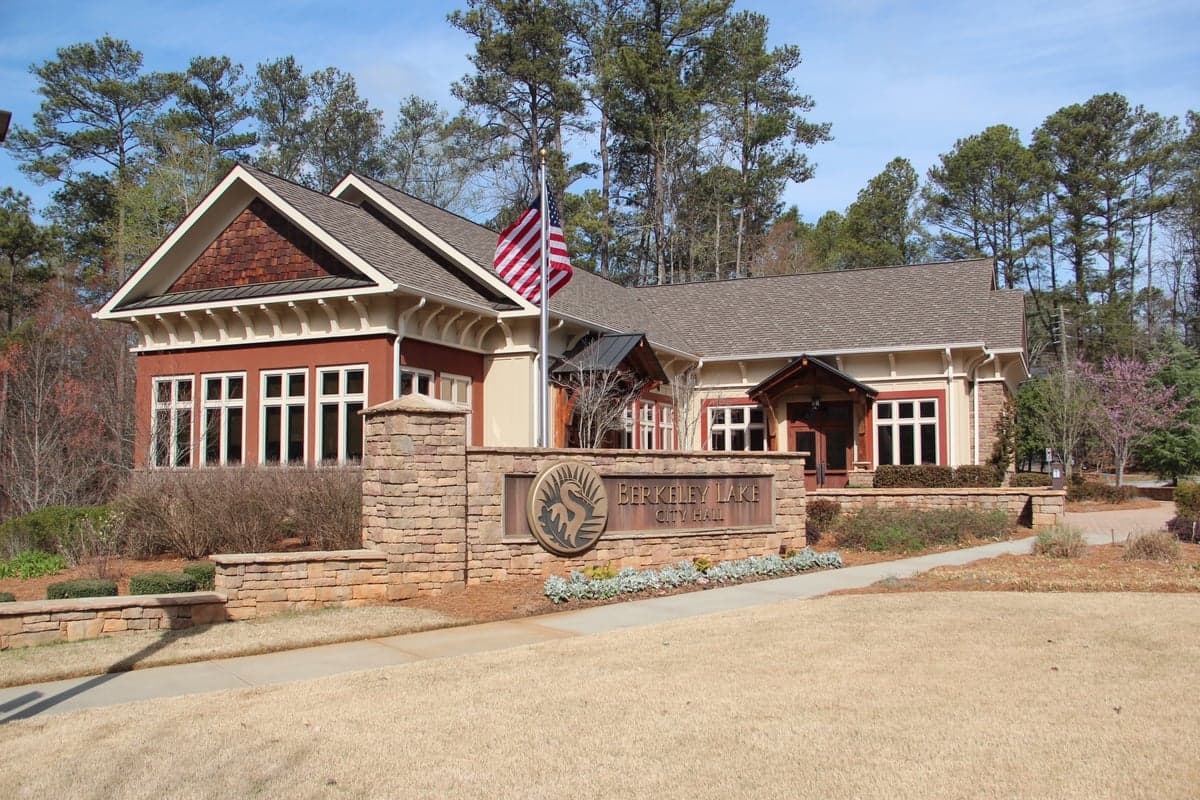
Berkeley Lake, Georgia, is a small, affluent, and predominantly white city of 2,615 residents, characterized by its tight-knit community centered on the private 88-acre lake from which it takes its name. With a 78.2% white population, a 62.7% college-educated rate, and a notably low foreign-born share of just 2.4%, the city stands out as a stable, family-oriented enclave in Gwinnett County. Its population is older and more homogeneous than the surrounding county, reflecting a history of deliberate, low-density suburban development rather than rapid, diverse growth.
How the city was settled and grew
Berkeley Lake is a distinctly post-1900 community, with no colonial or antebellum history. The area was originally sparsely settled farmland and timberland in the early 20th century. The defining event was the construction of the lake itself in 1948 by a group of investors who dammed a tributary of the Chattahoochee River to create a private recreational lake. The original population was a small wave of middle-class white families from Atlanta and nearby Norcross who bought lots for weekend cabins and summer homes. These early settlers built the first homes along Berkeley Lake Shores and Lakeview Drive, forming the nucleus of a seasonal community that gradually became year-round. The city was officially incorporated in 1956, largely to preserve the lake's private, low-density character and to control development. Through the 1960s, the population remained under 500, composed almost entirely of white professionals who valued the seclusion and water access.
Modern era (post-1965)
The post-1965 era brought suburbanization to Gwinnett County, but Berkeley Lake absorbed it differently than nearby cities like Duluth or Norcross. The 1970s and 1980s saw the conversion of summer cottages into permanent homes, driven by Atlanta's northward expansion and the construction of GA-141 (Peachtree Industrial Boulevard). New subdivisions such as Berkeley Glen and Lake Ridge were developed, attracting white-collar families—engineers, managers, and executives—who worked at the emerging technology and telecom firms in the Perimeter area. The city's zoning remained restrictive, with minimum lot sizes of one acre, which limited density and kept home values high. Unlike the broader county, Berkeley Lake saw virtually no influx of Hispanic or Asian populations during the 1990s and 2000s. The city's 2.4% foreign-born rate is a fraction of Gwinnett County's 24% rate. The small East/Southeast Asian community (6.3%) and Indian community (5.5%) are concentrated in newer, larger homes in the Berkeley Chase and Berkeley Manor subdivisions, built in the late 1990s and early 2000s. These residents are typically second-generation professionals who sought the same low-density, high-amenity lifestyle as the original white settlers. The Hispanic population (6.2%) is dispersed, with no single ethnic enclave, and the Black population (2.1%) is minimal.
The future
Berkeley Lake's population is heading toward slow, selective homogenization rather than rapid diversification. The city is essentially built out, with no large tracts of undeveloped land, so future growth will come from teardowns and rebuilds of older homes. This process is already underway in Berkeley Lake Estates, where mid-century ranches are being replaced by larger custom homes, typically purchased by white professionals from inside the metro area. The Indian and East/Southeast Asian populations are likely to grow modestly as these groups continue to move into higher-end suburbs, but they will remain a minority presence. The city's restrictive zoning and high price floor (median home value above $700,000) will continue to filter for high-income, college-educated buyers, regardless of ethnicity. The Hispanic and Black populations are unlikely to increase significantly due to the lack of affordable housing stock. The city is not tribalizing into distinct ethnic enclaves; rather, it is becoming a wealth-homogenized community where income and education level are stronger identity markers than race or national origin.
For someone moving in now, Berkeley Lake offers a stable, low-turnover community with strong property values and a deliberate small-town feel. The trade-off is limited demographic diversity and a population that skews older and more insular than the surrounding county. It is best suited for families and professionals who prioritize privacy, lake access, and a proven school district over urban energy or ethnic variety.

* Values derived from national, state, county, city and local statistics and may differ in a specific area. Last updated: 2026-04-23T05:08:37.000Z
Narrative content on this page is AI-generated and may contain mistakes. Verify any details that matter before acting on them.
ReloMaps may earn a commission from affiliate links at no extra cost to you.

