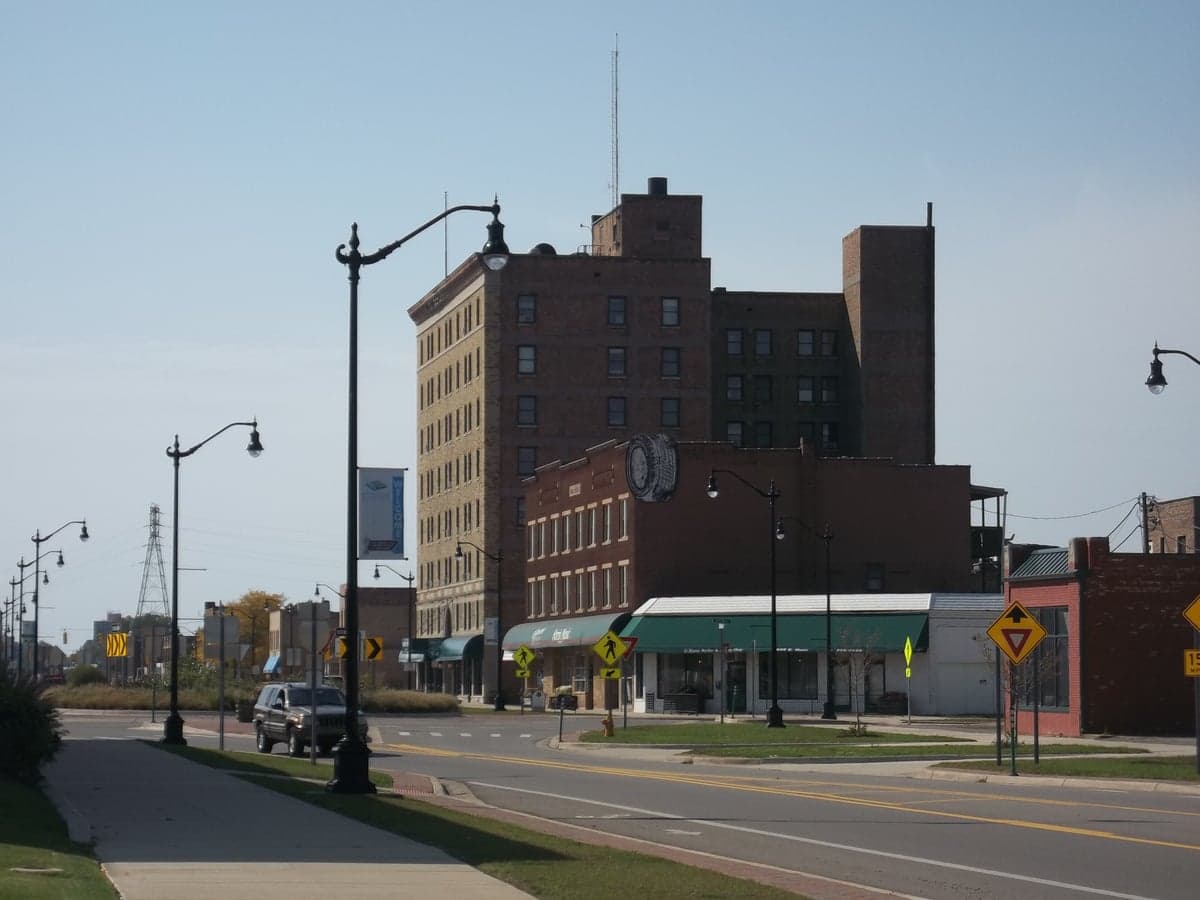
Photo: Wikipedia
Political ClimatePolitical Climate in Benton Harbor, MI
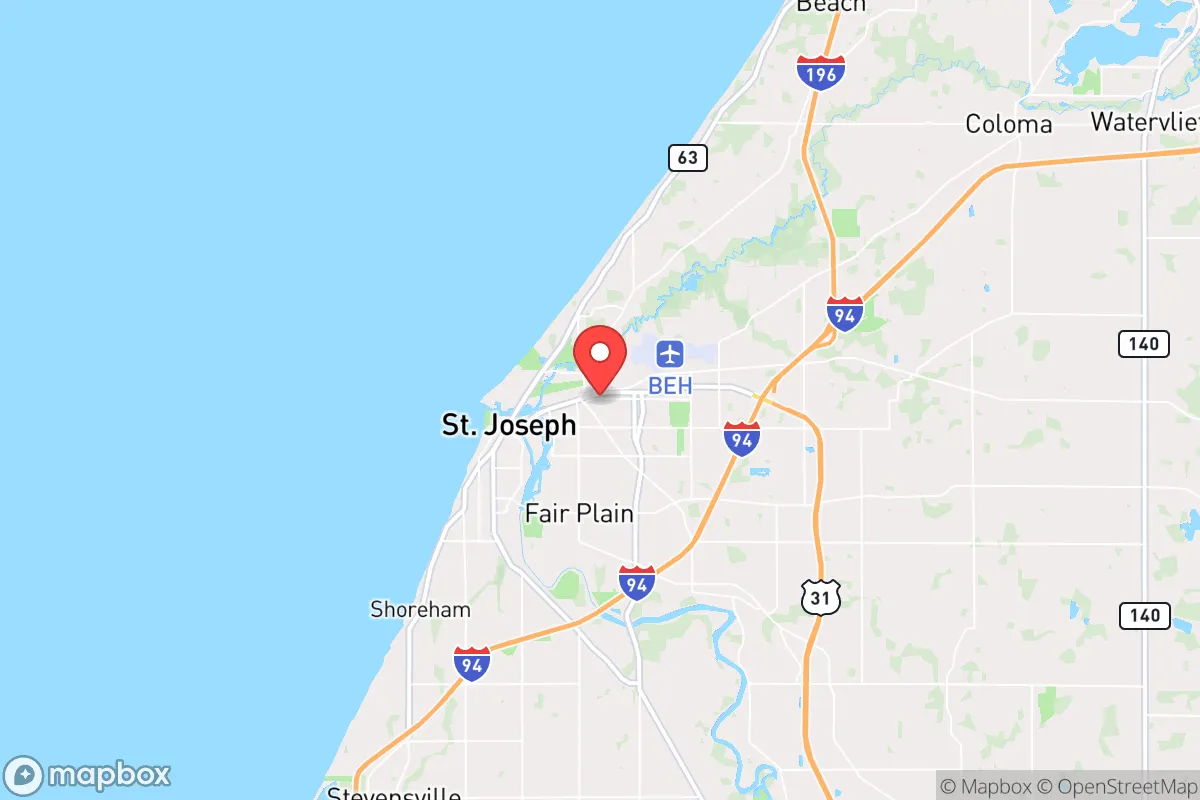
District shown is the primary district for this city’s centroid. Cities may span multiple districts.
Local Political AnalysisPolitical Analysis of Benton Harbor, MI
Benton Harbor’s political climate is a study in contrasts, shaped by a majority-Black, historically Democratic city surrounded by a predominantly white, conservative-leaning Berrien County. The city itself votes reliably blue—often by margins of 70% or more in presidential elections—but the broader area, including the county and the state’s 6th Congressional District, carries a Cook PVI of R+3. That means the region leans about three points more Republican than the national average, a notable shift from the statewide Michigan PVI of EVEN. Over the past decade, the county has drifted rightward, driven by rural and exurban growth around towns like St. Joseph and Stevensville, while Benton Harbor’s own population has declined, amplifying the political disconnect between the city and its surroundings.
How it compares
Compared to Michigan as a whole, Benton Harbor’s immediate area is more conservative, but the city itself is an outlier. The state’s EVEN rating reflects a competitive balance—think of the 2020 and 2024 presidential races, where Michigan flipped from Trump to Biden and back—but Berrien County has voted Republican in every presidential election since 2000, often by double digits. For context, neighboring towns like St. Joseph (a lakeside community with a higher median income) lean Republican, while Benton Harbor’s politics align more with majority-Black cities like Detroit or Flint. The contrast is stark: drive 10 minutes north to St. Joseph, and you’ll see Trump signs in yards; drive through Benton Harbor’s downtown, and you’ll find Harris-Walz posters in storefronts. This split isn’t new—it’s been a feature of the area for decades—but the gap has widened as national polarization intensified.
What this means for residents
For conservative residents—mostly in the surrounding towns and rural parts of the county—the R+3 lean means their views are well-represented in county commissions, state legislative seats, and federal representation. The 6th Congressional District, represented by Republican Debbie Dingell (a moderate by today’s standards) until redistricting, now sends Republican Bill Huizenga to Washington, a reliable conservative vote. Local policies, like tax rates and zoning, tend to favor business interests and property rights, which aligns with the area’s agricultural and manufacturing base. For liberal residents in Benton Harbor itself, the reality is more complicated. They often feel outnumbered in county-level decisions—funding for public transit, affordable housing, and social services can be a tug-of-war. But the city’s strong Democratic lean gives it a unified voice on issues like racial equity and economic reinvestment, and local leaders have pushed for state and federal grants to offset county-level resistance. The trajectory? Expect the city to remain a blue island in a reddening county, with tensions over resource allocation likely to persist.
Cultural and policy distinctions
One of the most telling cultural distinctions is how the area handles growth and development. Benton Harbor has seen a wave of investment in recent years—think the $100 million-plus redevelopment of the former Harbor Shores golf course and the new cannabis dispensaries that popped up after Michigan legalized recreational use. The city council has been more open to these projects than the county board, which tends to be skeptical of anything that might increase density or change the area’s character. Another policy split: school funding. Benton Harbor Area Schools, which serves a predominantly low-income, Black student body, has struggled with state takeovers and declining enrollment, while nearby St. Joseph Public Schools, whiter and wealthier, consistently passes millages. This isn’t just politics—it’s a lived reality that shapes everything from property values to daily commutes. If you’re moving here, know that your experience will depend heavily on which side of the Paw Paw River you live on.

State Political ClimatePolitical Climate in Michigan
State Political AnalysisPolitical Environment in the State
Michigan is the ultimate swing state, with a Cook PVI of EVEN that perfectly captures its knife-edge political balance. Over the past 20 years, it’s lurched from reliably blue (voting for Gore, Kerry, Obama twice) to a Trump pickup in 2016, then back to Biden in 2020 by just 154,000 votes, and then saw Republicans sweep the state House and Senate in 2024 while Trump carried it again. The dominant coalition is a three-way tug-of-war between the heavily unionized, diverse Detroit metro area, the conservative exurbs and rural west and north, and the rapidly shifting Grand Rapids corridor. For a conservative-leaning relocator, the state offers a mixed bag: low taxes on property and no income tax on retirement income, but a Democratic governor and a regulatory environment that can feel hostile to gun owners and school choice advocates.
Urban vs. rural divide
The political map of Michigan is a story of three distinct regions. Wayne County (Detroit) and Washtenaw County (Ann Arbor) are the Democratic engine room, delivering margins of 60-70% for Democrats. Detroit’s Black population and Ann Arbor’s university community create a solid blue wall that statewide Democrats must win by 200,000+ votes to offset the rest of the state. The Grand Rapids metro (Kent County) has been the biggest political story of the last decade: once a Republican stronghold, it flipped to Biden in 2020 and has become a competitive suburban battleground driven by educated professionals and a growing Hispanic population. Meanwhile, Macomb County (north of Detroit) is the iconic Reagan Democrat territory—blue-collar, union-heavy, and now reliably Trump country after flipping hard in 2016. The Thumb region and the Upper Peninsula are deeply red, with counties like Huron and Gogebic voting 65-70% Republican. The Lansing area (Ingham County) is a Democratic island surrounded by red rural counties, while Midland and Bay City are classic swing areas that have trended right in recent cycles.
Policy environment
Michigan’s policy environment is a study in contrasts. The state has a flat 4.25% income tax (scheduled to drop to 4.05% in 2026 under a 2015 law), and no tax on Social Security or most retirement income—a major draw for conservative retirees. Property taxes are capped at 5% annual growth under Proposal A, but can spike on reassessment after a sale. The regulatory posture is mixed: Michigan is a right-to-work state (the law was repealed in 2023 by the Democratic legislature, but the repeal is being challenged in court and may not survive a future Republican trifecta). Gun laws are moderately restrictive: universal background checks and safe storage requirements were passed in 2023, but the state still allows open carry and shall-issue concealed carry (with a permit). Education policy is a flashpoint: Michigan has a robust charter school sector (one of the strongest in the Midwest), but the Democratic legislature has moved to tighten oversight and cap new charters. Election laws are relatively accessible: no-excuse absentee voting and same-day registration were approved by voters in 2018 and 2022, respectively. Healthcare is dominated by the expansion of Medicaid under the Affordable Care Act, which covers about 1.2 million Michiganders.
Recent policy direction
The 2023-2024 Democratic trifecta (Governor Gretchen Whitmer, state House, state Senate) passed a flurry of legislation that shifted the state leftward. Gun laws: the "safe storage" law (requiring firearms to be locked if a minor is present) and universal background checks were signed in 2023, along with a "red flag" law allowing temporary confiscation of firearms from individuals deemed a threat. Parental rights: the state repealed the 2012 law requiring parental consent for abortion (the "Parental Rights Restoration Act"), and passed a law allowing minors to obtain gender-affirming care without parental consent—a major concern for conservative families. Education: the state banned for-profit charter schools and imposed new financial reporting requirements on all charters, while also expanding the "Read by Grade Three" retention law. Property rights: the "Brownfield Redevelopment" program was expanded, but no major changes to eminent domain or zoning. Voting access: the 2022 "Promote the Vote" constitutional amendment enshrined no-excuse absentee voting, same-day registration, and nine days of early voting. Taxation: the retirement tax exemption was expanded in 2023, but the corporate tax rate was also increased slightly to fund infrastructure. For a conservative relocator, the key takeaway is that the state’s direction is volatile—a Republican sweep in 2026 could reverse many of these laws.
Civil unrest & political movements
Michigan has been a national flashpoint for political activism. The 2020 Whitmer kidnapping plot (involving militia members targeting the governor) put the state’s far-right fringe in the headlines. The 2020-2021 protests at the state capitol over COVID-19 restrictions—including armed demonstrators entering the building—were a defining image of the pandemic era. On the left, the 2023-2024 protests over the Israel-Hamas war in Dearborn and Ann Arbor were among the largest in the country, reflecting the state’s significant Arab-American population (Dearborn is the largest Arab-majority city in the U.S.). Immigration politics are muted compared to border states, but the "sanctuary city" status of Ann Arbor and Detroit (which limit cooperation with ICE) is a recurring issue. Election integrity remains a live controversy: the 2020 election in Michigan was subject to multiple audits and lawsuits, with Republican activists still alleging irregularities in Wayne County. The "Michigan Conservative Coalition" and "Michigan Freedom Fund" are active in school board races and local elections. A new resident in the suburbs will notice yard signs and bumper stickers are common, but actual civil unrest is rare outside of downtown Detroit and Ann Arbor during major protests.
Projection
Over the next 5-10 years, Michigan is likely to remain a competitive swing state, but the demographic trends favor a slight rightward shift. The Grand Rapids metro is growing faster than Detroit, and its suburban voters are trending Republican again after a brief flirtation with Democrats. The Upper Peninsula is losing population, which hurts Democrats. The Detroit exurbs (Livingston, Macomb, and Oakland counties) are becoming more conservative as younger families move out of the city. However, the Ann Arbor and Washtenaw County area is growing and becoming more Democratic, as is the Lansing area. The wild card is the Hispanic population, which is growing fastest in the Grand Rapids area and tends to vote more conservative than the national average for Hispanics. If Republicans can hold the state House and Senate in 2026, they will likely pass a right-to-work restoration, a school choice expansion, and a repeal of the 2023 gun laws. If Democrats hold the governorship, the state will remain a policy battleground. For a relocator, the practical implication is that Michigan’s political climate is unpredictable—you could see a Republican trifecta by 2027 or a continued Democratic hold, depending on turnout in Detroit and the suburbs.
For a conservative-leaning individual or family moving to Michigan, the bottom line is this: you’ll find a state with low taxes on retirement income, a strong charter school sector, and a vibrant gun culture in the rural areas, but you’ll also face a Democratic governor who has signed restrictive gun laws and expanded transgender rights for minors. The best places to land are the Grand Rapids exurbs (like Rockford or Byron Center) or the Macomb County suburbs (like Shelby Township or Washington Township), where you’ll find like-minded neighbors and good schools. Avoid the Ann Arbor and Detroit city limits if you want a conservative-friendly environment. The state’s political future is genuinely up for grabs—and that uncertainty is both a risk and an opportunity for new residents who want to be part of shaping it.
* Values derived from national, state, county, city and local statistics and may differ in a specific area. Last updated: 2026-10-07T06:18:50.000Z
Narrative content on this page is AI-generated and may contain mistakes. Verify any details that matter before acting on them.
ReloMaps may earn a commission from affiliate links at no extra cost to you.

