Photo: Wikipedia
Demographics of Benton Harbor, MI
Affluence Level in Benton Harbor, MI
A low-income area with significant economic hardship. Household wealth and educational attainment are well below national averages.
People of Benton Harbor, MI
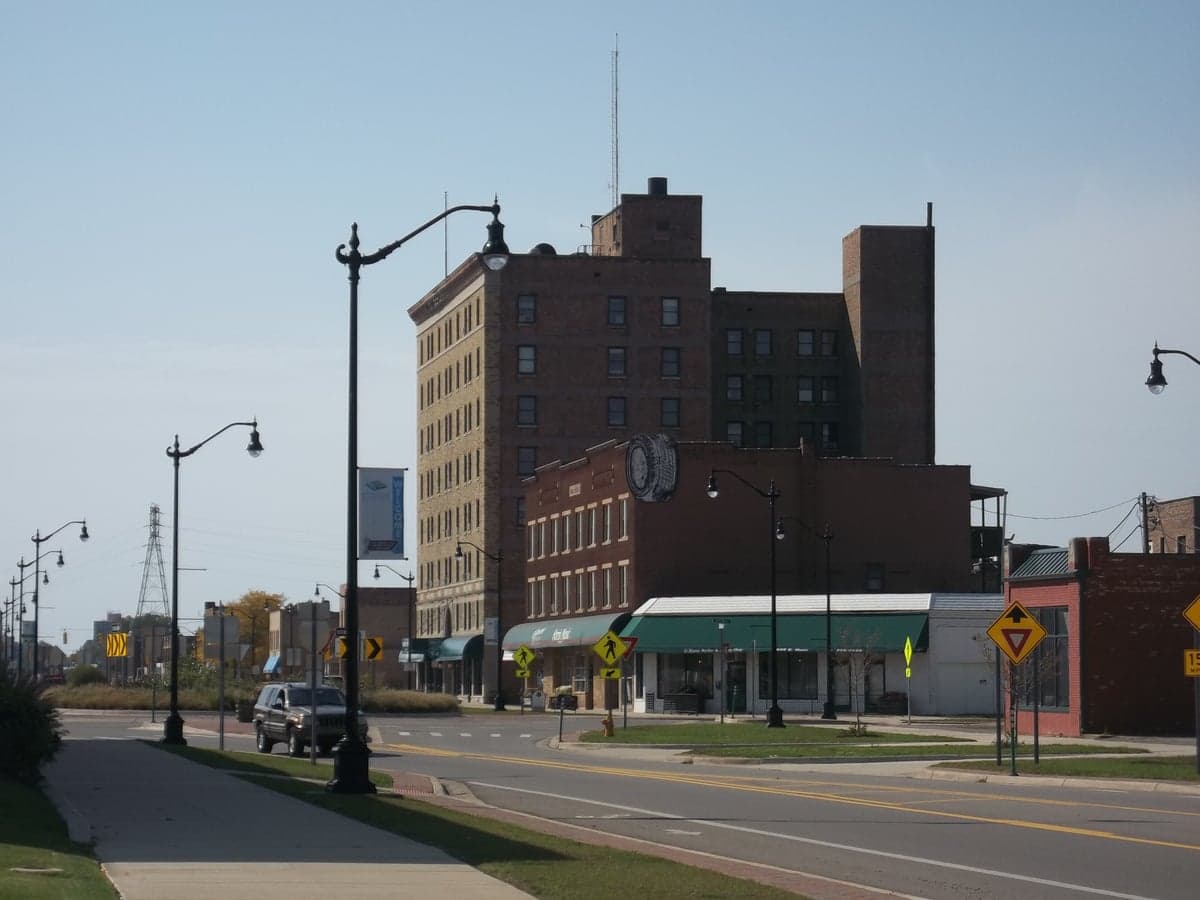
The people of Benton Harbor, Michigan, today form a predominantly Black community of just over 9,000 residents, shaped by a history of industrial migration, racial division, and economic restructuring. With a population that is 80.2% Black, 9.3% White, and 5.5% Hispanic, the city is one of the most heavily African American communities in southwest Michigan, yet it is also one of the poorest, with a median household income far below state averages and a college attainment rate of just 7.8%. The city’s identity is defined by its stark contrast with the neighboring, wealthier, and predominantly White city of St. Joseph, and by a deep sense of community resilience rooted in historic neighborhoods like the Pipestone area and the Downtown district.
How the city was settled and grew
Benton Harbor’s population history begins not with European settlement but with the industrial boom of the late 19th and early 20th centuries. The city was incorporated in 1869, but its real growth came after the establishment of fruit-processing plants and, most significantly, the arrival of the Whirlpool Corporation (originally Upton Machine Company) in 1911. The first major wave of settlers were Dutch and German immigrants who worked in the fruit canneries and small factories, settling in what is now the North Shore area and the East Side near the industrial corridor along the St. Joseph River. The Great Migration (1910–1970) brought the second, far larger wave: African Americans from the rural South, particularly Mississippi, Arkansas, and Tennessee, who came for jobs at Whirlpool, Auto Specialties, and other manufacturing plants. These Black migrants concentrated in the Pipestone neighborhood (south of Main Street) and the West Side near the river, building churches, social clubs, and a vibrant commercial strip along Britain Avenue. By 1950, Benton Harbor’s population peaked at roughly 19,000, with Black residents making up about 25% of the total.
Modern era (post-1965)
The post-1965 era in Benton Harbor is defined by rapid racial turnover and economic collapse. The 1967 Detroit riot and subsequent white flight accelerated suburbanization: White families moved en masse to St. Joseph, Stevensville, and other Berrien County townships, while Black families were largely confined to Benton Harbor by discriminatory housing practices and redlining. The 1970s and 1980s saw the city’s population plummet as manufacturing jobs disappeared—Whirlpool moved its headquarters to St. Joseph in 1999, and Auto Specialties closed in the 1980s. By 1990, the city was 92% Black. The Downtown district, once a bustling commercial hub, became largely vacant. The Fairplain neighborhood (along Fair Avenue) transitioned from mixed-income to predominantly low-income Black households. The small Hispanic population (5.5% today) began arriving in the 1990s, mostly Mexican-origin workers in agriculture and food processing, settling in the South Benton Harbor area near the interstate. The foreign-born share remains negligible at 0.8%, reflecting the city’s isolation from immigration flows that have reshaped other Rust Belt cities.
The future
Benton Harbor’s population is projected to continue its slow decline, from 9,023 today to perhaps 7,500–8,000 by 2040, as outmigration of working-age families persists. The city is becoming slightly more diverse: the Hispanic share is growing (from 3.2% in 2010 to 5.5% in 2024), and the White share has ticked up from 6.8% to 9.3% as a small number of artists, entrepreneurs, and remote workers are drawn by low housing costs and proximity to Lake Michigan. These newcomers are concentrating in the Downtown district, where a $100 million redevelopment project (the “Harbor Shores” golf resort and mixed-use development) has spurred some reinvestment. However, the Black population share is likely to remain above 75% for the foreseeable future, as the city’s poverty rate (over 40%) and low educational attainment deter significant in-migration. The cultural identity is evolving from a purely African American industrial town toward a more economically stratified community, with a small but visible creative class alongside a deeply impoverished majority.
For someone moving in now, Benton Harbor offers the lowest housing costs in the region—median home values around $50,000—but also the highest crime rates and weakest public services in Berrien County. The city is becoming a place of stark contrasts: a revitalized lakefront and golf course alongside blocks of vacant lots and abandoned homes. The population is not growing, but it is slowly diversifying, and the long-term trajectory depends on whether redevelopment can attract enough middle-income families—of any race—to reverse the decades-long decline.

* Values derived from national, state, county, city and local statistics and may differ in a specific area. Last updated: 2026-10-07T06:18:50.000Z
Narrative content on this page is AI-generated and may contain mistakes. Verify any details that matter before acting on them.
ReloMaps may earn a commission from affiliate links at no extra cost to you.

