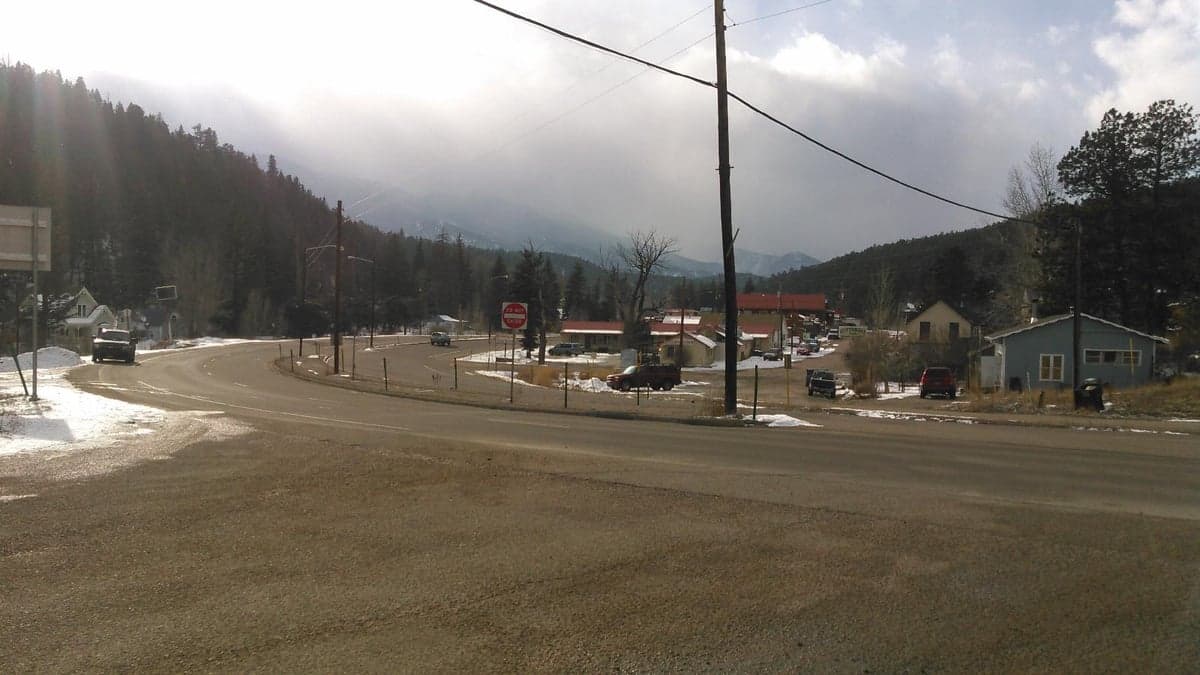
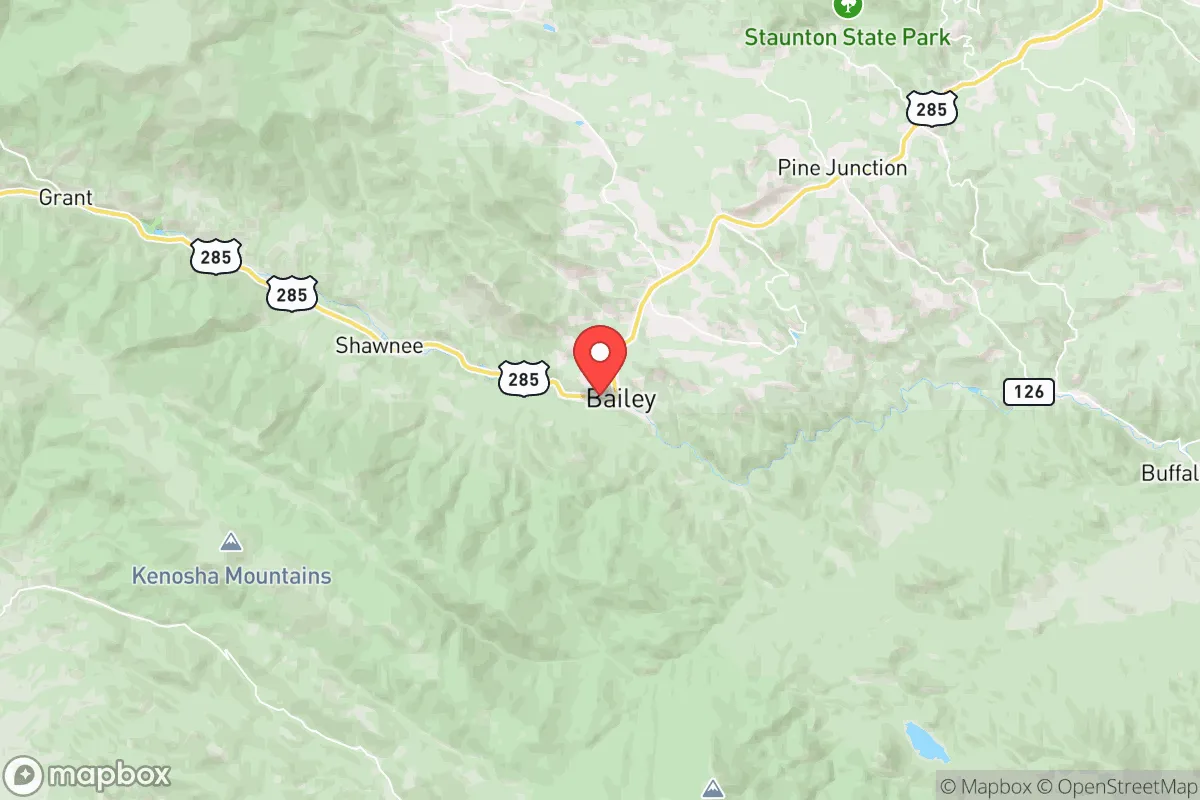
Photo: Wikipedia
Demographics of Bailey, CO
Historical data isn't available for Bailey, CO. Trends shown are for Park County, CO.
Affluence Level in Bailey, CO
A middle-class area roughly in line with national averages across income, home values, education, and employment.
People of Bailey, CO
Bailey, Colorado, is a small mountain community of 1,378 residents where the population is overwhelmingly white (90.1%) and nearly all native-born, with a foreign-born share of 0.0%. The town sits along U.S. Highway 285 in Park County, about 45 miles southwest of Denver, and its identity is defined by a mix of longtime mountain families, Denver commuters, and remote workers drawn to the pine forests and the North Fork of the South Platte River. With 53.2% of adults holding a college degree, Bailey is a well-educated, predominantly conservative enclave that has grown slowly and deliberately, resisting the rapid suburbanization seen elsewhere along the Front Range.
How the city was settled and grew
Bailey’s history as a populated place began in the 1860s, when the discovery of gold in the South Park region pulled prospectors through the Platte River canyon. The town itself was formally established in the 1870s, named after William Bailey, a rancher who recognized the valley’s potential as a way station for freight wagons and stagecoaches heading over Kenosha Pass. The original settlers were a mix of Anglo-American homesteaders, Cornish and Irish miners who had worked the nearby London Mine, and a scattering of German immigrants who took up ranching along the river bottom. These founding families built their homes in what is now the Bailey Hill district, the oldest residential area in town, where several original log structures still stand. By the early 1900s, the Denver, South Park & Pacific Railroad had made Bailey a summer resort destination, and wealthy Denver families erected cabins in the Deer Creek Valley area, establishing a pattern of seasonal mountain living that persists today. The mid-20th century brought a modest but steady influx of veterans and their families after World War II, who settled in the Stoney Creek subdivision, drawn by cheap land and the promise of a quiet, self-sufficient mountain life.
Modern era (post-1965)
The post-1965 era transformed Bailey from a ranching and mining outpost into a bedroom community. The passage of the 1965 Hart-Cellar Act had virtually no effect on Bailey’s demographics — the foreign-born population remains at 0.0% — but domestic in-migration accelerated dramatically. The completion of the four-lane expansion of U.S. 285 through the 1980s and 1990s cut the commute to Denver to under an hour, making Bailey viable for professionals working in the metro area. This new wave of white-collar migrants, largely from Denver’s southern suburbs, built homes in the Burland Ranches subdivision, a sprawling development of large lots that now holds the town’s highest concentration of college-educated residents. A second cluster of newcomers settled in the Spring Valley area, where hobby farms and equestrian properties attracted families seeking a rural lifestyle within commuting distance of the city. The Hispanic population, at 4.9%, is the only significant minority group in Bailey, and it is concentrated among families who moved up from the San Luis Valley in the 1990s and 2000s to work in construction, landscaping, and the service industry that supports the tourist trade along the 285 corridor. The Black population (0.7%) and East/Southeast Asian population (0.0%) are negligible, and there is no measurable Indian-subcontinent community.
The future
Bailey’s population is aging and slowly shrinking, a trend that mirrors rural Park County as a whole. The town is not becoming more diverse — the white share has remained above 90% for decades, and the small Hispanic community is stable rather than growing. The most significant demographic pressure comes from telecommuters and remote workers who arrived during and after the COVID-19 pandemic, purchasing existing homes in Bailey Hill and Deer Creek Valley and converting what were once weekend cabins into year-round residences. This influx has raised home prices and accelerated a generational turnover, as older longtime residents sell to younger families from the Denver metro. The next 10 to 20 years will likely see Bailey become slightly more affluent and more educated, with the college-educated share rising above its current 53.2%, while the overall population remains flat or grows only marginally due to limited water rights and restrictive county zoning that caps new development. The cultural identity is shifting from a working-class mountain town toward a professional exurb, but the conservative political character and the strong attachment to outdoor recreation — fishing, hiking, and off-roading in the Pike National Forest — are likely to endure.
For someone moving to Bailey today, the town offers a stable, safe, and increasingly well-educated community where neighbors know each other and the pace of life is dictated by the seasons rather than the stock market. The population is not diversifying in any meaningful way, and the dominant culture remains white, conservative, and outdoors-oriented. New arrivals will find a place that is becoming more expensive and more connected to Denver, but one that still retains the independent, self-reliant character that first drew settlers to this mountain valley more than 150 years ago.

* Values derived from national, state, county, city and local statistics and may differ in a specific area. Last updated: 2026-10-15T02:37:20.000Z
Narrative content on this page is AI-generated and may contain mistakes. Verify any details that matter before acting on them.
ReloMaps may earn a commission from affiliate links at no extra cost to you.

