 Popular

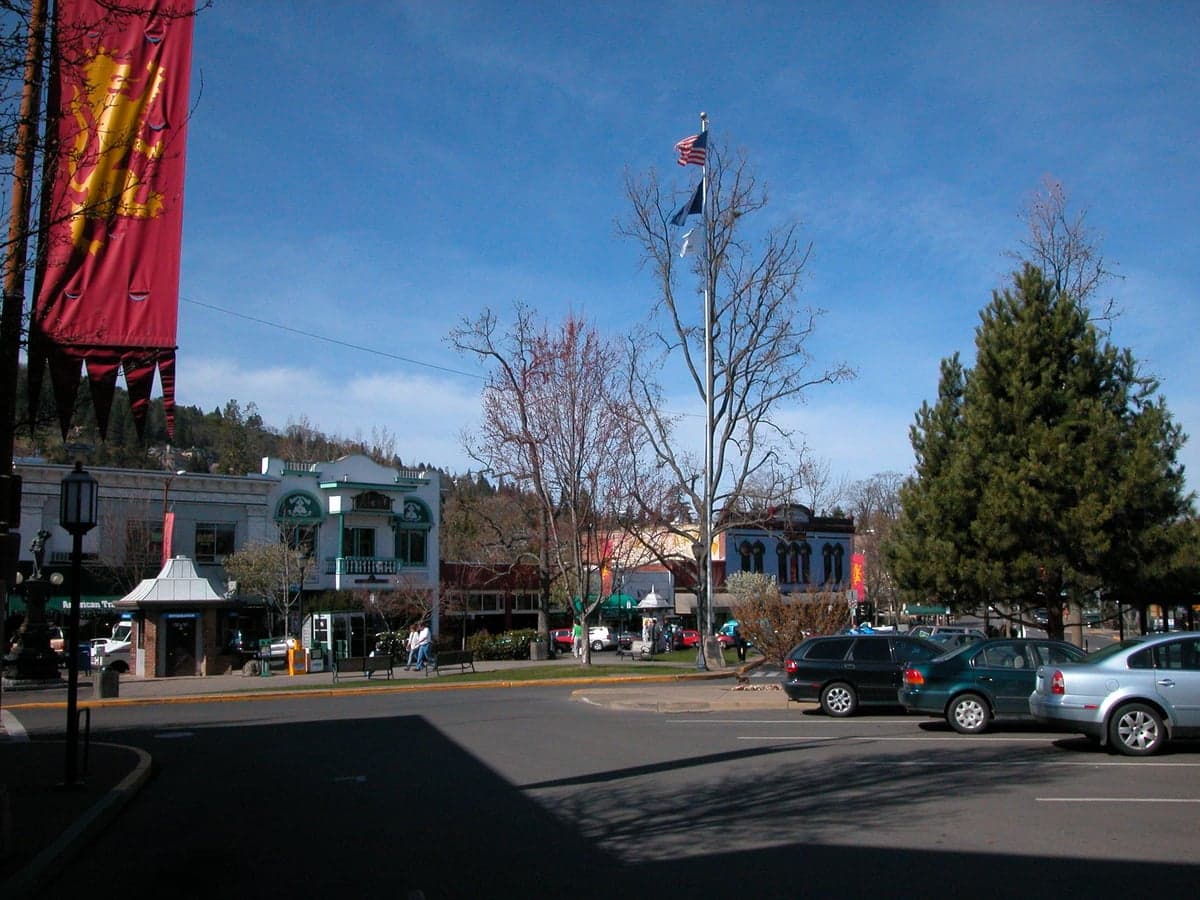
Photo: Wikipedia
Demographics of Ashland, OR
Affluence Level in Ashland, OR
A middle-class area roughly in line with national averages across income, home values, education, and employment.
People of Ashland, OR
Ashland, Oregon, is a city of roughly 21,300 residents that stands out for its high educational attainment—65% of adults hold a bachelor’s degree or higher—and its predominantly white population (81.9%). The city’s character is shaped by a blend of longtime Oregon families, retirees drawn to the Oregon Shakespeare Festival, and a steady stream of professionals and academics tied to Southern Oregon University. With a foreign-born population of just 2.3%, Ashland remains one of the least ethnically diverse cities in the Rogue Valley, though its Hispanic community (8.9%) has grown modestly in recent decades.
How the city was settled and grew
Ashland’s original population was drawn by the Donation Land Claim Act of 1850, which brought white American settlers into the Rogue Valley. The city was platted in 1852 around Ashland Creek, with early residents—mostly farmers, miners, and merchants from the Midwest and Upper South—building the first homes in what is now the Historic Railroad District. The arrival of the Oregon & California Railroad in 1884 shifted the town’s center eastward, and the Downtown Ashland core filled with hotels, saloons, and mercantile stores serving travelers. By the early 1900s, a small Chinese community—primarily former railroad laborers—had settled along the edges of the Granite Street corridor, though most were gone by the 1920s due to exclusionary laws. The founding of Southern Oregon Normal School (now Southern Oregon University) in 1926 brought a new wave of faculty and students, many of whom settled in the University Heights neighborhood, a grid of Craftsman bungalows and mid-century homes east of campus. Ashland’s population remained overwhelmingly white and native-born through the mid-20th century, with the 1950 census recording a 99.2% white population.
Modern era (post-1965)
The post-1965 era saw Ashland’s population grow from roughly 12,000 to over 20,000, driven primarily by domestic in-migration rather than international immigration. The Oregon Shakespeare Festival, which expanded into a year-round operation in the 1970s, attracted artists, retirees, and second-home buyers from California and the Pacific Northwest. Many of these newcomers settled in the Skylark Estates area, a hillside subdivision of custom homes built in the 1970s and 1980s, and in the East Main Street corridor, where larger lots and newer construction appealed to affluent transplants. The Hispanic population, which was negligible in 1970, grew to 8.9% by 2020, with most families concentrated in the North Mountain Avenue area and the southern edge of the city near Talent. The East/Southeast Asian population (1.8%) and Indian subcontinent population (0.1%) remain very small, largely tied to university faculty and medical professionals at Asante Ashland Community Hospital. The Black population (0.5%) has been historically tiny and remains so, with no single neighborhood concentration. Ashland’s foreign-born share (2.3%) is roughly one-third the Oregon state average, reflecting the city’s limited draw for recent immigrants.
The future
Ashland’s population is projected to grow slowly—perhaps 5-10% over the next two decades—constrained by limited developable land, strict urban growth boundaries, and high housing costs. The city is becoming slightly more diverse, but the pace is glacial: the Hispanic share may reach 12-14% by 2040, while the white share will likely remain above 75%. New residential development is concentrated in the Ashland Heights area, a master-planned subdivision on the city’s western edge, which is attracting a mix of retirees and remote workers from California and the Portland metro area. The East/Southeast Asian and Indian populations will likely grow incrementally as Southern Oregon University recruits more international students, but Ashland will remain a predominantly white, highly educated, and culturally liberal enclave. The city’s cultural identity—arts-focused, environmentally conscious, and politically progressive—is unlikely to shift dramatically, though rising housing costs may push younger families and lower-income residents toward neighboring Talent and Phoenix.
For someone moving to Ashland now, the city offers a stable, well-educated community with a strong arts scene and outdoor amenities, but little racial or ethnic diversity. New residents should expect a population that is older, whiter, and more college-educated than the Oregon average, with a cultural character shaped more by domestic migration from California and the Pacific Northwest than by international immigration. The city’s demographic trajectory points toward slow, incremental diversification rather than rapid change, making it a consistent choice for those seeking a predictable, amenity-rich small city.

* Values derived from national, state, county, city and local statistics and may differ in a specific area. Last updated: 2026-06-13T21:15:24.000Z
Narrative content on this page is AI-generated and may contain mistakes. Verify any details that matter before acting on them.
ReloMaps may earn a commission from affiliate links at no extra cost to you.

