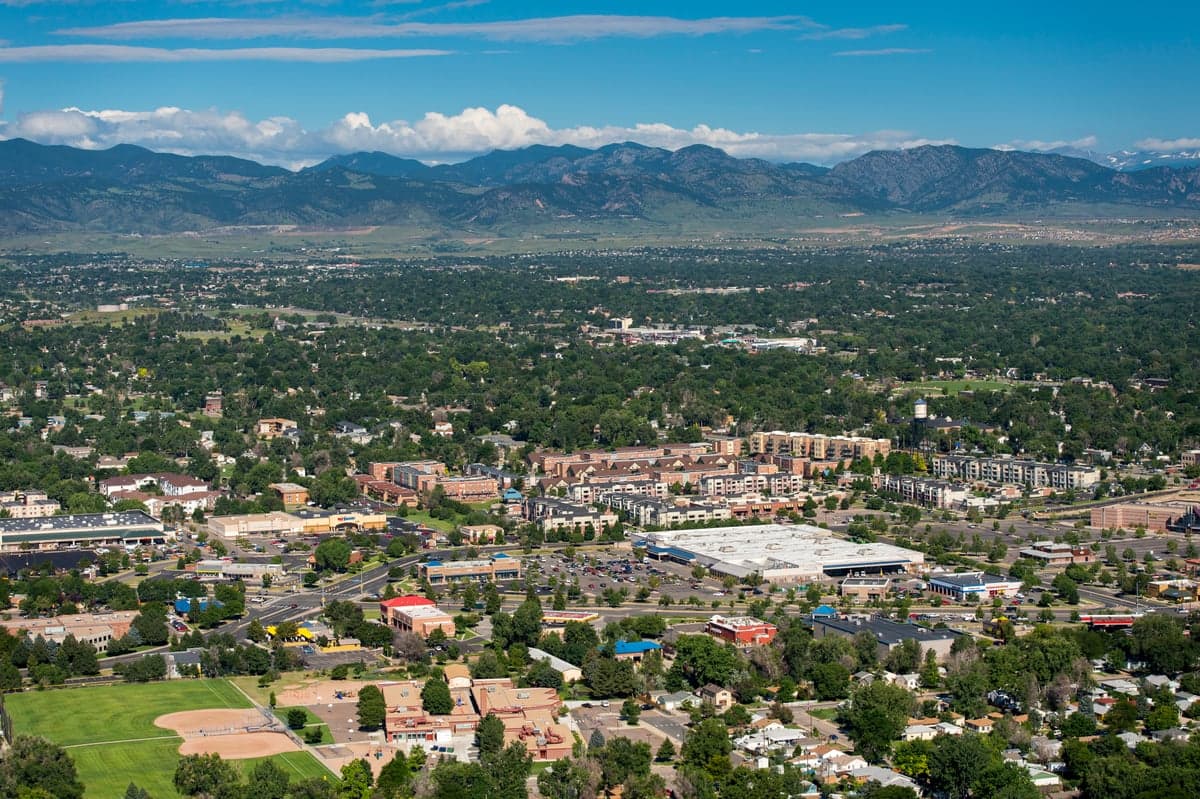
Photo: Wikipedia
Personal Sovereignty in Arvada, CO
Viable for self-reliance. Generally workable, though some barriers may limit total independence.
What does Personal Sovereignty tell us?
Personal Sovereignty measures your capacity for self-reliance and independence with minimal government friction. Higher scores mean fewer barriers between you and the way you want to live... but it assumes you have the space you need and good neighbors.
What does this tell us?
Personal Sovereignty measures your capacity for self-reliance and independence with minimal government friction. Higher scores mean fewer barriers between you and the way you want to live... but it assumes you have the space you need and good neighbors.
State Policy
Energy independence: Net exporter (110% of energy produced in-state)
Personal Liberty
Homesteading

Personal Liberty Analysis
Arvada, Colorado, offers a mixed bag for those prioritizing personal sovereignty, with a local culture that leans more self-reliant than the state's progressive urban cores, but ultimately operates under the heavy thumb of Colorado's increasingly restrictive state-level governance. For the survivalist or prepper, the city itself is a compromise: you get a relatively safe, family-oriented suburb with decent access to open space, but you must navigate a regulatory environment that is actively hostile to many forms of individual autonomy. The real question isn't whether Arvada is a libertarian paradise—it isn't—but whether its practical advantages outweigh the growing list of state-imposed constraints on your freedom to live, defend, and provide for yourself as you see fit.
Tax burden and regulatory posture: How Colorado's state policies affect your wallet and freedom
Colorado's state-level tax burden is moderate compared to high-tax states like California or New York, but it's creeping upward. The state income tax is a flat 4.4% (as of 2025), and sales tax in Arvada combines city, county (Jefferson), and state rates to land around 8.5%. Property taxes are relatively low—roughly 0.5% of assessed value—thanks to the Gallagher Amendment's legacy, though recent legislative tweaks have allowed for modest increases. For a prepper, the real concern isn't the raw tax rate but the regulatory posture. Colorado has a strict statewide building code (the 2021 IECC) that mandates energy-efficiency standards, which can complicate off-grid or unconventional construction. Zoning in Arvada is typical for a first-ring suburb: most lots are 6,000 to 10,000 square feet, with no allowance for agricultural use or livestock in standard residential zones. The city's land-use code is 1,200+ pages, and any significant modification to your property—sheds over 120 square feet, fences over 6 feet, or any "accessory dwelling unit"—requires a permit and often a public hearing. This is not a jurisdiction that tolerates "do what you want" on your own land. The state's renewable energy mandates (HB19-1261) also push utilities toward wind and solar, which can affect grid reliability during extreme weather—a concern for anyone planning for grid-down scenarios.
Self-defense and gun law specifics: Navigating Colorado's shifting firearm landscape
Colorado has become a battleground for gun rights, and Arvada sits squarely in the middle of it. The state now requires universal background checks for all firearm transfers (including private sales), a red flag law (HB19-1177) that allows family members or law enforcement to petition for temporary seizure of firearms, and a waiting period of three days for all firearm purchases (effective 2024). Magazine capacity is capped at 15 rounds for handguns and 10 for rifles—a direct hit to anyone building a practical defensive or prepper arsenal. Arvada itself is a home rule city that has not enacted additional local restrictions beyond state law, but the Jefferson County Sheriff's Office is generally pro-2A in its issuance of concealed carry permits (shall-issue, no local discretion). Open carry is legal in Arvada for those 18+ without a permit, though it's likely to draw police attention. For the survivalist, the key takeaway is that Colorado's gun laws are trending in the wrong direction: a 2025 bill to ban "assault weapons" (defined broadly) is under serious consideration. If you value the right to own standard-capacity rifles and handguns without state interference, Arvada is a less hostile environment than Boulder or Denver, but it's far from a safe harbor. You can still defend your home with a firearm under Colorado's "Make My Day" law (no duty to retreat in your home), but the legal climate for self-defense outside the home is increasingly litigious.
Self-reliance and homesteading viability: Lot sizes, zoning, and off-grid feasibility in Arvada
For the prepper looking to establish a self-sufficient homestead, Arvada's suburban density is a significant limitation. The typical residential lot is a quarter-acre or less, and zoning codes prohibit chickens, bees, and any livestock in standard R-1 districts (though a few neighborhoods with larger lots may allow chickens with a permit). Gardening is allowed, but HOAs in many subdivisions impose restrictions on front-yard vegetable gardens, compost piles, and clotheslines. Off-grid living is effectively illegal: the city requires connection to municipal water and sewer, and solar panels must be grid-tied (no battery-only systems) per the building code. Rainwater collection is legal in Colorado (since 2016) but limited to two 55-gallon barrels per household, and only for outdoor use. For a serious prepper, Arvada is a place to live while you prepare, not a place to bug in long-term. The better option for homesteading is to look at unincorporated Jefferson County or farther north into Boulder or Weld counties, where lot sizes of 1-5 acres are common and zoning allows for small-scale agriculture. Within Arvada, the best you can do is a well-stocked pantry, a robust water storage plan (municipal water is treated but not guaranteed in a crisis), and a generator—but you'll be reliant on the grid and supply chains for most essentials.
Personal liberties: Parental rights, medical autonomy, speech, and property in a blue state
Colorado's state government has aggressively expanded its reach into areas that directly affect personal sovereignty. Parental rights have been eroded by laws like the 2023 "Safe Schools" bill, which mandates that schools withhold information about a student's gender identity or sexual orientation from parents if the student requests it—a direct violation of traditional parental authority. Medical autonomy is similarly constrained: Colorado has no religious or philosophical exemption for vaccine mandates in schools (though a personal belief exemption exists for K-12), and the state's universal health insurance "public option" (the Colorado Option) imposes price controls on private insurance, reducing choice. On speech, Colorado has a strong anti-SLAPP law that protects critics of government and corporations, but the state's social media "content moderation" bill (SB23-158) allows platforms to remove "hateful" content without liability, which can chill conservative speech. Property rights are under pressure from statewide rent control bans (preempted by state law, but local efforts to impose them persist) and inclusionary zoning mandates that require a percentage of new housing to be "affordable." For the survivalist, the most concerning trend is the state's emergency powers: during the 2020 pandemic, the governor shut down businesses, churches, and schools by executive order, and the legislature has since codified broad emergency authority (HB20-1410) that could be used again. Arvada's city council is moderate (4-3 Republican-leaning as of 2025), but it has limited power to push back against state mandates.
Overall, Arvada offers a moderate level of personal sovereignty relative to other Colorado suburbs—better than Boulder or Denver, worse than rural Weld or El Paso counties. For the prepper or conservative individual, it's a viable base of operations if you're willing to accept the state's growing list of restrictions on guns, property use, and parental rights. The city's low crime rate (violent crime is about 40% below the national average), decent schools, and proximity to outdoor recreation make it a practical choice for families who want to live in a relatively safe environment while building resilience. But if your goal is maximum autonomy—the ability to build an off-grid homestead, own standard-capacity rifles, and raise your children without state interference—you'll need to look farther from the Front Range. Arvada is a compromise, not a sanctuary.

* Values derived from national, state, county, city and local statistics and may differ in a specific area. Last updated: 2026-05-02T00:49:28.000Z
Narrative content on this page is AI-generated and may contain mistakes. Verify any details that matter before acting on them.
ReloMaps may earn a commission from affiliate links at no extra cost to you.

