Photo: Wikipedia
Demographics of Arvada, CO
Affluence Level in Arvada, CO
An upper-middle-class area. Household wealth, education levels, and homeownership run ahead of national benchmarks.
People of Arvada, CO
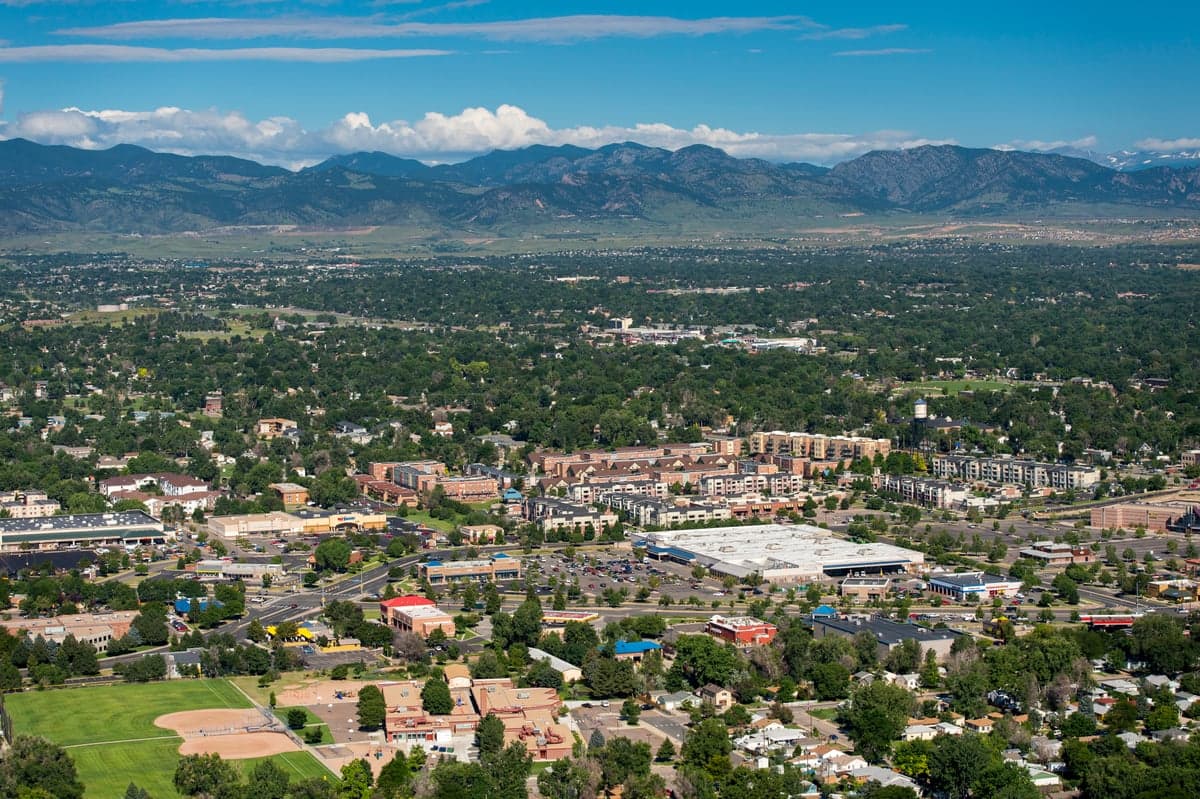
Today, Arvada, Colorado is a predominantly white, family-oriented suburb of Denver with a population of 122,835, marked by a notably low foreign-born share of just 2.0% and a high college attainment rate of 50.0%. The city’s character is defined by its historic downtown, extensive trail systems, and a strong sense of local identity that sets it apart from newer, more transient suburbs. Its population is 77.2% white, with a Hispanic community of 15.4% representing the largest minority group, while Black (0.9%), East/Southeast Asian (2.0%), and Indian subcontinent (0.5%) residents form much smaller enclaves. Arvada feels distinctly like a place where long-term residents and multigenerational families anchor the community, rather than a hub for recent international arrivals.
How the city was settled and grew
Arvada’s human history begins not with colonial settlement but with the 1850s Colorado Gold Rush, which drew the first wave of Anglo-American prospectors and farmers to the area. The city’s founding is tied to the 1870 arrival of the Colorado Central Railroad, which transformed a scattering of homesteads into a viable agricultural and mining supply center. The original settlers were overwhelmingly of Northern European descent—English, German, and Scandinavian—who established farms along Ralston Creek and built the first homes in what is now Olde Town Arvada, the historic commercial and residential core. A second wave arrived in the early 20th century, drawn by the sugar beet industry and the establishment of the Coors Porcelain Company (later CoorsTek) in nearby Golden, which provided stable industrial jobs. These workers, still largely of European stock, settled in modest bungalows in neighborhoods like Grandview and Allendale, areas that remain predominantly white and middle-class today. By 1950, Arvada’s population was roughly 2,500 and nearly entirely white, reflecting the region’s limited ethnic diversity before the post-war boom.
Modern era (post-1965)
The post-1965 era brought explosive suburban growth, but Arvada’s demographic profile remained remarkably stable compared to other Denver suburbs. The 1960s and 1970s saw a massive influx of domestic migrants—primarily white families from the Midwest and other parts of Colorado—drawn by affordable housing, new schools, and the expansion of the Jefferson County school system. This wave filled the sprawling subdivisions of Lamar Heights and Scenic Heights, which were built out with ranch-style homes and cul-de-sacs that still define much of the city’s housing stock. The Hispanic population began to grow modestly during this period, rising from negligible levels to roughly 8% by 1990, concentrated in the West Woods area and along the Wadsworth Boulevard corridor, where lower home prices attracted working-class families. The foreign-born share, however, remained very low—never exceeding 3%—as Arvada did not become a destination for the post-1965 immigration waves that transformed other Front Range cities. The East/Southeast Asian and Indian subcontinent populations arrived later, mostly after 2000, drawn by professional opportunities in Denver’s tech and healthcare sectors; they settled in smaller numbers in newer developments like Candelas, a master-planned community on the city’s western edge. Today, Arvada’s racial composition—77.2% white, 15.4% Hispanic, and tiny shares of other groups—reflects a city that grew primarily through domestic white migration rather than international immigration.
The future
Arvada’s population is slowly diversifying, but the pace is gradual and the city is not homogenizing into a single melting pot. The Hispanic share is projected to continue its steady rise, potentially reaching 20-22% by 2040, driven by natural increase and continued domestic migration from other Colorado communities. The East/Southeast Asian and Indian subcontinent populations, while small, are growing as professionals are attracted to the area’s strong schools and proximity to Denver’s job centers; these groups are likely to remain concentrated in newer, higher-priced neighborhoods like Candelas rather than dispersing evenly. The white population, while still the majority, is aging, and younger white families are increasingly priced out by rising home values, which could slow overall growth. The city is not tribalizing into distinct ethnic enclaves in the way some larger metros are, but subtle geographic sorting is visible: older, established neighborhoods like Olde Town and Grandview remain overwhelmingly white and affluent, while Hispanic residents are more common in the central and southern parts of the city near Wadsworth. For a mover considering Arvada, the next decade will likely bring a slightly more diverse but still predominantly white, family-oriented suburb where the biggest demographic change will be the gradual aging of the existing population rather than a surge of new arrivals.
Arvada is becoming a more expensive, slightly more diverse version of its past self, but it remains a place where the dominant culture is white, Midwestern-influenced, and rooted in long-term homeownership. For a conservative-leaning individual or parent, this means a stable, low-crime environment with strong schools and a community that values tradition over rapid change. The low foreign-born share and high college attainment rate suggest a population that is educated, insular, and resistant to the demographic upheavals seen in other parts of the Denver metro. Moving to Arvada today means joining a community that is quietly evolving but unlikely to undergo a radical transformation in the next 20 years.

* Values derived from national, state, county, city and local statistics and may differ in a specific area. Last updated: 2026-05-02T00:49:28.000Z
Narrative content on this page is AI-generated and may contain mistakes. Verify any details that matter before acting on them.
ReloMaps may earn a commission from affiliate links at no extra cost to you.

