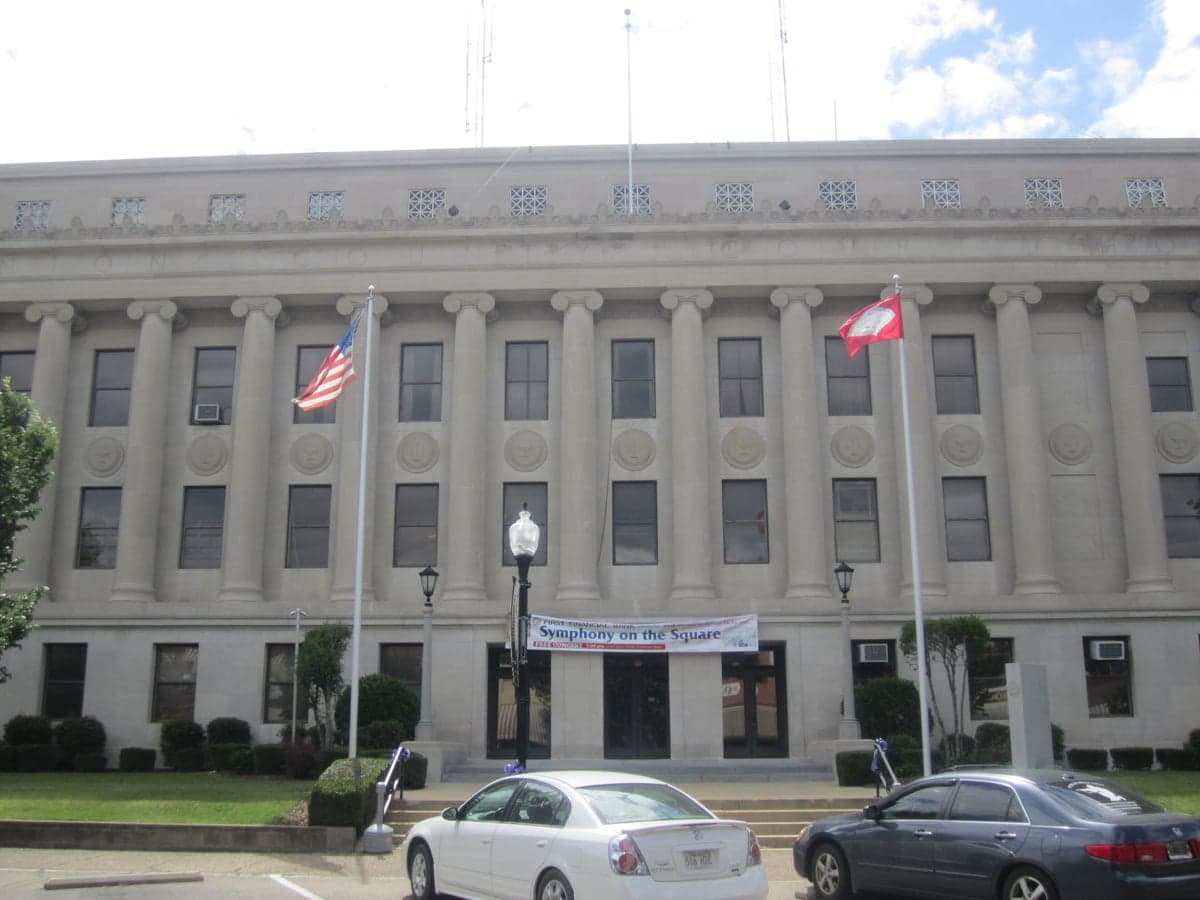
Photo: Wikipedia
Political ClimatePolitical Climate in Union County
Showing district-level results — no local-only data available.
Local Political AnalysisPolitical Analysis of Union County
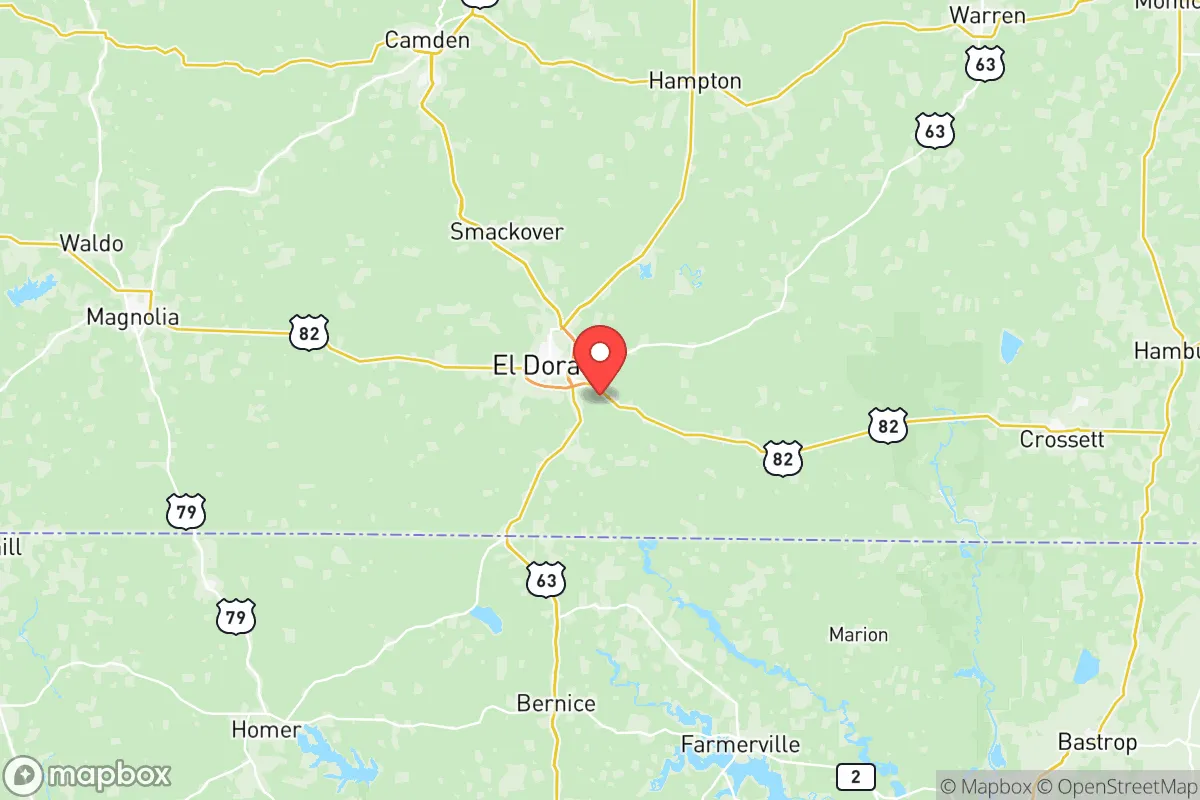
Union County, Arkansas leans reliably Republican with a Cook PVI of R+20, making it about four points more conservative than the state's overall rating of R+16. That margin has held steady over the last three presidential cycles, though it tightens in midterm years when local turnout shifts. Within the county, the political landscape splits more than the precinct-level numbers suggest: El Dorado, the county seat and largest city, has a handful of reliably blue precincts around its historic downtown and industrial neighborhoods, while the outlying towns like Smackover, Norphlet, and Strong vote consistently red. The true swing territory sits in the rural corridors along Highway 15 and Highway 82, where oil-field workers and long-time farming families sometimes flip between cycles depending on local economic sentiment.
How it compares
Compared to Arkansas as a whole, Union County is notably redder. The state's R+16 rating already puts it among the most conservative states in the South, but Union County's R+20 reflects a deeper cultural attachment to the oil and gas industry — the county is the heart of Arkansas's Ark-La-Tex energy basin. In 2024, the county voted about 64% Republican, while the state averaged roughly 62%. That difference may sound small, but it manifests in local partisan primaries that often decide the race before November. El Dorado's southern precincts, especially around the university and the medical district, occasionally produce Democratic wins in county commission and school board races, but those are the exception. Smackover and Norphlet, for example, have not gone blue in a countywide election since the early 2000s. The biggest contrast with the state is the near-total absence of any competitive Democratic stronghold — unlike in northwest Arkansas or the Delta region, there is no growing college-town turnout or minority-concentrated city that shifts the overall balance.
What this means for residents
For conservative residents, the political reality is comfortable and predictable. Local policy — zoning, school funding, and tax rates — tends to align with small-government principles. The Union County Sheriff's Office and the El Dorado City Council are reliably Republican, so there isn't much internal political friction. For liberal residents, the landscape is tougher but not hostile. El Dorado's active Democratic club holds monthly meet-ups and fields candidates in off-cycle races, even if those candidates rarely win countywide. The practical effect is that conservative voices dominate county-level decisions, but liberal and moderate viewpoints still surface at city council meetings in El Dorado, especially around public-school funding and downtown development. Voter turnout in Union County runs about 55–60% in presidential years, which is slightly above the state average — locals take their politics seriously, but without the deep partisan animosity you'd see in a swing county.
A cultural distinction that sets Union County apart from much of Arkansas is the centrality of the oil and gas economy. Policy debates here often circle back to energy regulation, mineral rights, and property taxes on industrial land — bread-and-butter issues that don't carry the same weight in, say, the Ozarks or the Delta. The county also has a long history of union activity in the oil fields, which creates a pragmatic strain of blue-collar Republicanism that can sometimes break with the state party on labor and environmental permitting. For anyone moving here, the political message is straightforward: it's a red county that votes accordingly, but local conversations are shaped more by the industry that built the towns than by national culture-war flashpoints.

State Political ClimatePolitical Climate in Arkansas
State Political AnalysisPolitical Environment in the State
Arkansas is a solidly Republican state with a Cook Partisan Voting Index of R+16, reflecting a deep red trend that has only intensified over the past two decades. Twenty years ago the state was still competitive at the presidential level – George W. Bush won it by single digits in 2004 – but by 2024 Donald Trump carried Arkansas by roughly 30 points. The dominant coalition today is a mix of rural evangelical voters, Northwest Arkansas transplants, and suburban retirees, while Democrats hold ground only in a handful of urban and college-town pockets. The shift has been driven by national polarization and the rapid growth of conservative-leaning metro areas like Bentonville and Rogers, which now rival Little Rock in political influence.
Urban vs. rural divide
The political map of Arkansas breaks cleanly along metro and rural lines. Pulaski County (Little Rock) is the only reliably blue stronghold, delivering about 60% of its vote to Joe Biden in 2020, but its population is stagnant relative to the rest of the state. Northwest Arkansas – the Fayetteville-Springdale-Rogers-Bentonville corridor – used to be a swing area thanks to the University of Arkansas in Fayetteville, but over the last decade it has trended sharply right. Washington County (Fayetteville) is still purple-ish, voting about 55% Republican, while neighboring Benton County (Bentonville, Rogers) is now reliably red – it flipped from purple to dark red as corporate transplants from Walmart and Tyson filled the suburbs. Other metro areas like Jonesboro (Craighead County) and Fort Smith (Sebastian County) lean Republican but are more moderate than the surrounding countryside. The rural counties – places like Mississippi County in the Delta and Conway County in the center – consistently vote 70-80% Republican. The result is a state where Democratic influence is almost entirely confined to Little Rock city limits and a few precincts in Fayetteville and Hot Springs.
Policy environment
Arkansas’s policy environment reflects its Republican supermajority and a pragmatic, low-tax ethos. The state income tax is a flat rate of 4.9% after years of incremental cuts, and the state sales tax is 6.5% with local add-ons pushing it to 9.5% in some cities – high by Southern standards but offset by low property taxes. It is a right-to-work state with tort reform caps on non-economic damages. Education policy has shifted dramatically: the 2023 LEARNS Act introduced universal school vouchers, eliminated teacher tenure, and raised starting teacher salaries to $50,000, making Arkansas a national leader in school choice. Healthcare is a mixed bag – the state expanded Medicaid via a private-option model in 2014, but the legislature recently added work requirements for able-bodied adults. Election laws require a photo ID to vote and limit absentee ballot drop boxes; there is no early voting on the Saturday before Election Day. On gun policy, Arkansas is deeply permissive: no permit requirement for open or concealed carry, no duty to retreat in self-defense, and a “stand your ground” law is on the books.
Recent policy direction
The last three years have seen a flurry of legislation that defines the state’s current direction. On education and parental rights, the LEARNS Act (2023) also banned classroom instruction on gender identity in K-2 and restricted library book challenges – a law that drew national attention but passed with comfortable Republican margins. On medical and bodily autonomy, Arkansas enacted a near-total abortion ban in 2022 with no exceptions for rape or incest, and in 2023 passed Act 626, which bans gender-affirming medical care for minors. Gun and self-defense law saw the passage of permitless carry in 2021 and a preemption statute that prevents cities from imposing their own gun restrictions. On speech and privacy, a 2023 law restricts drag show performances on public property and in the presence of minors. Property rights remain strong: there is no state-level property tax on business inventory, and homeowners enjoy generous homestead exemptions. For voting, a 2021 law requires signature verification on absentee ballots and prohibits the secretary of state from sending unsolicited absentee ballot applications. The overall direction points toward a more assertive social conservatism, especially on education and medical issues, paired with continued deregulation in business.
Civil unrest & political movements
Arkansas is not known for large-scale civil unrest, but there have been notable flashpoints. In 2020, Black Lives Matter protests in Little Rock led to clashes with police and the toppling of a confederate monument; a small counterprotest by armed militia groups occurred simultaneously. In 2023, the LEARNS Act sparked a movement called “Keep Our Kids in Public Schools,” but it failed to gather enough signatures to force a referendum. On the right, Moms for Liberty chapters are active in Benton County and Faulkner County, pushing for stricter policies on library content and critical race theory. There are no sanctuary cities in Arkansas; a 2021 law requires local law enforcement to cooperate with federal immigration authorities. Election integrity controversies have been minimal – a 2020 audit by the secretary of state found no widespread fraud, though some conservative groups pushed for hand-counting in a handful of rural precincts. The most visible cultural flashpoint today is the battle over library boards. In places like Fayetteville and Little Rock, heated city council meetings have erupted over book challenges and drag story hours. A new resident will notice yard signs and bumper stickers for local school board candidates much more than political rallies or street protests.
Projection
Over the next five to ten years, Arkansas is likely to stay deeply red, but with a subtle shift toward a more libertarian strain in the northwest. In-migration from California, Texas, and Colorado is concentrated in Benton and Washington counties, where many newcomers are conservative but skeptical of heavy-handed social legislation. Meanwhile, the Delta continues to lose population, and Little Rock’s growth is slow. That demographic churn suggests the state’s partisan lean will remain at roughly R+16 to R+18, but cultural divides within the GOP may widen. Expect more battles over school vouchers (which are now law but face implementation challenges) and further restrictions on transgender rights. Economic pressure from low taxes and a pro-business climate will likely continue, but infrastructure strains in Northwest Arkansas – especially on water and housing – could force conservative lawmakers to embrace more government spending. For a relocator moving in now, a decade from now you’ll find the same solid Republican majority but with more tension between the libertarian-leaning Northwest and the social conservative Delta. The state’s political trajectory is stable, not transformative.
For a new resident – whether you lean conservative or moderate – Arkansas offers a predictable political environment where state policy aligns closely with the values of its dominant Republican majority. If you’re conservative, you’ll find your views reflected in the laws around education, taxes, and gun rights. If you lean left, you’ll find friendly neighborhoods in Little Rock and Fayetteville but will have to accept that state-level decisions will often go against your preferences. The practical takeaway is simple: check the local school board and city council dynamics where you plan to live, because that’s where the real action is – from library policy in Fayetteville to development ordinances in Bentonville. The state’s low taxes and strong property rights work for almost everyone, but the
* Values derived from national, state, county, city and local statistics and may differ in a specific area. Last updated: 2026-06-24T22:33:45.000Z
Narrative content on this page is AI-generated and may contain mistakes. Verify any details that matter before acting on them.
ReloMaps may earn a commission from affiliate links at no extra cost to you.

