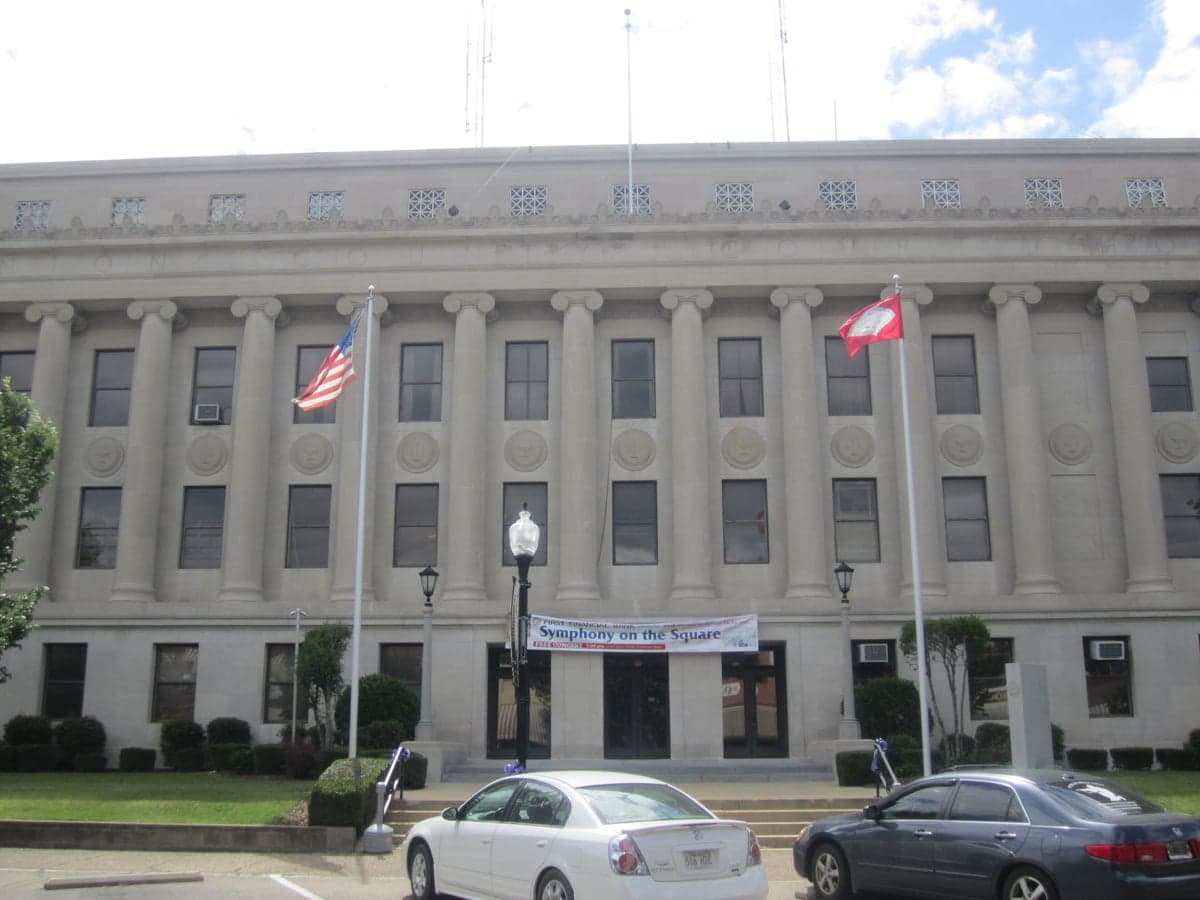
Photo: Wikipedia
Demographics of Union County
Affluence Level in Union County
A below-average socioeconomic profile. Incomes, home values, and educational attainment trail the U.S., with higher poverty and unemployment.
People of Union County
The people of Union County, Arkansas, today form a small, stable population of just over 38,000 that is overwhelmingly American-born—only 1.6% are foreign-born. This is a deeply rooted Southern community where White (59.7%) and Black (32.2%) residents have lived alongside each other for generations, concentrated in the county seat of El Dorado and smaller towns like Smackover, Norphlet, and Junction City. The county’s character is defined by a proud oil-and-timber heritage, low density, and a conservative social fabric that prizes self-reliance and neighborliness, with a college attainment rate of just 18.9% reflecting a blue-collar workforce that has long powered the region’s extraction industries.
Settlement & growth (pre-1960)
Before European settlers arrived, the area that is now Union County was home to Caddo and Quapaw peoples, who lived along the Ouachita River and its tributaries. French explorers and traders moved through the region in the 1600s and 1700s, but no permanent European settlements took root until after the Louisiana Purchase. The United States acquired the land in 1803, and Anglo-American settlers—mostly from Tennessee, Georgia, and the Carolinas—began arriving in the 1810s and 1820s to establish cotton plantations along the fertile bottomlands. The county was formally created in 1829, named in a spirit of national unity, and its first county seat was El Dorado, a small crossroads that would later boom.
The Civil War and Reconstruction brought profound change. Slavery had been central to the plantation economy, and after emancipation, many freed African Americans remained in the county, often working as sharecroppers or tenant farmers. By 1900, Union County’s population was roughly half White and half Black. The first major demographic upheaval came with the oil boom of the 1920s. In 1921, the Smackover oil field was discovered, and within a few years the town of Smackover swelled from a few hundred to over 25,000 people—mostly White and Black workers from across the South, joined by a handful of immigrants from Europe and Mexico. The nearby towns of Norphlet, Mount Holly, and Lawson also saw rapid growth as wildcatters and roughnecks flooded in. The boom subsided by the 1930s, but oil remained the economic backbone, supplemented by a growing timber industry that led to the establishment of mill towns like Huttig, Strong, and Calion.
By the mid-20th century, Union County’s population had stabilized. The 1950 census recorded just over 50,000 residents, making it one of the more populous counties in southern Arkansas. The racial composition remained roughly two-thirds White and one-third Black, with very few Hispanic or Asian residents. The economy diversified modestly with the rise of manufacturing and healthcare in El Dorado, but the county’s rural identity persisted, and the small communities scattered across the piney woods—places like Felsenthal and Junction City—remained close-knit and predominantly family-based.
Modern era (post-1965)
The 1965 Hart-Cellar Act, which opened the United States to large-scale non-European immigration, had almost no effect on Union County. With no major urban center and an economy tied to extraction and agriculture, the county attracted virtually no new immigrant populations. Today, the foreign-born share is just 1.6%, one of the lowest rates in Arkansas. The small Asian (East/Southeast Asian) population, at 0.7%, consists mostly of a few families connected to medical or academic positions in El Dorado. The Indian-subcontinent population is negligible at 0.2%, and the Hispanic share of 4.6% represents a modest increase from near-zero in 1990, driven by a small number of workers in poultry processing and construction. These newer residents tend to live in El Dorado proper, not in the smaller towns.
Domestic migration has been more consequential. After the oil boom of the 1970s faded, Union County lost population steadily—the 2020 census showed 38,368, down from 45,000 in 2000. Young people have left for larger Arkansas cities like Little Rock or out of state for better opportunities, leaving an older population behind. Suburbanization within the county has been minimal; El Dorado, with about 18,000 residents, remains the only substantial town, while villages like Smackover and Norphlet have aged and shrunk. The racial balance has shifted slightly: the White share dropped from about 63% in 2000 to 59.7% in 2024, while the Black share held steady near 32%. The overall population is less diverse in origin than almost any other region of the United States, and the low college attainment rate (18.9%) reflects the exodus of educated young adults.
The future
Union County’s population is projected to continue a slow decline over the next two decades, though the rate may moderate as the cost of housing and land remains among the lowest in Arkansas. The county will likely become slightly more Hispanic, mirroring a statewide trend, but that share will probably stay below 10%. The Black and White populations will remain the two dominant groups, with no sign of significant in-migration from East/Southeast Asian or Indian-subcontinent communities. Geographically, population will concentrate even more in El Dorado, where healthcare, education, and retail jobs are anchored. The smaller towns—Smackover, Huttig, Junction City—will continue to lose residents, especially younger families, reinforcing their character as quiet, aging hamlets. The county’s cultural identity will remain deeply rooted in its oil-and-timber past, conservatism, and a cautious welcome to newcomers who share those values.
For someone moving into Union County today, the decision is about embracing a place where the past is never far away, the pace is slow, and the community is built on generations of shared experience. It is a stable, predominantly native-born, and politically conservative corner of Arkansas—a fit for those seeking a low-cost, low-drama life anchored in small-town tradition rather than demographic change.

* Values derived from national, state, county, city and local statistics and may differ in a specific area. Last updated: 2026-06-24T22:33:45.000Z
Narrative content on this page is AI-generated and may contain mistakes. Verify any details that matter before acting on them.
ReloMaps may earn a commission from affiliate links at no extra cost to you.

