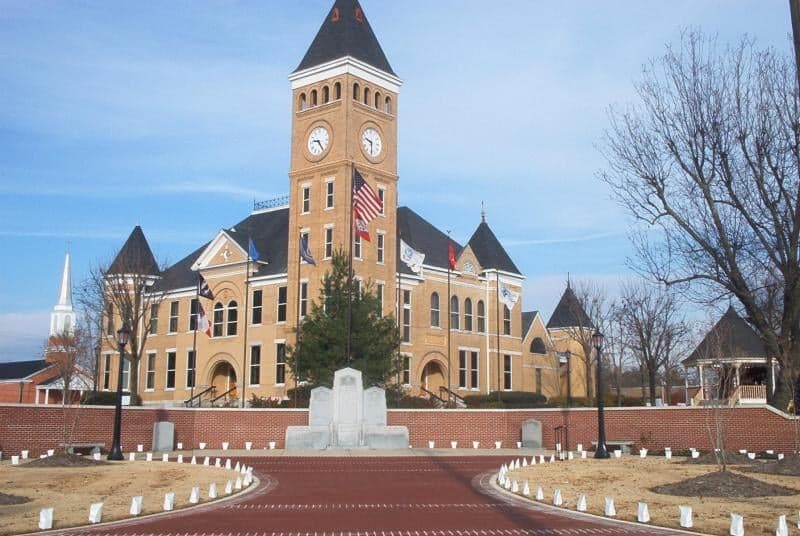
Photo: Wikipedia
Political ClimatePolitical Climate in Saline County
Showing district-level results — no local-only data available.
Local Political AnalysisPolitical Analysis of Saline County
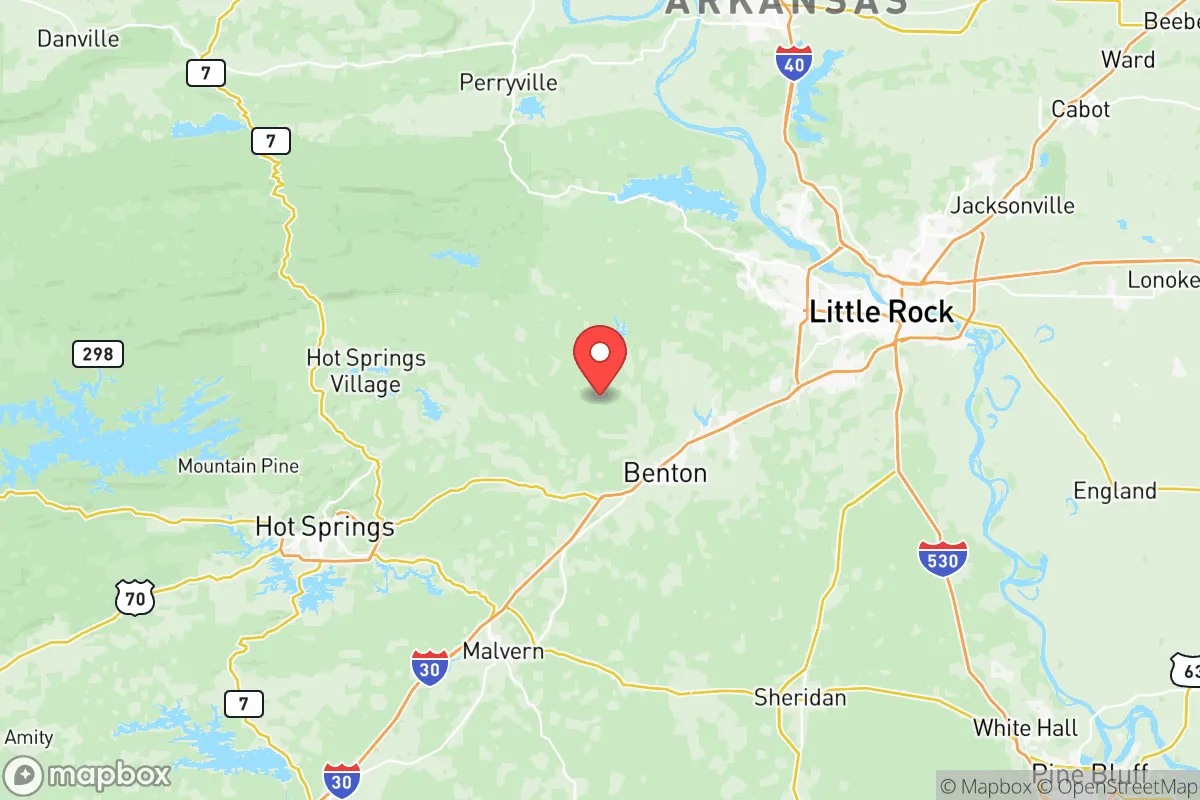
Saline County, Arkansas, is a reliably Republican area that has grown more conservative in step with the state, but it remains noticeably less red than Arkansas as a whole. With a Cook Partisan Voting Index (PVI) of R+8, the county is eight points more Republican than the national average, yet it is a full eight points less Republican than Arkansas’s statewide PVI of R+16. This gap reflects Saline County’s historical status as a more moderate, suburban-leaning part of central Arkansas, though recent election cycles have tightened that distinction as the county’s fast-growing exurbs have shifted rightward.
How it compares
The political difference between Saline County and the rest of Arkansas is most visible in its local voting patterns and the subtle variation across its towns. In the 2024 presidential election, Saline County voted for Donald Trump by roughly 62% to 36%, a margin of about 26 points, while Arkansas statewide gave Trump a 64% to 34% victory — a 30-point spread. The county’s relative moderation is concentrated in its older, more established communities. Benton, the county seat and largest city, has precincts that consistently run closer to the national average, with some central and downtown areas occasionally voting within single digits of the Democratic candidate. Bryant, a fast-growing suburb of Little Rock, leans Republican but still hosts a handful of swing precincts near its older neighborhoods and school zones. In contrast, the southern and western parts of the county — particularly around Haskell, Traskwood, and Lonsdale — are deeply red, often delivering 70% or more of the vote to Republican candidates. Shannon Hills and East End also trend conservative, though with slightly more variation due to their proximity to the Pulaski County line. The one notable exception is Bauxite, a small town with a working-class history tied to the aluminum industry, where Democratic candidates have occasionally outperformed the county average, though it too has shifted right in recent cycles.
What this means for residents
For conservative residents, Saline County offers a comfortable political environment where Republican candidates are the default winners in most local, state, and federal races. The county’s GOP lean means that conservative policy priorities — such as lower taxes, Second Amendment protections, and school choice — are broadly supported by the county’s elected officials and local government. For liberal residents, the political reality is more mixed. While they are a clear minority, they are not isolated; the proximity to Little Rock (Pulaski County, which leans Democratic) provides a nearby urban base for progressive organizing, cultural events, and political activism. Within Saline County itself, liberals tend to cluster in Benton and Bryant, where they can find like-minded neighbors and participate in local Democratic Party groups that remain active despite the county’s overall red tilt. The practical effect of the county’s R+8 lean is that Democratic candidates rarely win countywide, but they can be competitive in specific precincts and local races, particularly in municipal elections where turnout is lower and personal connections matter more.
Culturally, Saline County reflects a blend of suburban Arkansas values and a slower, more rural pace of life that sets it apart from both the deep-red Delta counties and the more liberal Pulaski County. The county has a strong tradition of church involvement, community festivals, and outdoor recreation centered on the Saline River and Lake Norrell. Policy-wise, the county government tends to follow state-level Republican priorities, including support for limited zoning regulations, low property taxes, and a business-friendly climate that has attracted new residents and commercial development. However, the county’s growth — particularly in the Bryant and Benton school districts — has also brought debates over infrastructure, school funding, and land use that sometimes cut across party lines. Longtime residents note that while the county has become more reliably Republican over the past two decades, it has also become more diverse in its economic base and population, which may gradually moderate its politics in the future, especially as younger families move in from Little Rock and other parts of the state.

State Political ClimatePolitical Climate in Arkansas
State Political AnalysisPolitical Environment in the State
Arkansas is a solidly Republican state with a Cook PVI of R+16, meaning it votes about 16 points more Republican than the national average in presidential elections. Over the past 20 years, the state has shifted from a competitive, ancestrally Democratic stronghold to a deep-red bastion, driven by the realignment of rural white voters and the collapse of the old conservative Democratic coalition. While Democrats still hold a few local offices in the Delta and in Little Rock, the state legislature, all six federal House seats, and both U.S. Senate seats are now held by Republicans, and the GOP has a supermajority in both chambers of the General Assembly.
Urban vs. rural divide
The political map of Arkansas is starkly divided between a handful of urban and suburban islands and a vast, deeply conservative rural expanse. The state’s largest metro, Little Rock (Pulaski County), is the only reliably Democratic stronghold, voting for Joe Biden by about 12 points in 2020. However, even here, the suburbs are shifting: Conway and Benton in the central part of the state have trended right as new arrivals from out of state and native conservatives have moved in. The northwest corner, anchored by Fayetteville and Springdale (Washington and Benton counties), is the state’s economic engine, home to Walmart, Tyson Foods, and the University of Arkansas. This region was once competitive but has moved decisively Republican over the last decade, though Fayetteville itself retains a liberal college-town streak. The rural Delta counties along the Mississippi River—places like Lee County and Phillips County—are among the poorest and most heavily Black in the state, and they vote overwhelmingly Democratic, but their populations are shrinking. Meanwhile, the Ozark and Ouachita mountain counties, such as Newton County and Montgomery County, are among the most Republican in the nation, often voting 80% or more for the GOP. The key takeaway: if you live outside of Little Rock or the Fayetteville city limits, you are in a deep-red environment.
Policy environment
Arkansas’s policy environment reflects its conservative lean, with low taxes, limited regulation, and a strong emphasis on religious liberty and gun rights. The state has a flat income tax rate of 4.4% (down from 7% a decade ago), a state sales tax of 6.5% (with local add-ons pushing it to 9% or more in some cities), and no estate tax. Property taxes are low, averaging about 0.6% of assessed value. The regulatory posture is business-friendly, with right-to-work laws and minimal zoning restrictions outside of a few cities. Education policy is a flashpoint: the state has a robust school choice program, including the LEARNS Act (2023), which created universal Education Freedom Accounts (vouchers) for private school tuition, and it has banned critical race theory and most diversity, equity, and inclusion initiatives in public schools. Healthcare is a mixed bag: Arkansas expanded Medicaid under the private option (Arkansas Works), but the state has also passed some of the strictest abortion laws in the country, including a near-total ban with no exceptions for rape or incest (triggered by the Dobbs decision). Election laws have tightened: the state requires a photo ID to vote, has limited early voting to 15 days, and banned ballot drop boxes in 2021. Gun laws are among the most permissive in the nation: permitless carry for adults 18 and older, no waiting periods, and no red-flag law.
Recent policy direction
The last five years have seen Arkansas accelerate its conservative policy agenda, with Governor Sarah Huckabee Sanders (elected 2022) pushing through a slate of legislation that touches nearly every liberty a relocator might weigh. On gun and self-defense law, the state passed Act 777 (2023), which prohibits any state or local enforcement of federal gun laws that conflict with state law, effectively a nullification measure. On parental and education rights, the LEARNS Act (2023) not only created universal school vouchers but also banned the teaching of “gender identity” and “sexual orientation” in K-3 classrooms and required schools to notify parents of any changes in a child’s mental or physical health. On speech and privacy, the state passed Act 372 (2023), which requires public libraries to create policies for removing “obscene” materials and creates criminal liability for librarians who distribute them. On medical and bodily autonomy, the state’s near-total abortion ban (Act 180 of 2019, triggered in 2022) has no exceptions for rape or incest, and the state has also banned gender-affirming care for minors (Act 626 of 2021, upheld by the 8th Circuit). On property rights, Arkansas is a “Dillon’s Rule” state, meaning local governments have limited authority, but the state has preempted local control on issues like plastic bag bans and short-term rentals. On taxation, the state has cut the top income tax rate from 7% to 4.4% over the last decade, with further cuts planned. On voting and ballot access, the state has made it harder to vote by mail, requiring a notary or two witnesses for absentee ballots, and has purged voter rolls aggressively.
Civil unrest & political movements
Arkansas is not a hotbed of civil unrest, but there have been notable flashpoints. The most visible recent protest movement was the 2020 Black Lives Matter demonstrations in Little Rock, which were largely peaceful but saw some property damage and a heavy police response. On the right, the state has seen a strong “constitutional sheriff” movement, with several sheriffs in rural counties (like Faulkner County and Benton County) publicly refusing to enforce certain state or federal gun laws. Immigration politics are less heated than in border states, but the state passed Act 1162 (2023), which requires law enforcement to cooperate with federal immigration authorities and bans “sanctuary city” policies—though no Arkansas city had such a policy. There has been no serious secession or nullification rhetoric beyond the gun nullification law mentioned above. Election integrity controversies have been minimal, though the state’s 2020 election was certified without major dispute. A new resident would notice that political signs and bumper stickers are common, especially in rural areas, and that conversations about politics are more frequent and less guarded than in more polarized states. The most visible political movement is the Christian conservative network, which is deeply embedded in local churches and civic organizations, particularly in the northwest and central parts of the state.
Projection
Over the next 5-10 years, Arkansas is likely to become even more Republican, driven by two demographic trends. First, the state is seeing steady in-migration from California, Illinois, and other high-tax states, particularly to the northwest Arkansas corridor (Bentonville, Rogers, Springdale). These newcomers tend to be conservative-leaning, often moving for lower taxes and a perceived better quality of life, but they may bring more moderate views on issues like marijuana legalization (which is already legal for medical use) and some environmental regulations. Second, the rural Delta counties continue to lose population, reducing the Democratic base. The state’s Republican supermajority is unlikely to be challenged in the next decade, and the policy direction will likely continue toward further tax cuts, expanded school choice, and tighter restrictions on abortion and transgender rights. However, there is a wild card: the growing Hispanic population in northwest Arkansas (about 20% of the region) could shift the political calculus over time, as this group tends to be more conservative on social issues but more moderate on economic ones. A relocator moving in now should expect to find a state that is deeply conservative, with a government that is actively pushing that conservatism into every policy lever, but also a state where local communities vary widely—from the liberal enclave of Fayetteville to the deep-red Ozarks.
For a new resident, the bottom line is straightforward: Arkansas is a state where conservative values are not just dominant but actively legislated into law. If you align with those values—low taxes, gun rights, school choice, limited government—you will find a welcoming environment with a strong sense of community and a low cost of living. If you lean liberal, you will find a few urban pockets (Little Rock, Fayetteville) where you can feel comfortable, but you will be living under a state government that is actively hostile to many of your priorities. The state is not a place of political drama or frequent protests, but it is a place where the political culture is deeply embedded in daily life, from church attendance to local school board meetings. Come for the low taxes and the natural beauty, but understand that the politics are as much a part of the landscape as the Ozarks.
* Values derived from national, state, county, city and local statistics and may differ in a specific area. Last updated: 2026-07-27T17:51:05.000Z
Narrative content on this page is AI-generated and may contain mistakes. Verify any details that matter before acting on them.
ReloMaps may earn a commission from affiliate links at no extra cost to you.

