Photo: Wikipedia
Demographics of Independence County
Affluence Level in Independence County
A middle-class area roughly in line with national averages across income, home values, education, and employment.
People of Independence County
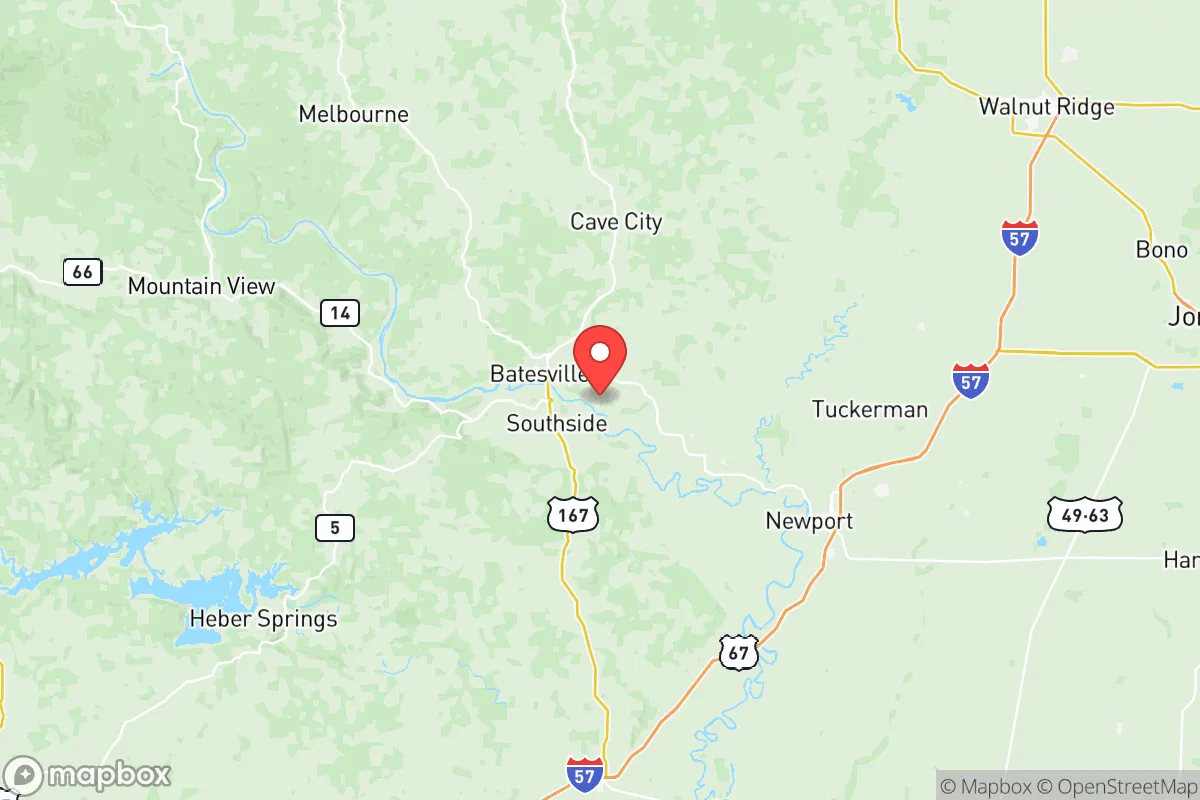
The people of Independence County, Arkansas today number 38,120, forming a predominantly white (82.9%) and native-born (97.7%) population with a small but growing Hispanic minority (8.7%). The county is anchored by the seat of Batesville (population ~11,000), with secondary population centers in Newark, Cushman, Sulphur Rock, and the historic river town of Oil Trough. Distinctive identity markers include a deep-rooted Southern Baptist and Methodist religious culture, a strong connection to the White River and its outdoor recreation, and a local economy still tied to agriculture, timber, and manufacturing rather than the fast-growing Northwest Arkansas corridor.
Settlement & growth (pre-1960)
Before American settlement, the area was home to the Osage and Quapaw nations, who used the White River valley for hunting and seasonal camps. The first European presence was French fur traders and trappers in the early 1700s, who established small posts along the White River, but no permanent settlements took hold until after the Louisiana Purchase. The first American settlers were Scots-Irish and English pioneers who arrived via the Tennessee and Mississippi river systems in the 1810s and 1820s, drawn by cheap land under the 1820 Land Act. They founded Batesville in 1821 as a river port and county seat, making it one of the oldest continuous settlements in Arkansas.
By the 1830s and 1840s, a second wave of settlers pushed into the interior, founding communities like Newark (originally called "New Ark"), Cushman, and Sulphur Rock. These were subsistence farmers and small-scale cotton planters, many bringing enslaved Black laborers with them. The 1860 census recorded a Black population of roughly 15% in the county, almost entirely enslaved. After the Civil War, many freedmen remained in the area, concentrating in small rural hamlets and on the outskirts of Batesville, where they worked as sharecroppers and tenant farmers. This post-war period also saw a small influx of German immigrants, who settled around the county seat and established truck farms and vineyards, though they never formed a large ethnic enclave like in central Texas.
The late 19th and early 20th centuries brought the railroad, which connected Batesville to the national rail network in the 1880s. This spurred modest industrial growth: cotton gins, sawmills, and a furniture factory. The railroad also brought a handful of Italian and Lebanese immigrant families to Batesville, who opened grocery stores and restaurants. However, the county remained overwhelmingly rural and agricultural through the 1940s. The Dust Bowl and Great Depression drove some Okie and Arkie families into the county, but the population actually declined between 1930 and 1950 as young people left for factory jobs in Memphis, St. Louis, and Detroit. By 1960, Independence County had about 24,000 residents, still 95% white and native-born, with a small Black population concentrated in Batesville's south side and the rural community of Floral.
Modern era (post-1965)
The 1965 Hart-Cellar Act had minimal direct impact on Independence County, as the area attracted almost no international immigration for decades. The foreign-born population today stands at just 2.3%, far below the national average. Instead, the major demographic shift since 1965 has been domestic: the slow outmigration of young adults to larger cities, offset by retirees and remote workers drawn to the White River's recreational appeal. The county's population grew from 24,000 in 1960 to 38,120 by 2024, a modest 59% increase over 64 years, compared to Arkansas's overall growth of 85% in the same period.
The most significant change has been the rise of the Hispanic population, which grew from near zero in 1990 to 8.7% today. This wave began in the late 1990s and accelerated after 2005, driven by labor demand in poultry processing (a major employer in Batesville) and construction. The Hispanic community is overwhelmingly Mexican-American, with smaller numbers from Central America, and is concentrated in Batesville's west side and in the unincorporated community of Magness. Unlike in many parts of Arkansas, this population has not dispersed widely across the county; it remains largely clustered in and around the county seat. The Black population, by contrast, has declined from its post-Civil War peak of roughly 15% to just 1.6% today, as younger generations left for better opportunities in Little Rock, Memphis, and beyond. The Asian population (0.8%) and Indian population (0.2%) are tiny and consist almost entirely of professionals employed at the county's two hospitals and the University of Arkansas Community College at Batesville.
Suburbanization has been limited. Batesville has expanded its city limits modestly, annexing land along Highways 167 and 25, but the county remains dotted with small, unincorporated communities like Oil Trough, Pleasant Plains, and Moorefield that have seen little new development. The biggest growth corridor is the stretch between Batesville and Newark, where a few subdivisions have gone up since 2010, catering to commuters who work in Batesville but want a rural home site. The county's college-educated share is only 16.9%, reflecting a workforce still heavily employed in manufacturing, agriculture, and retail rather than professional services.
The future
Independence County is likely to remain one of Arkansas's least diverse counties over the next 10-20 years. The Hispanic population will continue to grow slowly, potentially reaching 12-14% by 2040, driven by natural increase and continued labor demand in poultry and construction. However, the county's low college attainment rate and limited high-wage job base will continue to push young adults—especially the college-bound and the Black population—toward larger metros. The white population is aging: the median age in the county is 42, several years above the national median, and the 65+ cohort is the fastest-growing age group. This suggests that the county will become older, whiter, and more dependent on healthcare and retirement services in the coming decades.
New residential development will likely remain concentrated in Batesville's expanding fringe and along the Highway 167 corridor toward Newark, with scattered rural subdivisions for retirees and remote workers. The county's cultural identity—rooted in Southern Protestantism, hunting and fishing, and a suspicion of rapid change—will persist, though the growing Hispanic presence in Batesville is already diversifying the local restaurant scene and Catholic parish. The biggest wildcard is whether the University of Arkansas Community College at Batesville can attract more out-of-county students and faculty, which would be the most plausible source of new diversity. Without that, the county's demographic trajectory is one of slow, steady aging and modest Hispanic growth, with little change in the overall racial or ethnic makeup.
For someone moving in now, Independence County offers a stable, slow-paced, and culturally conservative environment where the population is older, less educated, and less diverse than the state or national average. The county is not becoming more cosmopolitan or diverse in any meaningful way; it is quietly aging in place, with the biggest changes being the gradual Hispanicization of Batesville's working class and the steady departure of young adults. It remains a place where roots run deep, newcomers are measured by their willingness to fit in, and the White River still defines the rhythm of life.

* Values derived from national, state, county, city and local statistics and may differ in a specific area. Last updated: 2026-06-22T03:30:56.000Z
Narrative content on this page is AI-generated and may contain mistakes. Verify any details that matter before acting on them.
ReloMaps may earn a commission from affiliate links at no extra cost to you.

