
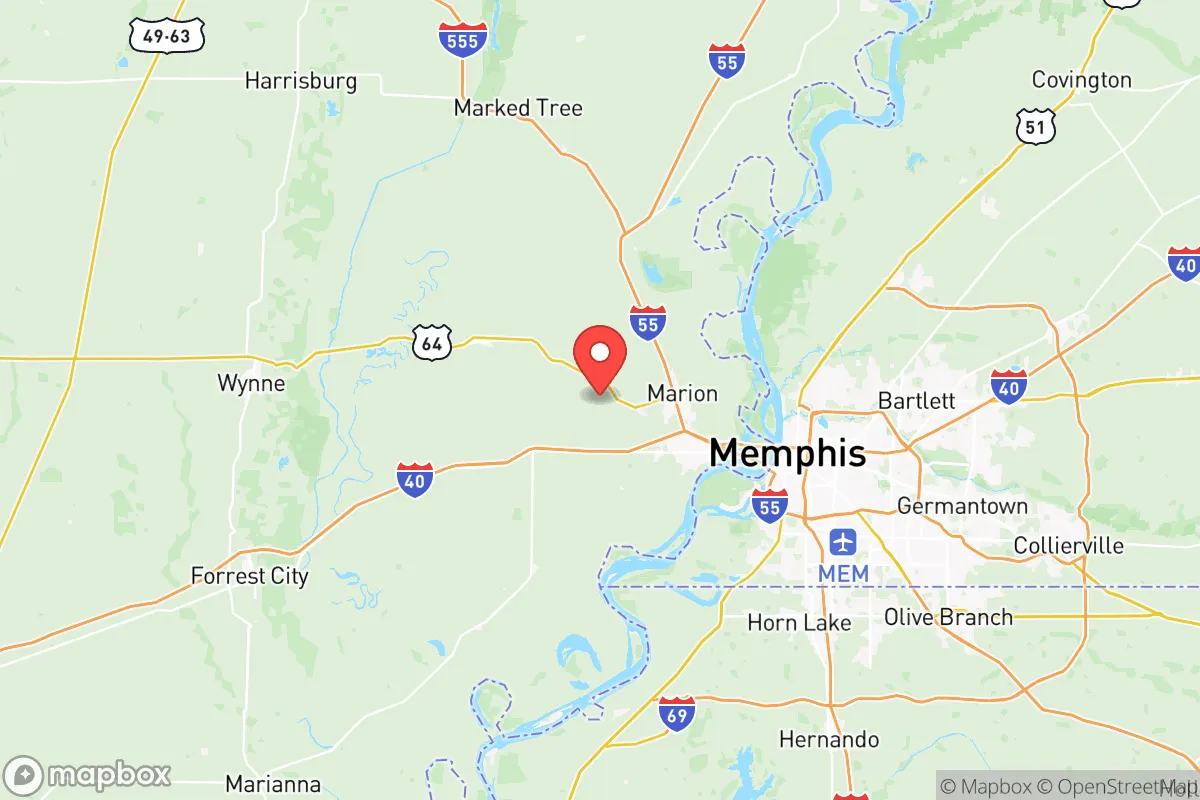
Photo: Wikipedia
Quality of Life in Crittenden County
A livable area that tracks near national norms for affordability, walkability, and neighborhood health.
What does Quality of Life tell us?
Quality of Life measures an area by evaluating factors like cost of living, nearby amenities, country club access, airport proximity, socioeconomic signals and neighborhood character. For large states, this is a general average — quality of life can vary dramatically between metro areas, suburbs, and rural communities within the same state.
What does this tell us?
Quality of Life measures an area by evaluating factors like cost of living, nearby amenities, country club access, airport proximity, socioeconomic signals and neighborhood character. For large states, this is a general average — quality of life can vary dramatically between metro areas, suburbs, and rural communities within the same state.
Cost of Living
32% below national average
123%
The Real Cost of Living in Crittenden County for 2026
| Tier | Individual | Family (4) |
|---|---|---|
| Survival | $14k | $26k |
| Comfortable | $30k | $44k |
| Luxury | $98k+ | $152k+ |
| Elite (Top 5%) | $118k+ | $183k+ |
Quality-of-Life Analysis
Crittenden County, Arkansas, offers a broad quality-of-life spectrum that ranges from the Mississippi River-oriented commerce of its largest city to the quiet, deeply rural farmlands and unincorporated communities that define much of its eastern and southern reaches. The county’s overall cost of living index of 68 (well below the US average of 100) and a median home value of $155,100 make it one of the more affordable places in the Memphis metro area, attracting a mix of Memphis commuters, agricultural workers, and retirees seeking space and lower expenses. The character of daily life shifts dramatically depending on whether one lives in the county’s primary population center, a smaller river town, or a sparsely populated rural pocket.
Largest town(s) & population centers
West Memphis is the county’s economic and demographic anchor, home to roughly 23,000 residents and the primary hub for retail, healthcare, and employment. Daily life here is shaped by its position as a border city just across the Mississippi River from Memphis, Tennessee, with a strong industrial and logistics base anchored by the Port of West Memphis and major distribution centers. The average commute of 22 minutes is notably shorter than the Memphis average, a practical advantage for residents who work locally in warehousing, manufacturing, or the service sector. West Memphis offers a range of housing from older, affordable bungalows near the river to newer subdivisions in the eastern parts of town, with median rent at $883 reflecting the lower cost of living. The city provides the county’s most concentrated amenities, including the West Memphis Municipal Airport, multiple grocery chains, and the Southland Casino Hotel, which draws visitors from across the region. Marion, immediately west of West Memphis, functions as a quieter, more suburban alternative with a population around 12,000, featuring newer schools, larger lots, and a growing retail corridor along Interstate 55. Many families choose Marion for its lower crime rates relative to West Memphis and its proximity to Memphis jobs via a 20-minute commute.
Smaller towns & rural pockets
Beyond the I-55 corridor, Crittenden County’s smaller communities offer a distinctly slower, more agricultural pace. Crawfordsville (population ~500) sits along Highway 64 in the county’s western farmlands, where life centers on local churches, the school, and the surrounding cotton and soybean fields. Earle (population ~2,300) is a historic railroad town with a compact downtown and a strong sense of community identity, though it has seen population decline and limited retail options. Turrell (population ~600) and Gilmore (population ~250) are unincorporated or small-town stops along the old rail lines, where residents often commute to West Memphis or Memphis for work. The most rural pockets lie in the county’s southern and eastern reaches, including the Mississippi River levee communities like Sunset and Clarkedale, where homes sit on large lots with direct access to hunting and fishing along the river bottomlands. These areas lack municipal services like public water and sewer in many cases, but offer land prices well below the county median home value of $155,100.
Cost & lifestyle range
The cost of living and lifestyle options in Crittenden County span a clear spectrum. At the higher end, Marion and the newer subdivisions of eastern West Memphis (such as the areas near Marion High School) see home values approaching $200,000–$250,000, with newer construction, sidewalks, and access to parks and the Marion Athletic Complex. Here, the cost of living remains well below the national average but is the highest in the county. At the lower end, Earle and Crawfordsville offer median home values often below $80,000, with many older homes needing renovation. Rent in these smaller towns can fall below $600 per month for a two-bedroom unit, though rental inventory is scarce. The lifestyle trade-off is clear: West Memphis and Marion provide jobs, shopping, and schools within a short commute, while the smaller towns and rural areas offer deep quiet, land, and a lower cost of entry but require longer drives for groceries, healthcare, and employment. The county’s average commute of 22 minutes reflects the fact that many residents live in the rural areas but work in the population centers.
Crittenden County is best suited for those who value affordability and proximity to Memphis above urban density or high-end amenities. Commuters who work in Memphis but want a lower cost of living and a yard will find Marion and West Memphis practical choices. Retirees, hunters, and farmers will gravitate toward the rural communities of Earle, Crawfordsville, and the levee areas, where land is cheap and neighbors are few. The county’s range of options—from the casino-lit riverfront of West Memphis to the silent soybean fields of Gilmore—means that almost any budget or lifestyle preference can find a fit, provided the trade-offs in services and commute are accepted.

Crime in Crittenden County
Crime rates similar to the national median for U.S. locations.
Violent CrimeViolent Crime Analysis
Property CrimeProperty Crime Analysis
Crime Analysis
Crittenden County, Arkansas, reports a violent crime rate of 525.4 per 100,000 residents and a property crime rate of 1,639 per 100,000, placing it among the higher-risk areas in the state. The county's proximity to Memphis, Tennessee, and its role as a regional transportation hub contribute to crime patterns that differ significantly from rural Arkansas averages. Residents in communities like West Memphis, the county seat and largest city, experience the bulk of reported incidents, while smaller towns such as Marion and Crawfordsville show notably lower crime densities.
Crime in context
Both of Crittenden County's key crime metrics exceed national and state benchmarks. The violent crime rate of 525.4 per 100,000 is roughly 45% higher than the national average and about 30% above the Arkansas state average. Property crime at 1,639 per 100,000 is similarly elevated, driven largely by theft and vehicle break-ins along the I-40 and I-55 corridors. For comparison, the statewide violent crime rate in Arkansas hovers near 400 per 100,000, while the national rate is approximately 380 per 100,000. The county's numbers are heavily influenced by West Memphis, where concentrated poverty, transient populations, and proximity to Memphis create conditions for higher incident counts. By contrast, Marion—a growing suburb just north of West Memphis—reports violent crime rates roughly half the county average, though property crime remains a concern due to its retail and residential density.
What residents experience
Daily life in Crittenden County varies sharply by jurisdiction. In West Memphis, residents frequently cite concerns about aggravated assault and robbery, with the police department responding to a disproportionate share of the county's violent incidents. The city's location as a trucking and logistics hub means property crime—especially theft from vehicles and commercial burglary—is a persistent issue. In Marion, the atmosphere is more suburban, with families reporting a stronger sense of security, though unlocked cars and package thefts remain common. Earle and Turrell, smaller rural communities, see far fewer total incidents but lack the police staffing levels of larger towns, meaning response times can be longer. A significant factor affecting public safety across the county is the judicial philosophy of the local district attorney and judges. The Second Judicial District, which covers Crittenden County, has in recent years seen progressive-leaning prosecutors and judges who prioritize diversion programs and reduced sentencing for non-violent offenders. While intended to reduce incarceration, this approach has drawn criticism from residents who argue it leads to repeat offenders cycling back onto the streets quickly, particularly in property crime cases. The result is a justice system that, while sympathetic to offenders, often leaves victims feeling underserved and the public exposed to higher recidivism rates.
Neighborhood-level variation is pronounced. Within West Memphis, areas east of I-55 near the Mississippi River tend to have higher violent crime concentrations, while newer subdivisions west of the interstate near the Marion border are safer. Marion's planned communities and school-adjacent neighborhoods consistently report the lowest crime rates in the county. For those considering relocation, Marion and the outskirts of West Memphis near the Crittenden County line offer the best balance of affordability and safety, while the core of West Memphis and isolated rural pockets near Horseshoe Lake warrant closer scrutiny of block-level crime maps.
* Values derived from national, state, county, city and local statistics and may differ in a specific area. Last updated: 2026-07-24T06:40:17.000Z
Narrative content on this page is AI-generated and may contain mistakes. Verify any details that matter before acting on them.
ReloMaps may earn a commission from affiliate links at no extra cost to you.

