

Photo: Wikipedia
Demographics of Crittenden County
Affluence Level in Crittenden County
A below-average socioeconomic profile. Incomes, home values, and educational attainment trail the U.S., with higher poverty and unemployment.
People of Crittenden County
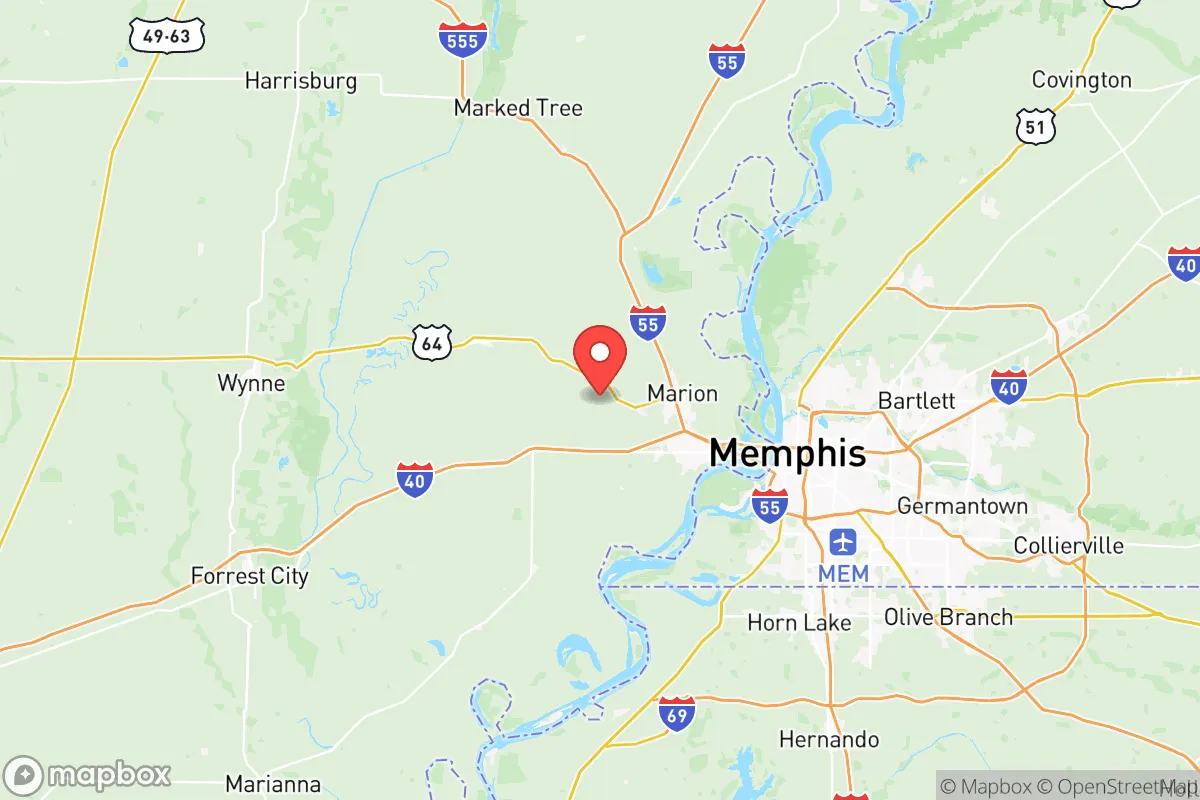
Crittenden County, Arkansas, is a predominantly Black-majority community of 47,609 residents, shaped by a deep agricultural history and its position as the eastern gateway to the state along the Mississippi River. The county’s population is 50.4% Black, 39.3% White, and 3.1% Hispanic, with a very small foreign-born share of just 1.1%. Its identity is rooted in the legacy of plantation-era settlement, the Great Migration, and a modern economy tied to Memphis, Tennessee, just across the river. For a conservative-leaning audience, Crittenden County represents a place where traditional Southern values persist, but where economic challenges and demographic shifts are reshaping daily life.
Settlement & growth (pre-1960)
Before American settlement, the area now known as Crittenden County was inhabited by the Quapaw and Chickasaw nations, who used the Mississippi River floodplains for hunting and seasonal camps. French explorers and trappers passed through in the 17th and 18th centuries, but no permanent European settlements took hold until after the Louisiana Purchase in 1803. The county was formally established in 1825, named after U.S. Attorney General Robert Crittenden, and its early economy was built entirely on cotton plantations worked by enslaved Black labor.
The first major wave of White settlers arrived from the Upper South—primarily Kentucky, Tennessee, and Virginia—in the 1820s through 1840s. These families, largely of Scots-Irish and English descent, established the county’s earliest towns: Marion (the county seat, founded 1836), Crawfordsville (1840s), and Earle (founded as a railroad town in the 1880s). They brought with them a slave-based agricultural system that defined the region until the Civil War. By 1860, enslaved people made up over 70% of the county’s population, a ratio that would leave a lasting demographic imprint.
After emancipation, many freed Black families remained in the county as sharecroppers and tenant farmers, concentrating in rural settlements like Turrell and Clarkedale. The post-Reconstruction era saw the rise of all-Black communities such as Horseshoe Lake, where African American landowners carved out independent farming enclaves. The Great Migration (1910–1970) drew many Black residents north to Chicago and St. Louis, but Crittenden County’s Black population remained substantial due to the continued dominance of cotton agriculture. Meanwhile, White settlement remained concentrated in Marion and the railroad town of West Memphis, which grew rapidly after the Memphis & Arkansas Bridge opened in 1929, connecting the county directly to Memphis.
By 1960, Crittenden County’s population was roughly 55% Black and 45% White, with virtually no other racial groups. The economy was still heavily agricultural, though West Memphis was emerging as a commercial and industrial hub, drawing workers from both sides of the river.
Modern era (post-1965)
The 1965 Hart-Cellar Act had minimal direct impact on Crittenden County, as the region never attracted significant international immigration. The foreign-born share remains just 1.1% today, far below the national average. Instead, the major demographic shift since the 1960s has been domestic: the continued outmigration of Black residents to Memphis and other urban centers, and a slower but steady influx of White residents moving from rural areas into West Memphis and Marion.
Suburbanization reshaped the county’s population geography. West Memphis grew from a small railroad town into the county’s largest city, with a population of about 25,000 today. It serves as a bedroom community for Memphis, attracting both Black and White families seeking lower housing costs and a slower pace of life. Marion has become the county’s most affluent and fastest-growing town, with new subdivisions drawing White families from Memphis and other parts of the Mid-South. The Hispanic population, while still small at 3.1%, has grown modestly since 2000, primarily in West Memphis and Marion, where workers have found jobs in logistics, warehousing, and construction tied to the Interstate 40 corridor.
The county’s racial composition has shifted gradually. The Black share has declined from roughly 55% in 1960 to 50.4% today, while the White share has held steady near 39%. The Asian population (East and Southeast Asian) is negligible at 0.6%, and the Indian subcontinent population is 0.1%. The college-educated share is just 17.2%, reflecting the region’s historical reliance on blue-collar and agricultural employment. The county’s cultural identity remains distinctly Southern and conservative, with strong church attendance, a focus on family, and a wariness of rapid change.
The future
Crittenden County’s population is projected to remain stable or decline slightly over the next decade, as outmigration of young adults to Memphis and other job centers continues. The county is becoming slightly more diverse, but primarily through the slow growth of the Hispanic population, which may reach 5–6% by 2035. The Black and White shares are likely to remain roughly equal, with no major influx of Asian or Indian residents expected due to the lack of high-skilled job opportunities.
Geographically, growth will concentrate in Marion and the western edge of West Memphis, where new housing developments cater to Memphis commuters. Rural communities like Turrell, Earle, and Crawfordsville will continue to lose population as young people leave for better economic prospects. The county’s cultural identity will remain rooted in its Black and White Southern heritage, with a growing Hispanic presence adding a new layer to the region’s character. For a conservative-leaning family moving in, Crittenden County offers affordable housing, a slower pace of life, and proximity to Memphis’s jobs and amenities—but also limited economic opportunity and a population that is slowly aging and shrinking.
Bottom-line: Crittenden County is a historically Black-majority, conservative Southern community that is slowly diversifying through Hispanic growth while losing population to outmigration. It remains a place where traditional values and a strong sense of place endure, but where economic stagnation and demographic stability—rather than boom—define the outlook. For someone moving in now, the county offers a low-cost, family-oriented lifestyle with deep roots, but limited upward mobility and a future that looks much like the present.

* Values derived from national, state, county, city and local statistics and may differ in a specific area. Last updated: 2026-07-24T06:40:17.000Z
Narrative content on this page is AI-generated and may contain mistakes. Verify any details that matter before acting on them.
ReloMaps may earn a commission from affiliate links at no extra cost to you.

