
Photo: Wikipedia
Political ClimatePolitical Climate in Crittenden County
Showing district-level results — no local-only data available.
Local Political AnalysisPolitical Analysis of Crittenden County
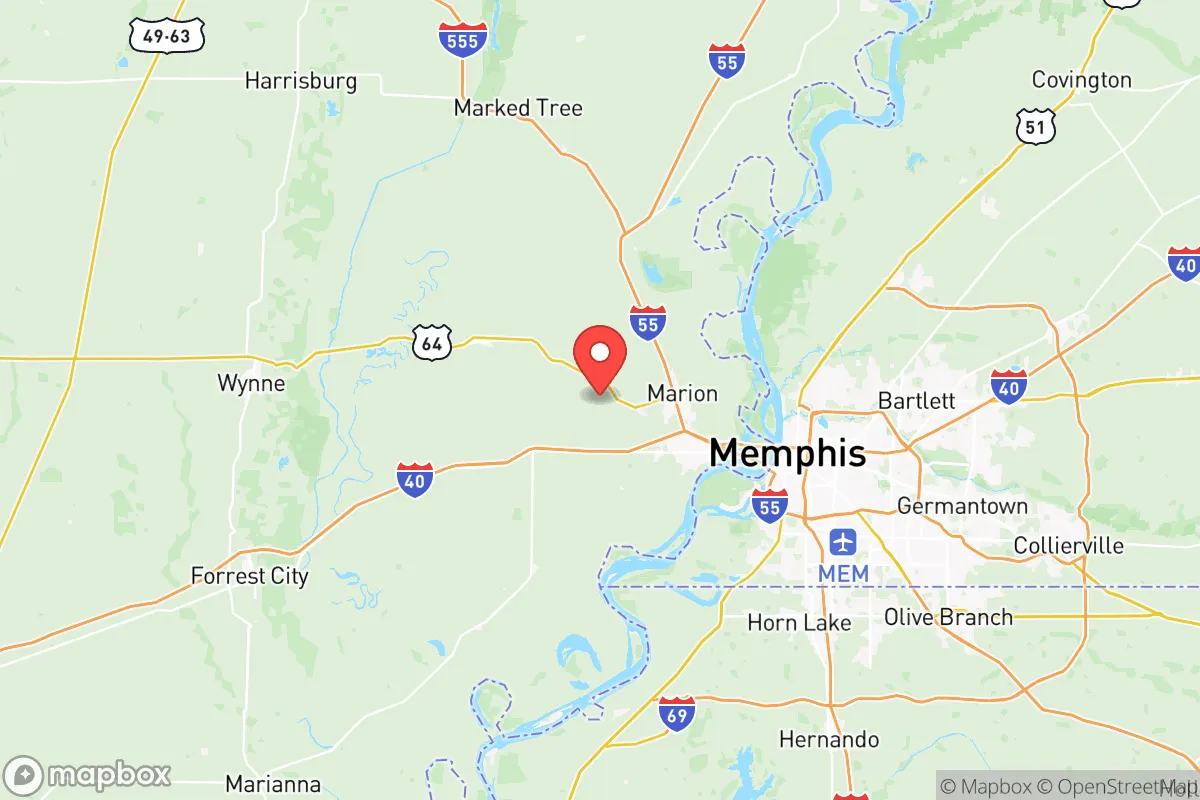
Crittenden County is a deep red stronghold in eastern Arkansas, carrying a Cook Partisan Voting Index of R+23, which is a full seven points more conservative than the state of Arkansas as a whole (R+16). This isn't a recent shift; the county has been reliably Republican in presidential elections for over a decade, with the margins widening each cycle. The 2024 results saw the GOP candidate winning by roughly 30 points, a trend that mirrors the broader realignment of rural, white, working-class voters across the Delta region. However, the county's politics are not monolithic—there's a meaningful Democratic presence concentrated in the majority-Black city of West Memphis, where local elections often flip blue, and in smaller communities like Marion, which has a more mixed voting pattern. The swing precincts are typically found in the unincorporated areas around Turrell and Earle, where economic anxiety and local issues can override party loyalty.
How it compares
Compared to the rest of Arkansas, Crittenden County is both more conservative and more racially polarized in its voting behavior. The state's R+16 PVI already places it among the most Republican states in the country, but Crittenden's R+23 reflects a deeper entrenchment. For context, the state's largest metro areas—Little Rock and Fayetteville—are more moderate, with PVIs around R+10 and R+12 respectively. In Crittenden, the rural precincts outside of West Memphis vote at rates similar to the most conservative counties in the Ozarks, while the urban core of West Memphis votes like a mid-sized Southern city with a strong Black electorate. This creates a sharp urban-rural divide within the county that is more pronounced than in most of Arkansas. The county's Republican dominance is also driven by a strong evangelical presence and a local GOP apparatus that has been active for decades, unlike some neighboring counties where the shift to the right is more recent.
What this means for residents
For conservative residents, the political climate means their values are reflected in local governance—school board policies, zoning decisions, and law enforcement priorities tend to align with traditional Republican platforms. There's little friction in daily life for a Republican voter; the county commission, sheriff's office, and most city councils are reliably conservative. For liberal residents, especially those in West Memphis, the reality is more nuanced. While they can win local offices in their own precincts, they have little influence over county-wide policy or state legislative representation. This can feel isolating, but it also means that progressive activism is often hyper-local, focused on neighborhood issues like infrastructure, public health, and education funding. The practical effect is that political conversations in Crittenden County are less about national culture wars and more about the local economy—specifically, the decline of manufacturing, the challenges of the Mississippi River shipping industry, and the need for better schools.
Culturally, Crittenden County is distinct from the rest of Arkansas in its strong ties to Memphis, Tennessee. Many residents commute across the bridge for work, entertainment, and healthcare, which means the county's political identity is shaped as much by Tennessee's politics as by Arkansas's. This cross-state influence softens some of the hard edges of Arkansas conservatism, particularly on economic issues like taxes and business incentives. Policy-wise, the county has been a testing ground for school choice initiatives and rural broadband expansion, both of which have bipartisan support locally. The biggest distinction, however, is the county's relationship with the Mississippi River—flood control, levee maintenance, and port development are nonpartisan issues that dominate local politics in a way they don't in the rest of the state. Looking ahead, the county's political trajectory is likely to remain deeply conservative, but the growing Hispanic population in Crawfordsville and Hughes could introduce new political dynamics within a decade, especially around immigration and labor policy.

State Political ClimatePolitical Climate in Arkansas
State Political AnalysisPolitical Environment in the State
Arkansas is a solidly Republican state with a Cook PVI of R+16, meaning it votes about 16 points more Republican than the national average in presidential elections. This wasn't always the case — as recently as the 1990s, Arkansas was a Democratic stronghold, but a dramatic realignment over the past 20 years has turned it into one of the most reliably red states in the South. The shift is driven by a combination of cultural conservatism, a growing evangelical population, and the collapse of the old "Dixiecrat" coalition that once dominated local politics.
Urban vs. rural divide
The political map of Arkansas is starkly divided between its few urban centers and the vast rural expanse. The state's two major metros — Little Rock (Pulaski County) and Fayetteville-Springdale-Rogers (Washington and Benton counties) — are the only real blue or purple areas. Pulaski County, home to the capital, has voted Democratic in every presidential election since 2000, though its margins have narrowed. The Northwest Arkansas corridor, anchored by the University of Arkansas in Fayetteville and the corporate headquarters of Walmart and Tyson Foods, is a fascinating mix: Benton County is reliably red, but Washington County (Fayetteville) has trended blue in recent cycles, especially in local races. Meanwhile, the rest of the state is deeply Republican. Counties like Boone (Harrison), Faulkner (Conway), and Saline (Benton) routinely deliver 70-80% of the vote for GOP candidates. The Mississippi Delta region in the east, once a Democratic stronghold due to its large Black population, has seen its political influence shrink as population has declined, though it still leans Democratic in local contests.
Policy environment
Arkansas's policy environment is a textbook example of conservative governance. The state has a flat income tax that was recently cut from 4.9% to 4.4%, with a goal of reaching 3.9% by 2027. Sales tax is around 6.5% at the state level, but local add-ons can push it to 9% or higher in some cities. There is no state property tax, but local property taxes fund schools and counties. The regulatory posture is business-friendly, with right-to-work laws and a tort reform system that caps non-economic damages in medical malpractice cases. Education policy is a hot topic: the state has a robust school choice program, including the Arkansas LEARNS Act (2023), which created universal Education Savings Accounts (ESAs) for private school tuition and expanded charter schools. Healthcare is a mixed bag — Arkansas expanded Medicaid under the Affordable Care Act (the "Private Option"), but the state has also imposed work requirements for able-bodied adults. Election laws are restrictive: voter ID is required, early voting is limited to 15 days, and absentee voting requires an excuse. The state has also passed laws banning ballot drop boxes and limiting mail-in ballot applications.
Recent policy direction
Arkansas has moved aggressively to the right in the last five years, especially on cultural and liberty issues. On gun and self-defense law, the state passed constitutional carry (permitless carry) in 2021, and there is no waiting period or magazine capacity limit. Parental and education rights are a major focus: the LEARNS Act also banned "critical race theory" and "indoctrination" in public schools, and a 2023 law requires schools to notify parents of any changes to a student's "mental, emotional, or physical health" — effectively a parental notification requirement for transgender students. Speech and privacy are protected by a 2023 law that prohibits social media platforms from censoring users based on political viewpoints, though it's currently tied up in court. On medical and bodily autonomy, Arkansas has one of the strictest abortion bans in the country — a near-total ban with no exceptions for rape or incest, only to save the mother's life. The state also passed a law in 2023 banning gender-affirming care for minors, which is also being challenged in court. Property rights are strong, with no statewide zoning and a "right to farm" law that protects agricultural operations from nuisance lawsuits. Taxation is trending downward: the 2023 income tax cut was the third in four years, and the state has eliminated the grocery tax. Voting and ballot access have tightened: a 2021 law shortened the absentee ballot application window and banned unsolicited mail-in ballot applications.
Civil unrest & political movements
Arkansas has not seen the kind of large-scale civil unrest seen in larger states, but there are flashpoints. The Black Lives Matter protests in Little Rock in 2020 were relatively small and peaceful compared to other cities, but they did lead to a local debate over Confederate monuments — the state removed a statue of a Confederate soldier from the Capitol grounds in 2020. Immigration politics are less visible here than in border states, but there is a vocal anti-immigrant faction, especially in the rural northwest. The town of Marshall (Searcy County) made headlines in 2023 for passing a resolution declaring itself a "Second Amendment Sanctuary" and opposing federal gun laws. The Walmart family (the Waltons) has a significant political influence, funding both conservative and moderate causes, including charter schools and criminal justice reform. Election integrity controversies have been minimal — the state's 2020 election was certified without major disputes, though the legislature did pass the 2021 voting restrictions in response to "concerns" about mail-in voting. There is a small but active secessionist movement in the Ozarks, but it's fringe and not taken seriously.
Projection
Over the next 5-10 years, Arkansas is likely to remain solidly Republican, but the demographic shifts in Northwest Arkansas could create a more competitive dynamic. The Fayetteville-Springdale-Rogers corridor is growing rapidly, attracting young professionals and out-of-state transplants drawn by the low cost of living and job opportunities. This area is becoming more moderate and even slightly liberal on social issues, which could eventually turn Washington County into a swing county. Meanwhile, the rural areas are aging and shrinking, which will only deepen their Republican lean. The state's tax cuts are likely to continue, possibly reaching a zero income tax rate within a decade, which would further attract retirees and remote workers. However, the state's education and healthcare challenges — low rankings in both — could limit long-term growth. A new resident moving in now should expect a state that is politically stable, culturally conservative, and increasingly focused on economic growth, but with a growing urban-rural tension that could lead to more local political battles.
For a new resident, the bottom line is this: Arkansas offers a low-tax, low-regulation environment with strong protections for gun rights, parental control in education, and religious liberty. Conservative residents will find a state that largely aligns with their values, with a government actively pushing those policies. Liberal residents will find a state where their views are in the minority, but they can find like-minded communities in Little Rock and Fayetteville, and the state's politics are unlikely to change dramatically in the near term. The key practical takeaway is that Arkansas is a place where your personal freedoms — especially around property, guns, and education — are broadly protected, but your social freedoms, particularly around reproductive rights and LGBTQ+ issues, are heavily restricted. If you're looking for a state where the government stays out of your business and your wallet, Arkansas delivers. If you're looking for a place with a vibrant progressive scene and expansive social services, you'll want to look elsewhere.
* Values derived from national, state, county, city and local statistics and may differ in a specific area. Last updated: 2026-07-24T06:40:17.000Z
Narrative content on this page is AI-generated and may contain mistakes. Verify any details that matter before acting on them.
ReloMaps may earn a commission from affiliate links at no extra cost to you.

