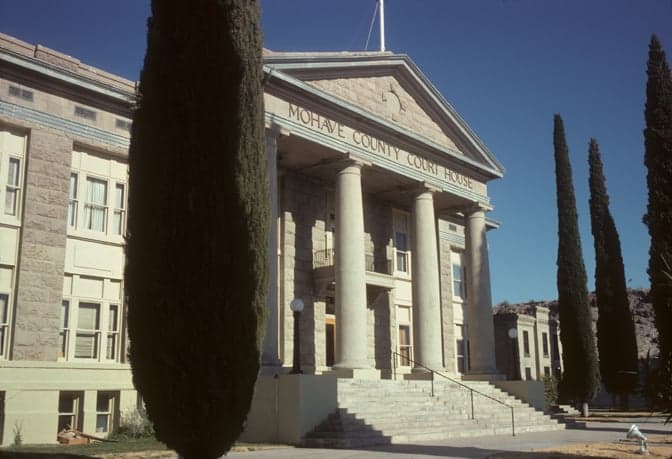
Photo: Wikipedia
Political ClimatePolitical Climate in Mohave County
Showing district-level results — no local-only data available.
Local Political AnalysisPolitical Analysis of Mohave County
Mohave County is one of the most reliably Republican strongholds in Arizona, with a Cook Partisan Voting Index (PVI) of R+7, meaning it votes about seven points more conservative than the national average. That’s a stark contrast to the state of Arizona as a whole, which sits at EVEN on the PVI—a pure swing state that flipped blue for president in 2020 and has been hotly contested ever since. The county’s GOP tilt is deeply entrenched, but it’s not a monolith; the political reality varies noticeably from the Colorado River towns to the high desert interior, and that variation tells you a lot about what life is like here for both conservatives and liberals.
How it compares
The gap between Mohave County and statewide Arizona is enormous in practice. While Maricopa County (Phoenix) and Pima County (Tucson) drive the state’s purple-to-blue lean, Mohave County reliably delivers 70–75% of its vote to Republican candidates in presidential and Senate races. In 2024, Donald Trump carried the county by roughly 30 points, even as the statewide margin was much tighter. But look closer at the map and you’ll see real variation. Lake Havasu City and Bullhead City are the reddest anchors—both are retirement-heavy, with strong gun-rights and anti-tax sentiment, and they routinely vote 75%+ GOP. Kingman, the county seat, is slightly more moderate but still solidly red, with a working-class base that leans conservative on economics but can be populist on trade and immigration. The swing precincts are in the unincorporated areas around Golden Valley and Meadview, where libertarian-leaning independents sometimes split tickets. The only place you’ll find a noticeable blue pocket is Oatman, a tiny historic mining town with a handful of progressive transplants, but it’s too small to move the needle. Meanwhile, statewide, places like Flagstaff and Tucson are reliably blue, and Phoenix suburbs like Chandler and Scottsdale are now purple—a world away from Mohave’s political culture.
What this means for residents
For conservatives, Mohave County is a comfortable place to live politically. Local offices—county supervisors, sheriff, school board—are almost uniformly held by Republicans, and policy leans heavily toward low taxes, limited regulation, and Second Amendment rights. The county has a strong “constitutional sheriff” tradition, and you’ll see “Don’t Tread on Me” flags flying alongside American ones. For liberals, the reality is more isolating. There’s no active Democratic Party infrastructure in most towns; the nearest Democratic club meetings might be a 90-minute drive to Prescott or Flagstaff. Socially, progressive residents often keep their politics private to avoid friction, especially in smaller communities like Dolan Springs or Topock. That said, the county’s libertarian streak means most people respect live-and-let-live attitudes on personal lifestyle choices, as long as you don’t push for government intervention. The practical effect is that public discourse skews heavily right, but daily life is generally civil—neighbors help neighbors regardless of party.
Culturally, Mohave County stands apart from the rest of Arizona in a few key ways. The county’s economy is driven by tourism (Lake Havasu, the Colorado River), retirement communities, and a growing logistics sector around Kingman’s industrial parks—not the tech or aerospace industries that fuel Phoenix’s growth. That economic base reinforces a more traditional, blue-collar conservatism. Policy-wise, the county has been a battleground over water rights and land use, with local officials often clashing with state and federal environmental regulations. You’ll hear more talk about “federal overreach” and “Bureau of Land Management restrictions” here than in Maricopa County. For newcomers, the biggest adjustment is the pace: political debates are slower, more personal, and less polarized than the cable-news shouting matches you get in Phoenix. It’s a place where your vote is almost certainly not going to decide a statewide race, but your voice still matters at the local level—especially if you’re willing to show up to a county supervisor meeting in Kingman.

State Political ClimatePolitical Climate in Arizona
State Political AnalysisPolitical Environment in the State
Arizona is a pure swing state in 2026, carrying a Cook Partisan Voting Index of EVEN, meaning it votes almost identically to the national average in presidential elections. Over the past 20 years, it has shifted from a reliably Republican stronghold (it voted GOP in every election from 1952 to 2016 except 1996) to a fiercely competitive battleground, driven by massive population growth in Maricopa County and an influx of voters from blue states and from Latin America. The coalitions are split roughly in thirds: a solid Democratic base anchored in Phoenix, Tucson, and Flagstaff; a Republican base concentrated in the suburban “exurbs” like Maricopa County’s East Valley (Mesa, Gilbert, Chandler) and rural counties; and a fast-growing independent bloc (now roughly 35% of registered voters) that decides every close race.
Urban vs. rural divide
Pima County (Tucson) has been reliably Democratic for decades, but the real story is Maricopa County, home to nearly 60% of the state’s population. Maricopa was a Republican bastion through the 2000s, but it flipped to Biden in 2020 by about 2 points and has stayed competitive ever since. The divide within Maricopa is stark: the urban core of Phoenix and its inner-ring suburbs (Tempe, Scottsdale’s southern parts) lean left, while the fast-growing East Valley suburbs (Mesa, Chandler, Gilbert) remain conservative but are trending purple, especially among younger families. The state’s rural counties—Yavapai (Prescott), Mohave (Kingman/Lake Havasu City), and Cochise (Sierra Vista)—vote Republican by 20–40 points. Meanwhile, Flagstaff in Coconino County and Sedona in Yavapai are small blue islands, driven by tourism and Northern Arizona University.
Policy environment
Arizona’s policy environment is a hybrid of conservative fiscal governance and mixed social stances. The state has a flat income tax rate of 2.5% (enacted in 2022 via Proposition 146 from the state legislature), one of the lowest in the country, and no estate tax. Sales tax averages around 5.6% state-level, with local add-ons varying by city (Phoenix is 8.6%, Tucson 8.7%). Property taxes are moderate, assessed at roughly 0.6% of home value. Business regulation is light—Arizona is a right-to-work state and has no corporate income tax on some pass-through entities. Education policy is a flashpoint: the state’s powerful universal school voucher program (Empowerment Scholarship Account, expanded to all students in 2022) is the most expansive in the nation, but public school funding per pupil remains near the bottom nationally (around $10,000 per student). Healthcare: Arizona expanded Medicaid (AHCCCS) under the Affordable Care Act in 2013, and roughly 20% of residents rely on it. Election laws are a national battleground: the state requires voter ID at the polls (not just for registration), has permanent early voting lists (nearly 80% of ballots are cast by mail), and conducted a full hand-count audit of 2020 ballots in Maricopa County after the election, which confirmed Biden’s win. Abortion access is currently legal up to 15 weeks (a 2022 law), but a near-total ban from 1864 was struck down by the state Supreme Court in 2024, leaving the 15-week limit in place.
Recent policy direction
Arizona’s recent legislative sessions have swung right on some fronts and stayed moderate on others. On gun rights: permitless carry (constitutional carry) was signed into law in 2024, allowing anyone over 21 to carry a concealed firearm without a permit—a major win for the 2A community. On parental and education rights: the 2022 expansion of universal vouchers gave every family a public-funded alternative to public schools, with no income cap, which has been heavily pushed by conservative groups. On speech and privacy: the state passed a social media content moderation law in 2022 (HB 2616) that barred platforms from removing posts based on viewpoint, but it was blocked by the courts as unconstitutional; similar debates continue. On medical and bodily autonomy: the 2022 15-week abortion ban went into effect, and a 1864 territorial ban was repealed in 2024 after a legal fight, meaning the current status quo is more moderate than many neighboring states but still restrictive compared to the West Coast. On property rights: Arizona is a strong “non-disclosure” state for property sales data (only the buyer and seller know the exact price), which is favored by the real estate lobby. On voting and ballot access: the state legislature passed a law in 2024 (HB 2700) that tightened signature verification on mail-in ballots, requiring a matching signature or a second form of ID—a move backed by election integrity advocates and criticized by voting rights groups as a burden. Overall, the direction is a moderate-right tilt, but the independent median voter keeps any extreme swings in check.
Civil unrest & political movements
Arizona has been a national epicenter of activism on both sides. The 2020 election aftermath saw the “Audit the Vote” movement centered in Phoenix, with a full hand-count audit of Maricopa County’s 2.1 million ballots that lasted months and became a partisan flashpoint. Immigration politics are constant: the state was the home of SB 1070 (2010’s “show me your papers” law), and in 2024, voters approved Proposition 314, a state-level law that criminalizes unauthorized entry into Arizona from Mexico, modeled after Texas’s SB 4—though it’s currently blocked in court. Organized left-wing activism is visible in Phoenix and Tucson, with regular marches for abortion rights and immigrants’ rights. Right-wing groups, including the Arizona Freedom Alliance and local Tea Party remnants, are well-funded and active in school board races and county-level politics. A Janus-faced reality: Tucson has declared itself a “sanctuary city” (though state law preempts it), while Cochise County on the border has a significant militia presence. No serious secession talk, but Pinal County (between Phoenix and Tucson) has seen debates about splitting into a new county or merging with neighboring areas over disputes about “alienated” rural voters.
Projection
Over the next 5–10 years, Arizona’s trajectory is toward purple permanence. In-migration from California (net 100,000+ annually pre-2023, now slightly less) continues to bring more independents and moderate Democrats, while native-born Arizonans in rural areas remain deep red but are shrinking as a share of the population. Maricopa County is likely to stay competitive, possibly trending slightly left as denser infill development continues and younger families move into Chandler and Gilbert. The 2024 presidential election saw Trump only win Arizona by 2.6 points (down from his 2016 margin of 3.5), so the state will be a toss-up for the foreseeable future. On policy, the trend is likely toward more moderate fiscal conservatism (lower taxes, lighter regulation) but continued fights on social issues—abortion and education vouchers will stay as referenda-level battles. The independent voter majority will push both parties toward the center, meaning a relocator can expect no dramatic swings in either direction, but a constant low-grade political noise on every issue.
For a newcomer, the bottom line is that Arizona’s politics are a bundle of contradictions: low taxes and light regulation live alongside fiercely contested social issues and high civic engagement. A conservative relocator will find gun-friendly laws, school choice, and a growing network of like-minded suburban communities (Mesa, Prescott). A liberal relocator will find blue enclaves in Phoenix and Tucson with strong labor unions and public transit fights, plus a state that legalized medical marijuana in 2010 and recreational in 2020. The practical takeaway: you can live comfortably with your political views here no matter which side you’re on, but you’ll hear about the other side every day. Be prepared to vote—your ballot truly matters in this state, more than in almost any other in America.
* Values derived from national, state, county, city and local statistics and may differ in a specific area. Last updated: 2026-06-23T07:01:52.000Z
Narrative content on this page is AI-generated and may contain mistakes. Verify any details that matter before acting on them.
ReloMaps may earn a commission from affiliate links at no extra cost to you.

