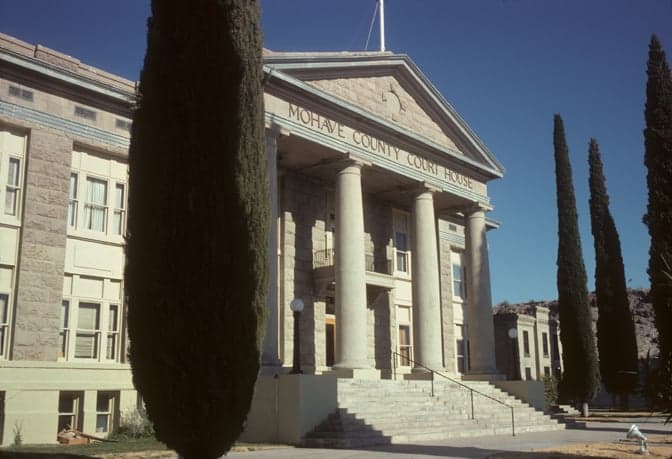
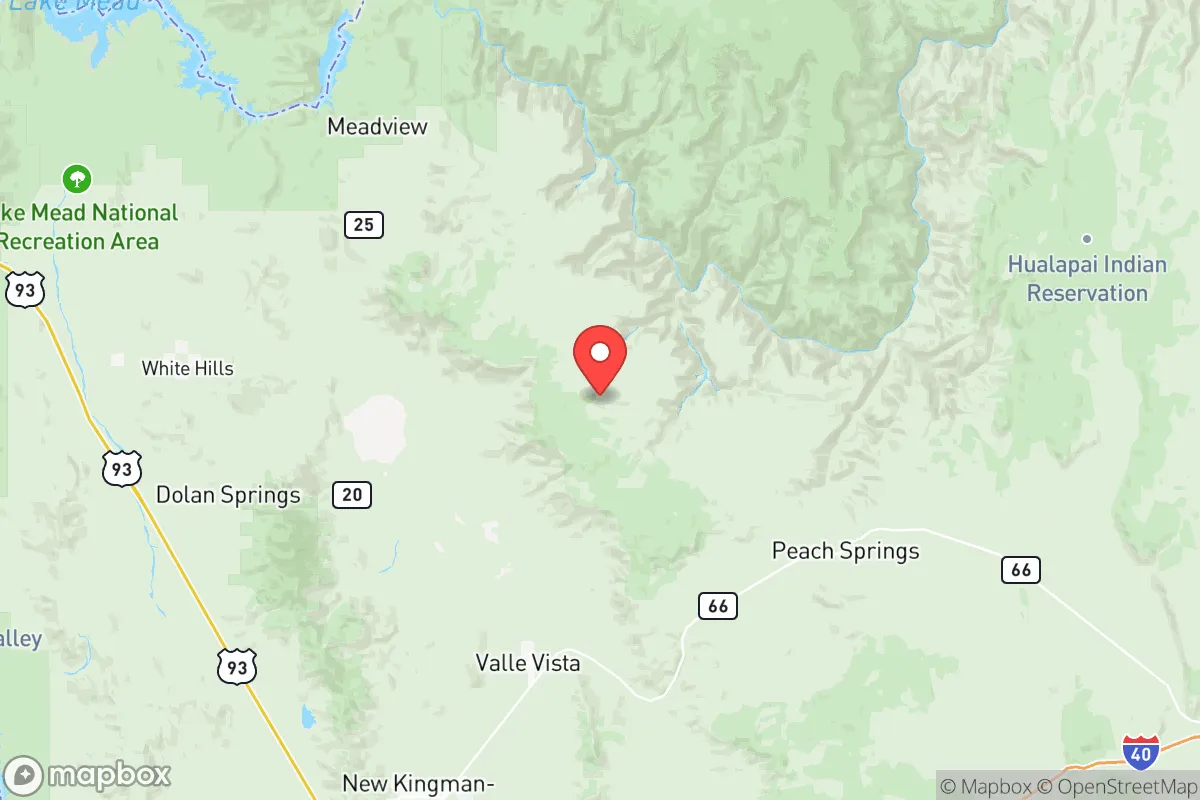
Photo: Wikipedia
Demographics of Mohave County
Affluence Level in Mohave County
A middle-class area roughly in line with national averages across income, home values, education, and employment.
People of Mohave County
Mohave County, Arizona is home to roughly 217,400 residents, making it one of the state’s more sparsely populated regions despite its vast size. The population is predominantly white (75.6%) with a significant Hispanic minority (16.7%), a very small foreign-born share (2.4%), and a notably low proportion of college graduates (14.9%). This is a region shaped by extraction industries, retirement migration, and border-state cultural influences, where a libertarian-leaning, self-reliant ethos remains strong and where population growth has been driven more by domestic relocations than by international immigration.
Settlement & growth (pre-1960)
The human history of Mohave County begins with its namesake, the Mojave people, whose ancestral lands spanned the Colorado River corridor. For centuries, the Mojave (along with the Hualapai and Paiute peoples) practiced floodplain agriculture along the river and maintained extensive trade networks across the Southwest. Contact with Spanish explorers began sporadically in the 17th century, but the region did not see sustained European settlement until after the 1848 Treaty of Guadalupe Hidalgo and the 1854 Gadsden Purchase, which brought the area under full U.S. control.
The first major non-Native wave arrived during the 1850s and 1860s, drawn by the discovery of gold, silver, and copper in the mountains east of the Colorado River. Boomtowns like Oatman (gold, 1906-1920s) and Chloride (silver, 1860s-1900s) sprang up almost overnight, attracting Anglo-American prospectors from California and the upper Midwest, as well as a smaller number of Mexican and Chinese laborers who worked deeper mines and constructed railroads. The Arizona & California Railroad, completed through the county in the 1900s, brought additional workers, including a small contingent of Italian and Irish track layers who settled in Kingman, which became the county seat in 1887. By 1920, Kingman had roughly 1,200 residents, mostly Anglo-American with a thin layer of European immigrant extraction.
World War II brought the second transformative wave. The 1942 construction of the Kingman Army Airfield (now Kingman Airport) drew thousands of servicemen and support workers to the area, many of whom stayed after the war. Simultaneously, the establishment of the Lake Mead National Recreation Area (1947) and the later damming projects on the Colorado River spurred preliminary tourism infrastructure. But it was the post-1950s uranium boom around Hackberry and Valentine that anchored the mid-century economy, pulling in more Anglo-American miners from the Southwest and Appalachia. These workers were overwhelmingly white, Protestant, and politically conservative, setting a demographic tone that persists today.
Native Americans, however, were largely marginalized during this period. The Fort Mojave Indian Reservation, established on the California-Nevada-Arizona border in 1870, concentrated Mojave people away from the growing white settlements of Kingman and Bullhead City. By 1960, the county’s population remained around 7,000, overwhelmingly Anglo-American, with a small Hispanic population concentrated in border-side farming areas like Topock.
Modern era (post-1965)
Mohave County’s modern demographic story is one of domestic in-migration rather than the waves of post-1965 international immigration that reshaped urban America. The 1965 Hart-Cellar Act had minimal direct impact here; the county’s foreign-born population stands at just 2.4%, far below the national average. Instead, the explosive growth came from Sun Belt relocation: starting in the 1970s, retirees from the Midwest and Pacific Northwest began migrating to the Colorado River corridor, drawn by low property taxes, warm winters, and recreation opportunities. Bullhead City (population 40,000 today) grew from a tiny river hamlet to a major retirement and service hub, while Lake Havasu City (also in Mohave County) became a destination for boating and part-year residents.
The 1980s and 1990s intensified this trend, with a second domestic wave: working-class families leaving California’s rising housing costs for Mohave County’s affordability. This "California exodus" was especially pronounced in Kingman, where the population roughly tripled between 1980 and 2020. These new arrivals were themselves predominantly white and, to a lesser extent, Hispanic, reinforcing rather than diversifying the county’s demographics. Today, Hispanic residents make up 16.7% of the population, a share that has grown steadily but remains moderate—anchored in communities like San Luis and Somerton on the border, and within Kingman and Bullhead City’s service economies.
Notably, Black (1.1%), East/Southeast Asian (1.0%), and Indian subcontinent (0.1%) populations remain minuscule, reflecting the absence of the immigrant-attracting industries—tech, higher education, professional services—that drive diversity in Phoenix and Tucson. What diversity does exist is overwhelmingly Hispanic, concentrated in the Kingman elementary school zones and the Bullhead City construction and hospitality sectors. The downtown Kingman area, along Beale Street, has become a small hub for Hispanic-owned businesses serving a growing second-generation population.
The future
Mohave County is projected to continue growing, though at a slower pace than earlier decades. The population will likely become slightly more Hispanic, as younger Hispanic families have higher birth rates and as some Mexican-national workers continue to enter the border economy, but the county will almost certainly remain overwhelmingly white for the foreseeable future. The real driver of change will be continued domestic relocation from California and the Pacific Northwest, where housing costs and politics are pushing more conservative-leaning families inland—a flow that has accelerated since 2020.
New master-planned communities on the outskirts of Kingman and Bullhead City, such as the Kingman Crossing development, are designed to attract exactly these relocators: white, middle-income, often retired or remote-working, and culturally conservative. Meanwhile, the small Native American population on the Hualapai and Mojave reservations is growing slowly but remains geographically and economically separate, concentrated in Peach Springs and the Fort Mojave Reservation. The county will not become a major destination for international immigrants—it lacks the job base and infrastructure—meaning that its cultural identity will remain rooted in a blend of Western pioneer heritage, border-state Hispanic influence, and retiree-leisure economy.
For someone moving in now, Mohave County offers an increasingly residential, relatively affordable slice of rural Arizona where the pace of life is slow, the politics lean libertarian-conservative, and the population is largely white and native-born. The county’s future, demographically, is not one of transformation but of modest, incremental growth—more of the same people, with a slowly rising Hispanic presence, in the same river-and-desert towns that have defined it since the mid-20th century.

* Values derived from national, state, county, city and local statistics and may differ in a specific area. Last updated: 2026-06-23T07:01:52.000Z
Narrative content on this page is AI-generated and may contain mistakes. Verify any details that matter before acting on them.
ReloMaps may earn a commission from affiliate links at no extra cost to you.

