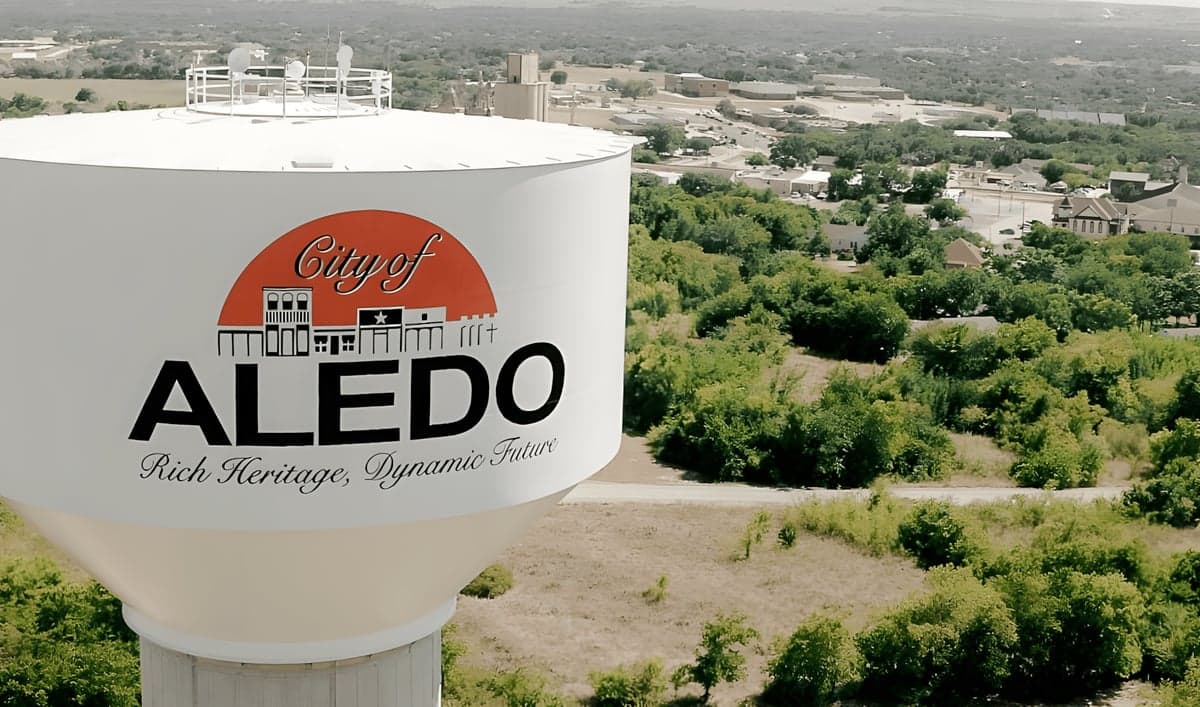
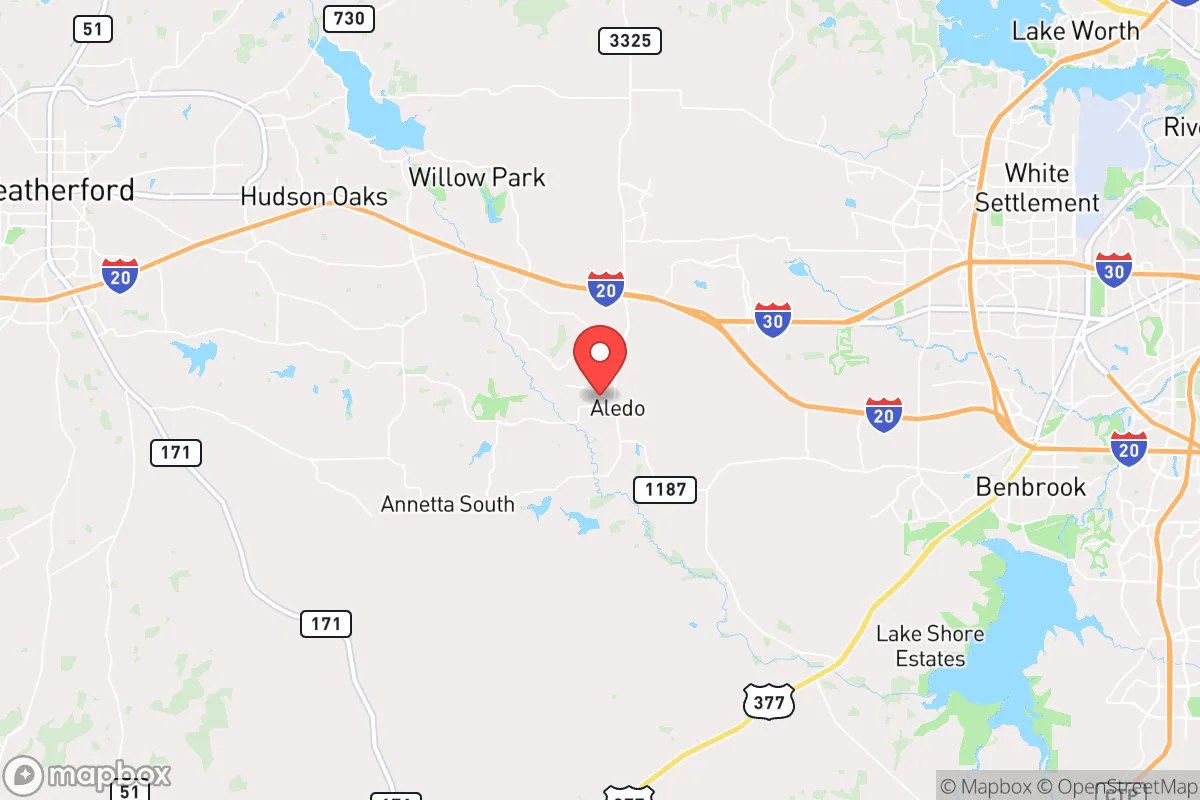
Strategic Assessment of Aledo, TX
Meaningful friction. Expect exposure to either population pressure, blast zones, or natural disaster risk. Consider buying a retreat property.
What does the Strategic Assessment tell us?
Our Strategic Assessment grades tactical survivability of an area. Major population centers, military targets, fallout zones, natural disasters, and border exposure all drive risk — lower exposure means a more defensible position in a crisis.
This is heavily inspired by Joel Skousen's Strategic Relocation book. Highly recommended you checkout the book ($)What does this tell us?
Our Strategic Assessment grades tactical survivability of an area. Major population centers, military targets, fallout zones, natural disasters, and border exposure all drive risk — lower exposure means a more defensible position in a crisis.
This is heavily inspired by Joel Skousen's Strategic Relocation book. Highly recommended you checkout the book ($)Strategic Pillars

Key Distances
Regional Safe Places
Below is our recommended "safe zones" in Texas and the surrounding area based on our strategic heuristics. For most people, it's unrealistic to live in a “safe zone” full-time due to work, family or other personal reasons. They tend to be more rural. However, many of these areas are perfect for second homes and retreat properties that double as a vacation home or even a short-term rental.

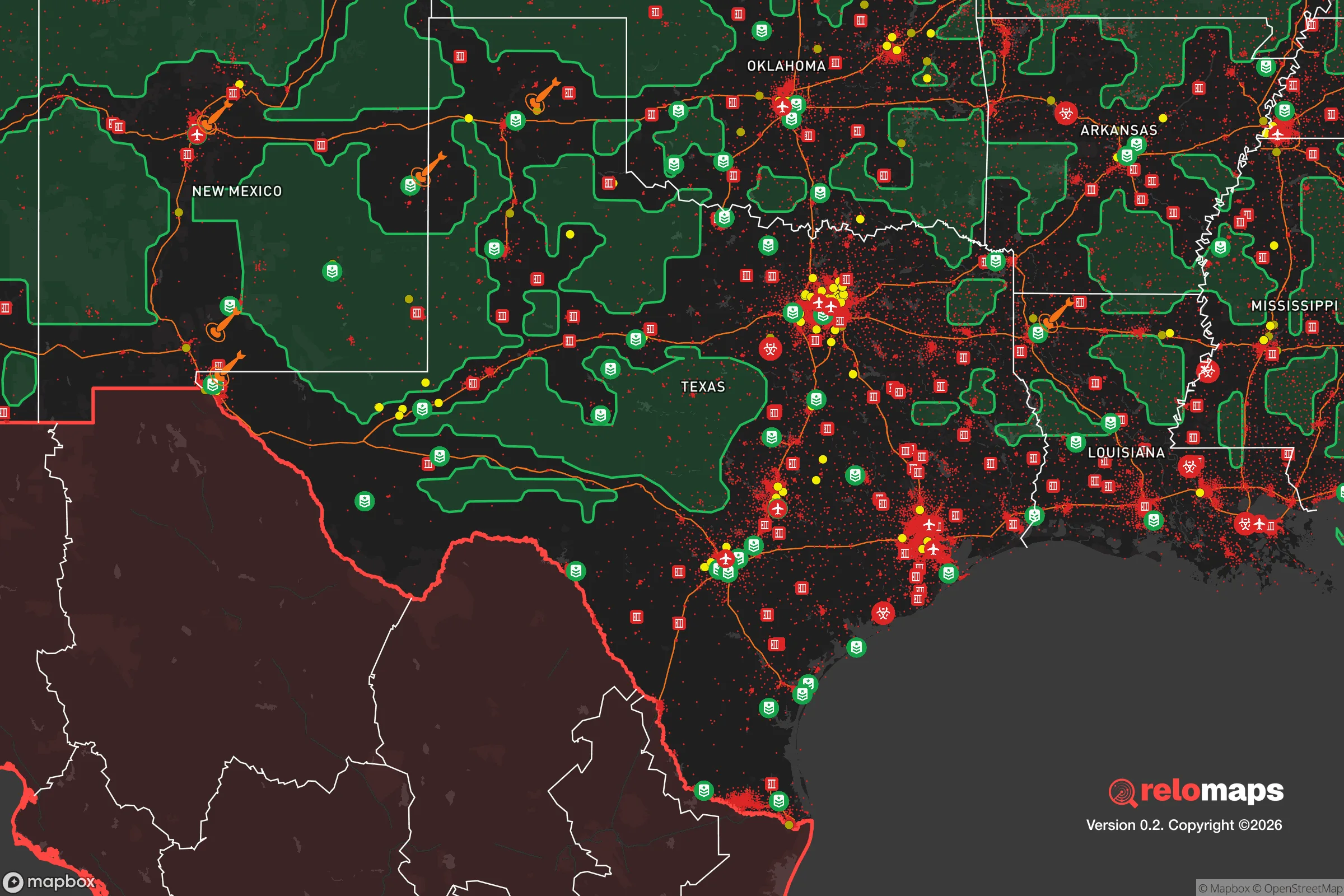


Important Note: For informational purposes only. This does not mean nothing bad ever happens in the green zones. Please use common sense. This is based on public data and modeled with AI. We tried to take a conservative approach but mistakes happen. We update this regularly as new information becomes available.
Solar Generator Recommendations
Backup power matters more here than in safer locations. We've picked three solar generators across budgets and capacity tiers — start with the budget unit if you only need a few essentials, or step up if you want to run a fridge and HVAC for days at a time.

Jackery Portable Power Station Explorer 300
Budget OptionPower on the Go: Weighing only 11 lbs, it's convenient to set up and store with book-sized foldable solar panels

BLUETTI Portable Power Station AC180
Designed for both indoor and outdoor scenarios, AC180 is highly capable as it has a robost capacity and continuous output power.

EF ECOFLOW DELTA Pro Ultra Power Station
Upgraded PickEcoFlow DELTA Pro Ultra is a whole-home energy system designed to grow with your family. Integrated with the Smart Home Panel 2, it scales to meet your evolving energy needs — keeping your home powered, intelligent, and secure through every stage of life.
We earn a commission, at no additional cost to you.
Strategic Assessment Analysis
Aledo, Texas, occupies a distinctive strategic position in the fast-growing corridor west of Fort Worth, offering a blend of rural quietude and practical access to urban resources that appeals to relocators weighing disaster readiness alongside daily convenience. The town’s resilience—physical, infrastructural, and social—stems from its location on the edge of the Dallas-Fort Worth metroplex, its distance from heavily targeted military and industrial zones, and the self-reliant culture common to Parker County. For someone focused on preparedness, Aledo provides a workable balance: close enough to metropolitan supply chains and emergency services, yet far enough to reduce exposure to the most acute fallout-zone risks.
Geographic position, natural advantages, and strategic buffer zones
Aledo sits at roughly the intersection of U.S. Routes 377 and 199, about 15 miles west of downtown Fort Worth and 35 miles from the Dallas County line. This places it in a natural buffer zone—the rolling, oak-dotted terrain between the western Fort Worth suburbs and the vast ranchlands and military preserve of Brownwood further west. The area lies in a relatively flat-to-gently-rolling prairie region at an elevation around 900 feet, with no major floodplains encroaching on the town’s core. The Brazos River’s main branch runs several miles south, but Aledo itself sits on higher ground, reducing flash flood risk compared to east or south Texas communities. The climate offers advantages for self-sufficiency: a long, hot growing season for staple crops—typically from March to November—and a relatively low annual tornado density versus central Oklahoma or North Texas proper. While the town is within what some might call the "DFW periphery" (roughly 70,000 people in the immediate postal area), it’s surrounded by cattle ranches and land tracts that provide both buffer zone and open space for resilient land use.
Aledo’s primary natural advantage is its location along the eastern edge of the vast, sparsely populated Texas Hill Country and the Edwards Plateau aviary. To the west stretches hundreds of miles of open ranchland, state forests, and National Petroleum Reserves—until you reach the Permian Basin or the hills of central Texas. This means that if a relocator prioritizes defensibility and low population density, the retreat corridor west of Aledo offers some of the best undeveloped land in the state. The town itself is also just 20 minutes from the Brazos River and 45 minutes from the large lakes along the Brazos such as Lake Granbury and Lake Whitney, providing alternative water sources and recreational fishing. For a family or single individual serious about prepping, this access allows sourcing water beyond municipal infield capability. However, a zero is the immediatefrom within the sprawling DFW metro—42% of Tarrant County residents live within a 50-mile radius of a disproportionate number of mid-sized natural gas facilities and power plants, so vulnerability to a cascading grid failure from an EMP or severe weather regionalization remains moderate.
Risks, exposures, and proximity to fallout-relevant landmarks and vulnerabilities
The most significant risk for Aledo residents is its proximity to the Dallas-Fort Worth metropolitan area—a high-consequence population and industrial center with over 8 million people. In a major civil disruption, natural disaster, or man-made event, the evacuation and supply-chain turbulence would affect Aledo quickly. The metroplex includes DFW Airport (one of the busiest in the world), major chemical plants, and multiple military installations: Fort Worth Naval Air Station Joint Reserve Base (14 miles east), the Dallas Army Air Defense command center, and Raphael State Training Center also within 50 miles. For a relocator concerned about nuclear or conventional military strike patterns, these sites are significant. The geopolitical reality is that DFW is a major logistical hub, and Aledo would be within the blast and short-term fallout potential for a single large-scale event. Specifically—within 30 to 100 miles of certain hypothetical ground-zero profiles. That said, Aledo is less directly compromised than Fort Worth suburbs like Haslet or Weatherford, which lie even closer to forward operating bases, and is dramatically better than any area inside the DFW beltway. For fallout patterns, prevailing winds are generally from the south and southeast, meaning the risk of widespread radioactive debris from a DFW incident is lower than eastward butNote the lateral plume risk should not be discounted.
On natural risks: Parker County sits within what is considered not a high-risk for major wildfires due to prairie-style land in openness, but drought conditions (frequent in Texas) can expand that risk substantially. No earthquake or tsunami risk. Flash flooding, especially in low-lying areas around Williams and Crock, is a seasonal issue; however, Aledo is built on upland, so most homes do not face inundation. The town is also on the far edge of tornado alley, but the risk is moderate—a significant but manageable hazard for a resident with a storm shelter or basement-designed house.
Practical resilience for a relocator: food, water, energy, and defensibility
For a self-sufficiency-minded relocator, Aledo’s practical resilience dimensions are a strong positive, though not all utilities and services are accessible in a full grid-down situation. Water is the first consideration. The town runs on municipal water drawn from aquifer in the Woodbine and Trinity systems—generally clean and reliable, but backup wells or rainwater collection allow for intentional redundancy. The median lot size of Aledo homes ranges from 1 to 5 acres, meaning many properties have room for a large catchment system, shallow or deep well and hot water storage. For guidance, the local county (Parker County) is not a typical regulatory dense area for rainwater permits, but it’s worth checking locals for restrictions. Food-wise, the found of Aledo indexes high for a suburban setup: established ranching community culture with abundant rural livestock; local farms and farmers markets exist within 20 minutes (Aledo Farmers Market, plus many producers in the Brazos Valley corridor). The growing season is 10 months in some areas; one can raise vegetables and small livestock (chickens, goats, chickens) on an acre lot easily. The local soil is loam-based with decent clay mixes—fertile but requires amendment if going full permaculture.
Energy resilience is solid. Aledo is on the Texas grid (ERCOT), which is notorious for blackouts like the 2021 winter storm, but does not connect to the major statewide power problems. Local power comes from Oncore Electric (which has intermittently bigger line-shed. Many residents already have backup generators (propane or diesel). The area also has moderate to high solar viability with over 200 sunny days per year, and standard solar panels will likely survive a grid disruption. A grid-down scenario at an Aledo residence would likely be a matter of “weeks” not “months” of early power recovery (as per precedent). However, defenses for any specific kind of harsh weather—such as a relatively small population density (about 100 people per square mile in the vicinity)—makes the area immediately defensible from a hazard. The population base for a survival community is known for a conservative, self-sufficient subculture: many residents are prepping on their own or with groups. There is a local sheriff step up in emergency if not disrupted. The only drawback is that Aledo is a destination where a lot of light urbanism is happening—all neighborhoods with HOA forbiddance to firearms, chickens, and adaptations—so a new resident may need to choose a non-HOA property or a little more acreage.
Strategic picture for a preparedness-minded family
In the end, Aledo is a tailgate town for a disaster-readiness mindset: you get the resource access of being within 30 minutes of military-grade hospital and trauma centers (notably Fort Worth’s level 3), plus big-box goods in Weatherford or Fort Worth, yet you can quickly step into a situation of semi-netral. The Balong risk, moderate because of distant major hazards, is manageable with basic steps like a well, 6-month food storage, and a remote retreat property to the west. For moderate-to-serious preppers, it’s a basecamp option, not a ultimate bug-in unless you own 50 acres in the Hill Country north. The primary decision should therefore tie around your tolerance for being near a metro area during a grid-down—a scenario where Aledo’s transition to a “crush zone” of evacuee density from the eastern parts would strain resources. But for a single individual or family with a safe room, decent store, and network of like-minded homeowners—it’s a well-stocked middle ground between complete isolation and access to everything. Not perfect, but for those looking to combine modern convenience with meaningful are self-sufficiency, it’s one of the better opportunities in northern Texas. Evaluate your own risk thresholds, and if you have the space, Aledo holds a solid tier of resilience.

* Values derived from national, state, county, city and local statistics and may differ in a specific area. Last updated: 2026-09-11T16:58:10.000Z
Narrative content on this page is AI-generated and may contain mistakes. Verify any details that matter before acting on them.
ReloMaps may earn a commission from affiliate links at no extra cost to you.

