Photo: Wikipedia
Demographics of Aleutians West County
Affluence Level in Aleutians West County
An upper-middle-class area. Household wealth, education levels, and homeownership run ahead of national benchmarks.
People of Aleutians West County
The people of Aleutians West County, Alaska, are a small, uniquely diverse population of just over 5,100 residents, shaped by a history of military strategy, commercial fishing, and Cold War-era infrastructure. Unlike most of Alaska, the county is majority Asian (40.6% East and Southeast Asian), with a significant White minority (23.7%), a notable Hispanic population (13.8%), and a Black community (5.3%). This is not a place of gradual agricultural settlement but of strategic government and industry-driven migration, concentrated in the remote Aleutian Islands, where the largest communities are the city of Unalaska (home to the port of Dutch Harbor) and the village of Atka.
Settlement & growth (pre-1960)
Human history in the Aleutians begins with the Unangax (Aleut) people, who inhabited the islands for over 8,000 years before European contact. Their traditional villages—such as those on Unalaska Island and Atka Island—were built around marine subsistence, with a population estimated in the tens of thousands. Russian colonization began in the 1740s, led by fur traders who forcibly conscripted Unangax hunters and established settlements like Illiuliuk (the original Unangax village on Unalaska Island). The Russian-American Company operated a major trading post there, and by the 1820s, the Unangax population had collapsed by over 80% due to disease and violence. The United States purchased Alaska in 1867, but the Aleutians remained sparsely populated for decades, with only a few hundred Unangax and a handful of American traders and missionaries.
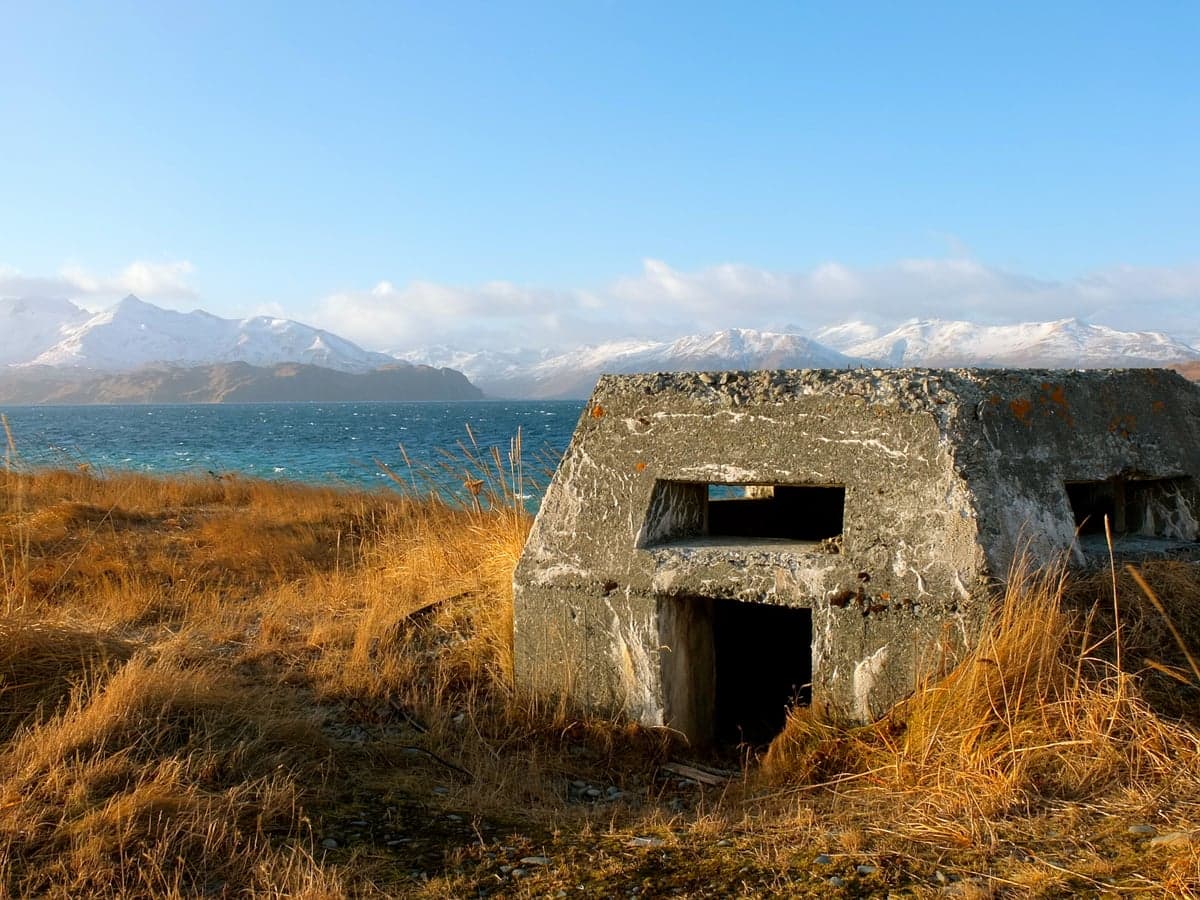
The first major demographic shift came during World War II. In 1942, the Japanese invaded and occupied the islands of Attu and Kiska, and the U.S. military forcibly evacuated nearly 900 Unangax from villages across the Aleutians—including Atka and Unalaska—to internment camps in Southeast Alaska. The U.S. then built massive military bases on Adak Island and Unalaska Island to repel the Japanese. The Battle of Attu in 1943 was the only land battle fought on U.S. soil during the war. After the war, the military presence remained: the Naval Air Facility on Adak became a Cold War submarine surveillance hub, and the base on Unalaska was maintained. This military infrastructure brought the first wave of non-Native, non-Unangax residents—mostly White servicemen and civilian contractors—who settled in the base towns of Adak and Dutch Harbor (the port of Unalaska). By 1960, the county's population was still under 1,000, but the foundation for modern growth was laid.
Modern era (post-1965)
The 1965 Hart-Cellar Act had little direct effect on the Aleutians, but the 1970s brought a transformative economic shift: the rise of the Bering Sea crab and pollock fisheries. Dutch Harbor became the largest fishing port in the United States by volume, and the industry attracted a global workforce. The first major group to arrive were Filipino and Vietnamese fishermen and processors, drawn by the promise of high wages in the dangerous but lucrative fishery. By the 1980s, East and Southeast Asian communities—primarily Filipino, with smaller numbers of Vietnamese and Korean workers—had established a permanent presence in Unalaska. They were followed by Hispanic workers from Mexico and Central America, who took jobs in fish processing plants, and a smaller number of Black workers from the Lower 48, also in the seafood industry. The military base on Adak was downsized in the 1990s and closed entirely in 1997, causing the town's population to collapse from over 6,000 to fewer than 100. Today, Adak is a tiny, mostly White community of about 50 residents, with a handful of Unangax families.
The 2020 Census data reflects this modern reality: Unalaska is the county's demographic anchor, with 40.6% of the county identifying as East/Southeast Asian (almost entirely Filipino), 23.7% White, 13.8% Hispanic, and 5.3% Black. The Indian subcontinent population is negligible at 0.1%. The foreign-born share is 24.5%, more than double the national average, driven by Filipino and Hispanic immigrants who work in the seafood industry. The Unangax population, now about 6% of the county, is concentrated in the village of Atka (population ~50) and in smaller numbers in Unalaska. The county's college-educated share is just 17.5%, reflecting the blue-collar, industrial nature of the fishing economy. Domestic migration is minimal—most new arrivals come directly from abroad to fill processing plant jobs, and turnover is high due to the harsh climate and isolation.
The future
The population of Aleutians West County is likely to remain small and volatile, driven by the boom-and-bust cycles of the Bering Sea fishery. The Asian (Filipino) share is expected to stay dominant, as the industry continues to recruit from the Philippines through labor contracts. The Hispanic share may grow modestly, as processing plants diversify their labor sources. The White population, already a minority, will likely shrink further as the military generation ages out and few new White workers arrive. The Unangax population is stable but aging, with younger members often leaving for Anchorage or the Lower 48. The county's future is not one of suburban expansion or cultural blending—it is a transient, industrial outpost where most residents stay for a few years and then leave. The only permanent communities are Unalaska and Atka; Adak is a ghost town with a handful of holdouts.
For someone moving in now, Aleutians West County offers a unique but narrow lifestyle: high wages in fishing or processing, extreme isolation, and a community that is majority immigrant and non-White. The cultural identity is not "Alaskan" in the frontier sense but rather a global fishing port with a strong Filipino influence. The county is not becoming more diverse—it already is, and has been for decades. The question is whether the fishery remains profitable enough to sustain the population. If the Bering Sea crab stocks collapse or automation reduces processing jobs, the county could see a rapid exodus, returning to the pre-1970s pattern of a tiny Unangax and White population. For now, it remains one of the most ethnically distinctive and economically precarious places in the United States.

* Values derived from national, state, county, city and local statistics and may differ in a specific area. Last updated: 2026-07-25T20:06:40.000Z
Narrative content on this page is AI-generated and may contain mistakes. Verify any details that matter before acting on them.
ReloMaps may earn a commission from affiliate links at no extra cost to you.

