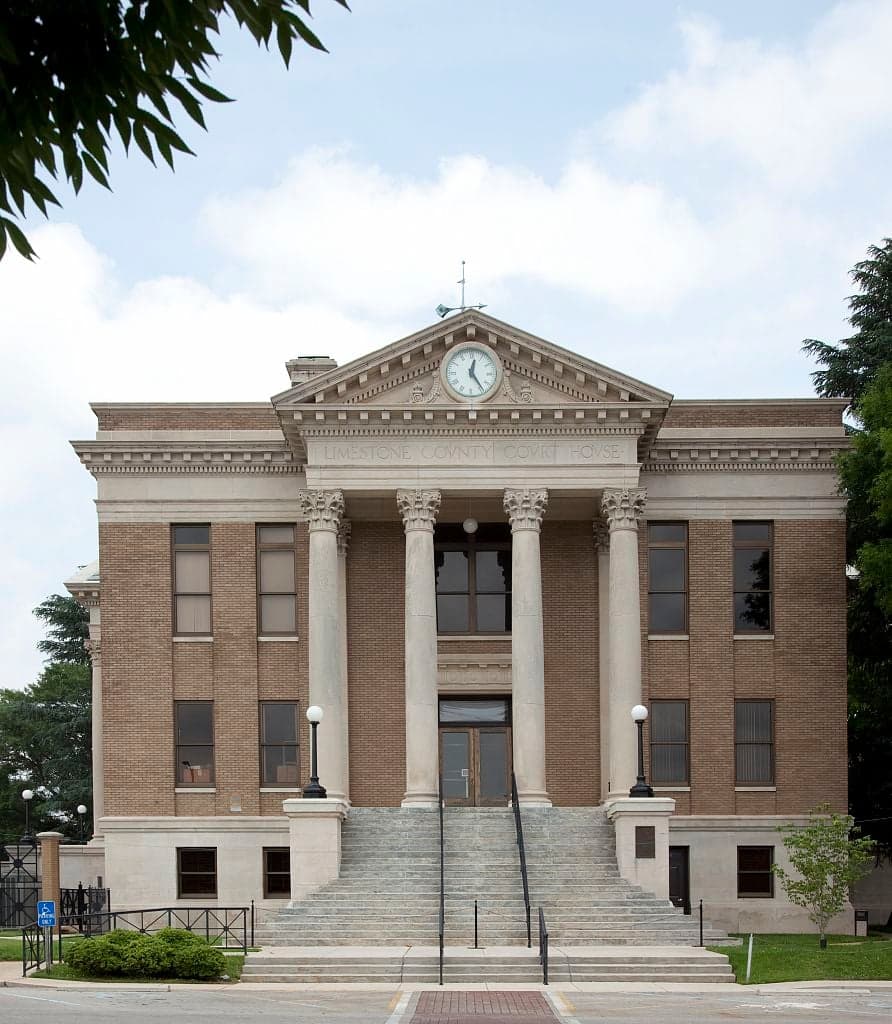
Photo: Wikipedia
Political ClimatePolitical Climate in Limestone County
Showing district-level results — no local-only data available.
Local Political AnalysisPolitical Analysis of Limestone County
Limestone County, Alabama, is a reliably Republican stronghold with a Cook Partisan Voting Index (PVI) of R+15, meaning it votes about 15 points more Republican than the national average. This isn't a new development—the county has been trending red for decades, but the shift has accelerated noticeably since 2016, driven by rapid population growth in the southern part of the county near Huntsville. While the state of Alabama as a whole is also deeply Republican (with a PVI of roughly R+15 to R+16, though exact figures vary), Limestone County is actually slightly more conservative than the state average in some recent elections, particularly in presidential races.
How it compares
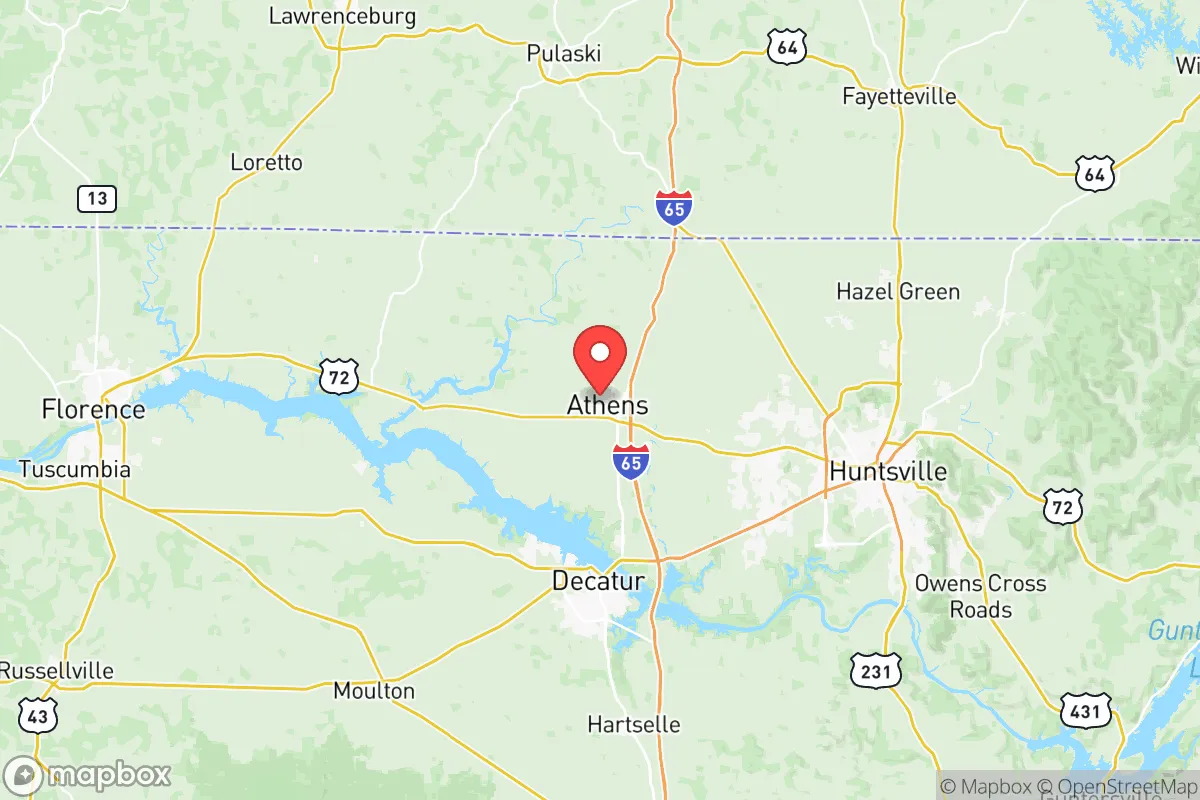
Compared to Alabama as a whole, Limestone County is a bit of a microcosm of the state's political geography, but with its own unique flavor. The county's southern towns—like Athens (the county seat) and Madison (which straddles the Limestone-Madison county line)—are where the action is. Athens itself is a mix: the older, rural parts lean heavily red, but the newer subdivisions near I-65 and the Huntsville metro area are more purple, with some precincts swinging blue in recent midterms. Madison, which is partly in Limestone County, is a classic example of a fast-growing suburb that's becoming more moderate—it's still Republican, but not as overwhelmingly as the county's rural areas. Meanwhile, towns like Elkmont and Ardmore in the northern part of the county are deeply conservative, with precincts that routinely vote 80%+ Republican. The swing precincts are almost entirely in the southern growth corridor, where new residents from out of state—many from blue states—are bringing a more mixed political outlook. This is a key difference from the rest of Alabama, where rural areas are more uniformly red and urban centers like Birmingham and Montgomery are more reliably blue. Limestone County doesn't have a major city like that; its political tension is between the old rural base and the new suburban influx.
What this means for residents
For conservative residents, Limestone County is a comfortable place to live politically. Local elections are dominated by Republicans, and the county commission, school board, and most municipal councils are solidly conservative. You'll find strong support for gun rights, low taxes, and traditional values in local policy. For liberal residents, the picture is more nuanced. While you won't find a progressive majority anywhere in the county, the southern precincts near Huntsville are becoming more tolerant and diverse. In Athens, for example, there's a growing community of younger professionals and tech workers who lean left, and they've been able to elect a few moderate Democrats to local offices in recent years—though it's still rare. The practical reality is that liberals here often feel like a minority, but they're not isolated; they can find like-minded people in the newer neighborhoods and at community events. The county's rapid growth (population up nearly 20% since 2020) is slowly shifting the political center, but it's a gradual process.
Culturally, Limestone County is more traditional than the Huntsville side of the line, but less so than the deep rural counties to the west. You'll see more Confederate flags in the northern parts, but also more "Huntsville transplants" in the south who are less invested in that symbolism. Policy-wise, the county has resisted some of the more aggressive conservative measures seen elsewhere in Alabama—for instance, it hasn't passed any local ordinances restricting LGBTQ+ rights, though it also hasn't passed any protections. The biggest distinction from the rest of Alabama is the economic influence of Huntsville's aerospace and defense industry, which brings a steady stream of out-of-state workers and a more cosmopolitan feel to the southern part of the county. This is slowly reshaping the political landscape, but for now, Limestone County remains a reliably red place where the biggest political fights are about growth management, not culture wars.

State Political ClimatePolitical Climate in Alabama
State Political AnalysisPolitical Environment in the State
Alabama is one of the most reliably Republican states in the country, with a deep-red partisan lean that has only intensified over the past two decades. The state hasn’t voted for a Democratic presidential candidate since 1976, and in 2024, Donald Trump carried it by roughly 30 points. The dominant coalition is a mix of rural white evangelicals, suburban conservatives in the Birmingham and Mobile metros, and a growing number of transplants from bluer states who are drawn to the state’s low taxes and business-friendly climate. The Democratic base is almost entirely concentrated in the Black Belt—a crescent of counties stretching from the Mississippi border to the Georgia line—and in the city centers of Birmingham, Montgomery, and Huntsville. Over the last 10-20 years, the state has shifted rightward even in historically competitive areas, as white voters in the suburbs and exurbs have consolidated behind the GOP and the rural vote has become more uniformly Republican.
Urban vs. rural divide
The political map of Alabama is a study in stark contrasts. The state’s three largest metros—Birmingham, Huntsville, and Mobile—each have their own political character. Birmingham (Jefferson County) is the state’s most reliably Democratic urban center, driven by a large Black population and a growing liberal white professional class. The city itself votes heavily Democratic, but the surrounding suburbs—Hoover, Vestavia Hills, and Mountain Brook—are solidly Republican, though they’ve trended slightly more competitive in recent cycles as college-educated voters shift left. Huntsville (Madison County) is a fascinating exception: a fast-growing, high-tech hub that remains Republican but is more moderate than the rest of the state, thanks to a large population of defense contractors and aerospace engineers. Madison County voted for Trump by about 20 points in 2024, down from 25 in 2020, reflecting a slow drift toward the center. Mobile (Mobile County) is a classic Gulf Coast conservative stronghold, with a strong military and maritime influence that keeps it reliably red. The rural areas—especially the Black Belt counties like Greene, Sumter, and Lowndes—are overwhelmingly Democratic, often voting 70-80% for the party, but their populations are small and shrinking. The real story is the exurban and rural white vote: counties like Blount, St. Clair, and Marshall routinely deliver 80%+ margins for the GOP, making the state’s overall partisan balance lopsided.
Policy environment
Alabama’s policy environment is a textbook example of a low-tax, low-regulation, socially conservative state. There is no state income tax on Social Security benefits, and the state’s top marginal income tax rate is 5%, one of the lowest in the Southeast. Property taxes are among the lowest in the nation, with an effective rate around 0.4% of home value. The state has a right-to-work law, meaning union membership is optional and collective bargaining is weak. Education policy is dominated by school choice: the Alabama Accountability Act provides tax credits for private school tuition, and the state has a growing charter school sector, though most schools remain traditional public. Healthcare is a mixed bag: Alabama did not expand Medicaid under the Affordable Care Act, leaving roughly 200,000 low-income adults in the coverage gap. The state has some of the strictest abortion laws in the country, with a near-total ban in effect since the Dobbs decision, including no exceptions for rape or incest. Election laws are moderately restrictive: voters must show a photo ID at the polls, and early voting is limited to absentee ballots with an excuse. The state has no ballot initiative process, meaning all policy changes must go through the legislature.
Recent policy direction
Over the last five years, Alabama has moved decisively to the right on a broad range of issues. In 2022, the legislature passed the Alabama Human Life Protection Act, which bans nearly all abortions from conception, with no exceptions for rape or incest. On gun rights, the state enacted constitutional carry in 2022, allowing residents to carry a concealed handgun without a permit. In education, the 2024 CHOOSE Act created a universal school choice program, offering education savings accounts (ESAs) worth up to $7,000 per student for private school or homeschooling expenses. On parental rights, the state passed the Alabama Parental Rights Protection Act in 2022, which requires schools to notify parents of any changes to a student’s mental, emotional, or physical health and prohibits classroom instruction on sexual orientation or gender identity in grades K-5. On speech and privacy, the state has not enacted a broad social media censorship law, but it has joined multistate lawsuits against federal vaccine mandates and environmental regulations. Property rights remain strong: Alabama is a “Dillon’s Rule” state, meaning local governments have limited authority, but there is no statewide rent control or land-use planning that would restrict development. On voting, the legislature passed a 2021 law that shortened the absentee ballot application window and banned curbside voting, though it stopped short of the more restrictive measures seen in Georgia or Texas.
Civil unrest & political movements
Alabama has a long history of civil rights activism, and that legacy continues in the Black Belt and urban centers. The Alabama Poor People’s Campaign and the NAACP Alabama State Conference remain active, organizing around Medicaid expansion, voting rights, and criminal justice reform. On the right, the Alabama Republican Assembly and local Tea Party groups are influential in primary elections, often pushing for more conservative candidates on social issues. Immigration politics are less heated than in border states, but the legislature has passed laws requiring businesses to use E-Verify and prohibiting sanctuary city policies. There is no serious secessionist movement, though some rural counties have passed symbolic resolutions asserting local control over federal land management. Election integrity has been a flashpoint: after the 2020 election, some Republican legislators called for an audit of the state’s voting machines, but no major irregularities were found. The most visible flashpoint for a new resident would be the annual Selma Bridge Crossing Jubilee, which draws thousands of activists and politicians to commemorate the 1965 Voting Rights March, and the ongoing debate over Confederate monuments in cities like Montgomery and Birmingham.
Projection
Over the next 5-10 years, Alabama’s political trajectory is likely to remain deeply red, but with some important nuances. The state is growing fastest in the Huntsville metro, which is attracting a younger, more educated, and slightly more moderate population. This could make Madison County a swing county in state-level races within a decade, though it will still lean Republican. The Black Belt will continue to lose population, reducing the Democratic base. Meanwhile, the exurban and rural white vote shows no signs of moderating on social or cultural issues. The biggest wildcard is in-migration: Alabama is seeing a steady stream of new residents from California, Illinois, and New York, many of whom are conservative-leaning but may bring different priorities on taxes and regulation. The state’s policy direction will likely continue to emphasize school choice, gun rights, and abortion restrictions, while resisting Medicaid expansion and any significant tax increases. A new resident moving in now should expect a state that is politically stable, with a government that is responsive to conservative voters and largely unresponsive to progressive activism, but with a slowly diversifying electorate in the fastest-growing cities.
For a new resident, the bottom line is this: Alabama is a state where conservative values are the default in both policy and culture. If you lean right, you’ll find a government that is actively expanding school choice, protecting gun rights, and keeping taxes low. If you lean left, you’ll find a vibrant activist community in Birmingham and the Black Belt, but you’ll be swimming against a strong current. The state is not politically volatile—there are no recall elections, no ballot initiatives, and no major third-party movements—so what you see is largely what you’ll get for the foreseeable future. The practical takeaway is to choose your location carefully: Huntsville offers a more moderate, tech-driven environment; Birmingham provides urban amenities and a Democratic stronghold; and the rural areas and Gulf Coast are reliably conservative. The state’s political climate is stable, predictable, and deeply rooted in its history, which is both a comfort and a constraint depending on your perspective.
* Values derived from national, state, county, city and local statistics and may differ in a specific area. Last updated: 2026-07-03T04:28:39.000Z
Narrative content on this page is AI-generated and may contain mistakes. Verify any details that matter before acting on them.
ReloMaps may earn a commission from affiliate links at no extra cost to you.

