
Photo: Wikipedia
Personal Sovereignty in Limestone County
Viable for self-reliance. Generally workable, though some barriers may limit total independence.
What does Personal Sovereignty tell us?
Personal Sovereignty measures your capacity for self-reliance and independence with minimal government friction. Higher scores mean fewer barriers between you and the way you want to live... but it assumes you have the space you need and good neighbors.
What does this tell us?
Personal Sovereignty measures your capacity for self-reliance and independence with minimal government friction. Higher scores mean fewer barriers between you and the way you want to live... but it assumes you have the space you need and good neighbors.
State Policy
Energy independence: Importer (45% of energy produced in-state)
Personal Liberty
Homesteading

Personal Liberty Analysis
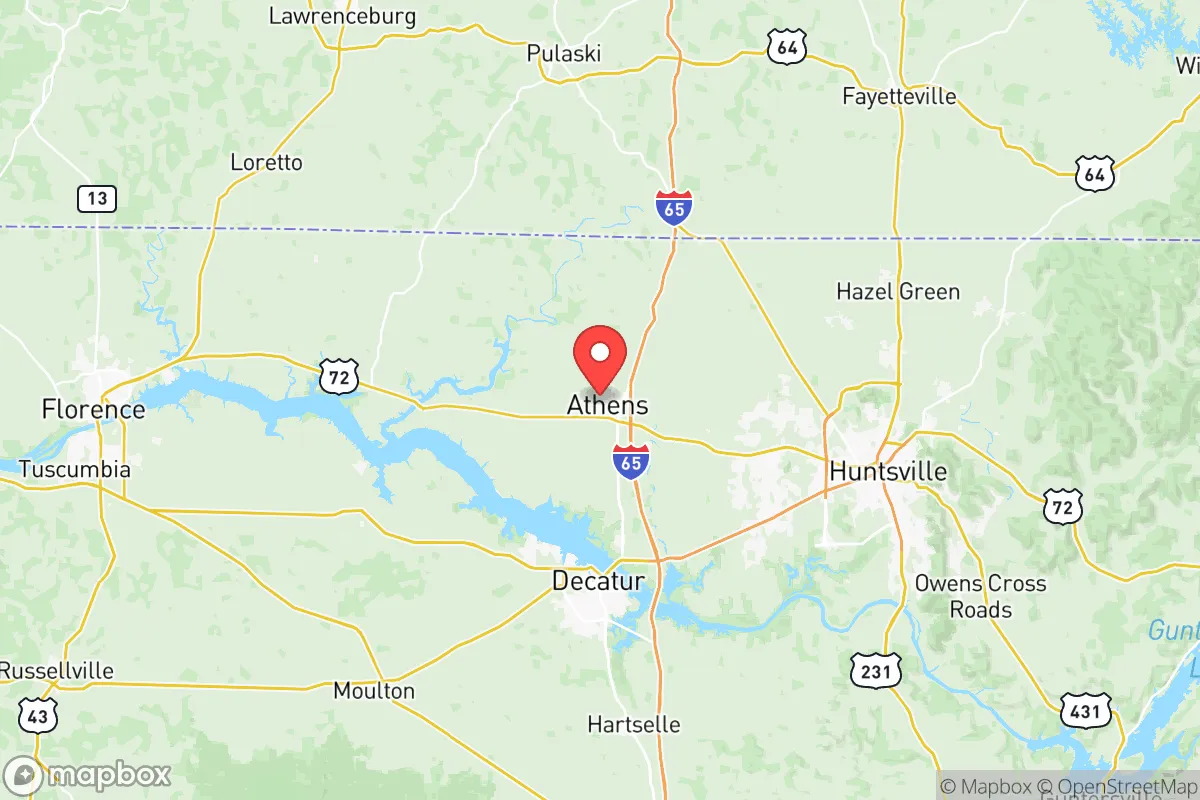
Limestone County, Alabama, offers a notably high degree of personal sovereignty, anchored by Alabama’s strong constitutional protections and a local culture that prizes self-reliance. The county’s regulatory environment is generally light-touch, with tax burdens among the lowest in the nation and a legal framework that explicitly supports gun rights, parental authority, and property freedom. For individuals and families seeking maximum autonomy, the area—particularly the rural stretches around Athens, Elkmont, and Ardmore—provides a distinct contrast to more heavily regulated urban centers like Huntsville, just 20 miles to the east.
Tax burden and regulatory posture in Limestone County
Alabama’s state and local tax structure is one of the most favorable in the country for those prioritizing financial sovereignty. Limestone County levies a combined state and local sales tax rate of 8.5% (4% state, 4.5% county), which is moderate for the region but still below the national average. The real game-changer is property tax: Alabama’s effective property tax rate is among the lowest in the United States, and Limestone County’s rate sits at roughly 0.33% of assessed value. A $250,000 home here carries an annual property tax bill of approximately $825, compared to over $3,000 in many parts of Texas or the Northeast. There is no state-level personal property tax on vehicles or boats. The regulatory posture is similarly restrained. Limestone County operates under a county commission system with limited zoning—most unincorporated areas have no formal zoning ordinances, meaning residents in places like Belle Mina or Tanner can build, fence, or operate small businesses on their property with minimal bureaucratic interference. The city of Athens does have zoning, but it is generally permissive, with no overly restrictive building codes or lengthy permitting processes for standard residential construction. The county’s approach is best described as “hands-off unless there’s a clear public safety issue,” which aligns well with a self-reliant lifestyle.
Self-defense and gun law specifics in Limestone County
Alabama is a “constitutional carry” state, and Limestone County fully reflects that. Since 2022, no permit is required to carry a concealed handgun for anyone legally allowed to possess a firearm. Open carry is also legal without a permit. The county sheriff’s office in Athens issues permits for reciprocity purposes, but there is no local licensing requirement or waiting period for firearm purchases. Stand-your-ground laws are in effect, with no duty to retreat in any place where a person has a legal right to be. Castle doctrine protections extend to occupied vehicles and workplaces, not just homes. The local gun culture is robust: Athens has multiple gun shops and indoor ranges, and the Limestone County Sheriff’s Office runs a popular concealed carry class for those who want a permit for travel. The area’s proximity to Huntsville means access to larger firearms retailers, but the local environment is distinctly pro-Second Amendment. In rural areas like Elkmont and Ardmore, target shooting on private property is common and generally accepted, provided it’s done safely and away from neighbors. There are no county-level restrictions on magazine capacity, firearm types, or ammunition sales. For a reader prioritizing self-defense sovereignty, Limestone County offers one of the most permissive legal environments in the Southeast.
Self-reliance and homesteading viability: lot sizes, zoning, and off-grid feasibility
Limestone County’s rural character makes it highly viable for homesteading and off-grid living. Outside the city limits of Athens (population ~25,000), most land is zoned agricultural or rural residential with minimum lot sizes of 1 to 5 acres in unincorporated areas. In the northern part of the county near Ardmore and the Tennessee line, 10- to 20-acre parcels are common and affordable, often selling for $4,000–$8,000 per acre. The county has no formal ban on rainwater collection, composting toilets, or solar panel installation. Off-grid feasibility is high: many rural homes already use well water and septic systems, and the county does not require connection to municipal utilities if a property has adequate private systems. Raising livestock—chickens, goats, cattle, even pigs—is allowed on most agricultural-zoned land without special permits. The city of Athens does have some restrictions on livestock within city limits (typically no roosters, and limits on the number of animals), but the surrounding unincorporated areas are largely unrestricted. The town of Elkmont, with its historic railroad depot and small population, has become a minor hub for homesteaders due to its low land prices and minimal regulation. The county’s building codes apply only to new construction and major renovations, and they are based on the International Residential Code with local amendments that are generally less stringent than those in larger cities. For someone wanting to build a cabin, install solar panels, and live off-grid, Limestone County presents few legal barriers.
Personal liberties: parental rights, medical autonomy, speech, and property
Alabama law provides strong protections for parental rights, and Limestone County’s school system and local government generally defer to parental authority. The state’s Parental Rights in Education Act ensures that parents have access to all instructional materials and can opt their children out of any curriculum they find objectionable. The Limestone County School District, which serves most of the county outside Athens, has a conservative school board that has resisted federal overreach on issues like transgender policies and critical race theory. Medical autonomy is similarly robust: Alabama has no state-level vaccine mandate for adults, and the county does not enforce any local mandates. The state’s medical freedom laws allow individuals to refuse any medical treatment, including vaccines, for themselves or their children, with broad exemptions. Speech protections are strong under both the U.S. and Alabama constitutions, and the county has no local ordinances restricting political speech, signage, or assembly. Property rights are protected by Alabama’s “takings” laws, which require just compensation for any regulatory taking, and the county has a relatively low rate of eminent domain use. The city of Athens does have a historic preservation commission that can affect exterior changes to properties in designated historic districts, but this applies to a very small area. For the vast majority of the county, property owners can use their land as they see fit, subject only to basic health and safety codes.
Overall, Limestone County ranks among the top-tier areas in Alabama for personal sovereignty. Its combination of low taxes, permissive gun laws, minimal zoning, and strong legal protections for parental and medical autonomy creates an environment where self-reliant individuals and families can operate with minimal government interference. The county’s proximity to Huntsville provides access to urban amenities and employment, but the regulatory culture remains distinctly rural and freedom-oriented. For a reader comparing this area to more restrictive parts of the country—or even to other parts of Alabama like Jefferson County or Mobile County—Limestone County offers a notably higher degree of personal autonomy, particularly in the unincorporated areas and smaller towns like Elkmont, Ardmore, and Belle Mina.

* Values derived from national, state, county, city and local statistics and may differ in a specific area. Last updated: 2026-07-03T04:28:39.000Z
Narrative content on this page is AI-generated and may contain mistakes. Verify any details that matter before acting on them.
ReloMaps may earn a commission from affiliate links at no extra cost to you.

