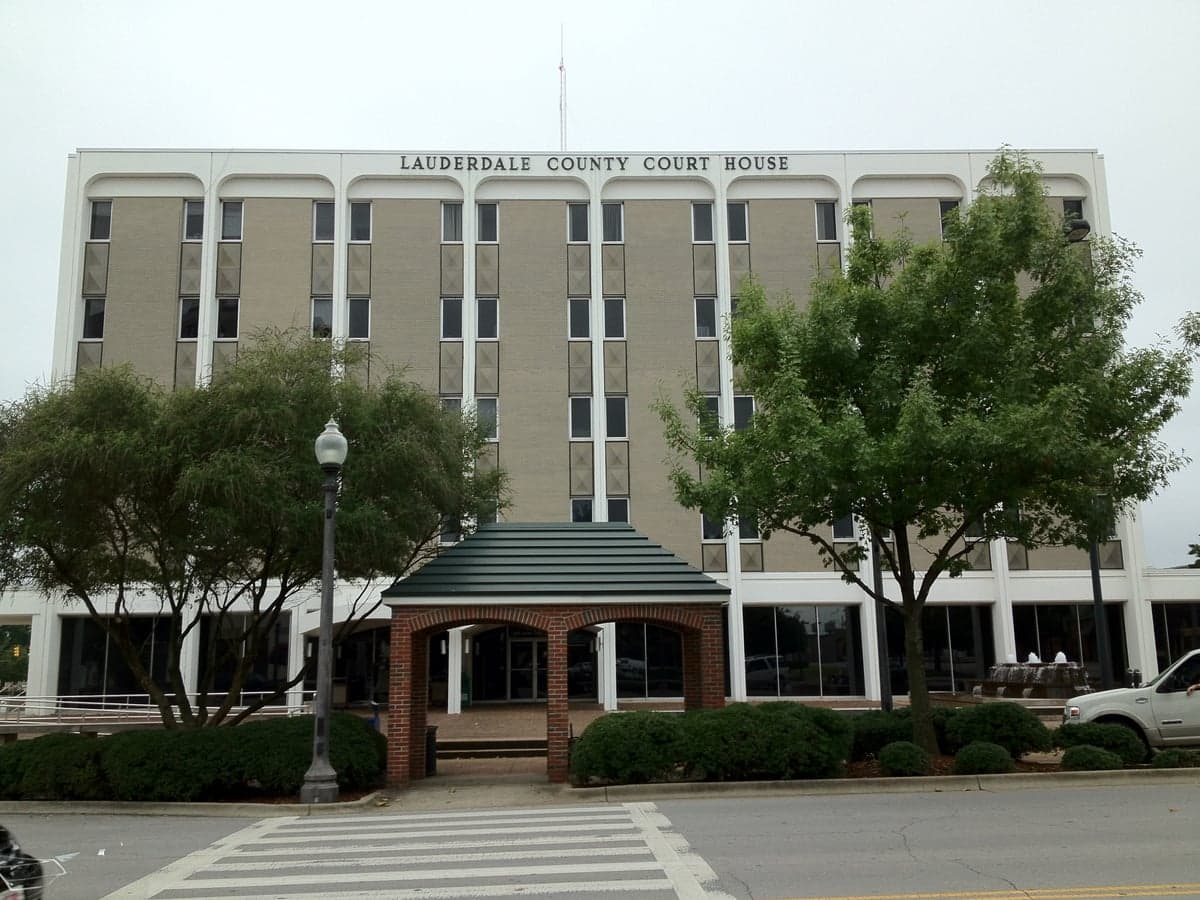
Photo: Wikipedia
Political ClimatePolitical Climate in Lauderdale County
Showing district-level results — no local-only data available.
Local Political AnalysisPolitical Analysis of Lauderdale County
Lauderdale County is one of the most reliably Republican strongholds in Alabama, carrying a Cook Partisan Voting Index (PVI) of R+33 — more than double the state’s already red R+14 rating. That means the county consistently votes about 33 points more Republican than the national average, a margin that has held steady through the last several presidential cycles. In 2024, Donald Trump carried Lauderdale County with roughly 78% of the vote, mirroring the pattern seen in 2020 and 2016. The county hasn’t backed a Democrat for president since Jimmy Carter in 1976, and that trend shows no sign of reversing.
How it compares
To put that R+33 in perspective, Alabama as a whole is R+14, meaning Lauderdale County is about 19 points more conservative than the state average. That gap is significant: while Alabama is reliably red, Lauderdale is deep crimson. The county’s politics align more closely with neighboring Colbert County’s rural precincts than with the more moderate pockets of the Tennessee Valley. Within Lauderdale County itself, there’s some variation. The city of Florence, the county seat and home to the University of North Alabama, leans slightly less conservative — precincts around the university and downtown Florence have occasionally gone 60-65% Republican rather than the 75-80% seen in outlying areas. Towns like Rogersville and Killen are reliably deep red, while St. Florian and Underwood-Petersville show similar patterns. The only precincts that ever approach competitive margins are in central Florence, but even there, Democrats haven’t won a precinct since 2012.
What this means for residents
For conservative residents, the political climate is comfortable and affirming. Local offices — from county commission to school board to sheriff — are held by Republicans, and policy debates tend to center on how conservative to go, not whether. Tax rates remain low, gun rights are broadly supported, and social conservative values shape public policy. For liberal or moderate residents, the reality is different. They are a clear minority, and their influence on local elections is minimal. However, Florence’s university presence creates a small but visible progressive community, and issues like downtown development, historic preservation, and public arts funding see cross-party support. Most residents, regardless of party, describe the county as polite in day-to-day interactions — political signs are common, but political arguments at the grocery store are not.
One cultural distinction worth noting: Lauderdale County’s politics are shaped heavily by its rural character and its position along the Tennessee border. The county is part of the Shoals area, which has a distinct musical and literary history (think Muscle Shoals Sound Studio and the Tennessee Valley Authority’s Wilson Dam). That local pride sometimes transcends party lines — debates over riverfront development or preserving the area’s music legacy can bring together conservatives and liberals. Looking ahead, the county’s Republican lean is likely to persist, though Florence’s gradual growth and the university’s influence could nudge the county’s margin a few points closer to the state average over the next decade. For now, though, Lauderdale County remains one of the most reliably red spots in an already red state.

State Political ClimatePolitical Climate in Alabama
State Political AnalysisPolitical Environment in the State
Alabama is one of the most reliably Republican states in the country, with a Cook Partisan Voting Index of R+14, meaning it votes about 14 points more Republican than the national average in presidential elections. Over the past 20 years, the state has shifted from a competitive Democratic stronghold at the local level to a deeply red state where Republicans hold every statewide elected office, supermajorities in both legislative chambers, and all seven U.S. House seats. The last Democrat to win a statewide election was in 2008, and the state hasn't voted for a Democratic presidential candidate since 1976, when Jimmy Carter carried it. That trajectory has only accelerated since 2010, driven by realignment of white rural voters, population growth in conservative suburbs, and the near-total collapse of the state Democratic Party outside of a few urban and Black Belt counties.
Urban vs. rural divide
The political map of Alabama is a stark study in contrasts. The state's three major metro areas — Birmingham, Huntsville, and Mobile — each have their own political character. Birmingham's Jefferson County is the state's most reliably Democratic stronghold, delivering margins of 60-65% for Democrats in recent presidential cycles, driven by a large Black population and a growing progressive white professional class. Huntsville, the fastest-growing major city in the state, is a more complex case: Madison County has trended Republican but is becoming more competitive as the city's tech and defense sectors attract a younger, more educated workforce. In 2020, Donald Trump still won Madison County by about 11 points, down from 22 points in 2016. Mobile County, anchored by the port city of Mobile, leans Republican but with a sizable Democratic minority, particularly among Black voters who make up about a third of the county's population. The real engine of Republican dominance, however, is the vast rural and exurban territory: counties like DeKalb, Marshall, and Blount in the north, and the Wiregrass region in the southeast, routinely deliver 75-85% Republican margins. The Black Belt — a swath of counties stretching from the Mississippi border to the Georgia line, named for its rich soil and majority-Black population — remains the last bastion of Democratic strength outside of Birmingham, with counties like Greene, Sumter, and Perry routinely voting 80% or more Democratic. The political reality is that Alabama's statewide elections are decided in the rural white counties, not the metros.
Policy environment
Alabama's policy environment reflects its deep-red political lean. The state has one of the lowest tax burdens in the country, with no state-level property tax to speak of (the average effective rate is about 0.4%, among the lowest nationally) and a flat income tax rate of 5%. Sales tax, however, is a different story: the state rate is 4%, but local add-ons push the combined rate in many cities above 10%, making it one of the most regressive tax systems in the country. Education policy is dominated by school choice: the state has a robust charter school law, a thriving private school sector, and a new Education Savings Account program passed in 2024 that allows parents to use state funds for private school tuition and homeschooling expenses. Healthcare is a perennial flashpoint: Alabama is one of the 10 states that has not expanded Medicaid under the Affordable Care Act, leaving roughly 300,000 low-income adults in the coverage gap. Election laws are among the most restrictive in the nation: the state requires a photo ID to vote, has limited early voting (no in-person early voting before 2024, when a new law allowed a single day of early voting), and has strict rules around absentee ballots. The state also passed a 2022 law that made it a crime to give water or food to voters waiting in line, though that provision was later blocked by a federal court.
Recent policy direction
Alabama's recent legislative sessions have pushed the state further to the right on nearly every front. On gun rights, the state passed constitutional carry in 2022, allowing permitless carry of concealed handguns, and has a strong Stand Your Ground law. On education and parental rights, the 2022 "Don't Say Gay" law (the Alabama version, which is broader than Florida's) prohibits classroom instruction on sexual orientation or gender identity in grades K-5, and a 2023 law requires students to use bathrooms corresponding to their sex assigned at birth. On abortion, the state passed a near-total ban in 2019, the Human Life Protection Act, which took effect after Dobbs and makes performing an abortion a felony punishable by up to 99 years in prison, with no exceptions for rape or incest. On voting, the 2024 law that created a single day of early voting was a modest expansion, but the state also passed a 2021 law that made it a crime to distribute absentee ballot applications to voters who didn't request them. On property rights, Alabama is a strong right-to-work state with no state-level property tax increases without a vote of the people. On speech and privacy, the state passed a 2023 law that prohibits TikTok on government devices and a 2024 law that restricts the collection of biometric data by private companies. The overall direction is clear: Alabama is moving to solidify its position as one of the most culturally and economically conservative states in the union.
Civil unrest & political movements
Alabama has a long and complicated history with civil rights activism, and that legacy continues to shape its political landscape. The state was the epicenter of the 1960s civil rights movement, and cities like Birmingham, Selma, and Montgomery remain touchstones for activism. In recent years, the most visible political movements have been on the right: the state was an early adopter of the "Stop the Steal" movement after the 2020 election, with then-Governor Kay Ivey and the entire Republican congressional delegation supporting challenges to the results. The state's immigration politics have been contentious: a 2011 law, HB 56, was one of the strictest anti-immigration laws in the country at the time, though much of it was later struck down by federal courts. There are no sanctuary cities in Alabama; in fact, a 2024 law requires local law enforcement to cooperate with federal immigration authorities. On the left, the most organized movements have been around voting rights and criminal justice reform, particularly in the Black Belt, where groups like the Alabama NAACP and the Southern Poverty Law Center (headquartered in Montgomery) have been active. The state has also seen periodic protests over Confederate monuments, most notably in Birmingham, where the city removed a Confederate obelisk from Linn Park in 2020. A new resident would notice that political signs and bumper stickers are common, particularly in rural areas, and that the state's political divides are often visible in the landscape — from the Confederate flags still flown on private property in some areas to the Black Lives Matter signs in Birmingham's more progressive neighborhoods.
Projection
Over the next 5-10 years, Alabama's political trajectory is likely to remain deeply Republican, but with some interesting shifts beneath the surface. The biggest wild card is Huntsville: the city is growing rapidly, adding about 20,000 new residents per year, many of them from out of state and from more politically diverse backgrounds. If Huntsville continues to trend toward competitiveness, it could eventually flip Madison County from red to purple, though that's still a decade or more away. Birmingham's Jefferson County will remain solidly Democratic, but the city's population is stagnant, limiting its statewide influence. The rural areas that drive Republican dominance are also aging and losing population, which could slowly erode the GOP's margins over time. The Black Belt, meanwhile, is losing population even faster, which weakens the Democratic base. The net effect is that Alabama is likely to remain R+14 or even move slightly more Republican in the near term, as the rural white vote consolidates and the Democratic base shrinks. The state's in-migration is mostly from other conservative states, not from blue states, so the cultural and political character is unlikely to shift dramatically. A new resident moving in now should expect to find the same political environment a decade from now, only more entrenched.
For a new resident, the bottom line is straightforward: if you're conservative, Alabama will feel like home politically, with a policy environment that aligns closely with your values on taxes, guns, education, and cultural issues. If you're liberal, you'll find your political home in Birmingham, Huntsville's more progressive pockets, or the Black Belt, but you'll be in the minority statewide and will face a policy environment that is actively hostile to many of your priorities. The state's political climate is stable, predictable, and unlikely to surprise you — for better or worse, Alabama knows what it is and isn't trying to be anything else.
* Values derived from national, state, county, city and local statistics and may differ in a specific area. Last updated: 2026-06-21T19:10:09.000Z
Narrative content on this page is AI-generated and may contain mistakes. Verify any details that matter before acting on them.
ReloMaps may earn a commission from affiliate links at no extra cost to you.

