
Photo: Wikipedia
Political ClimatePolitical Climate in Abingdon, VA
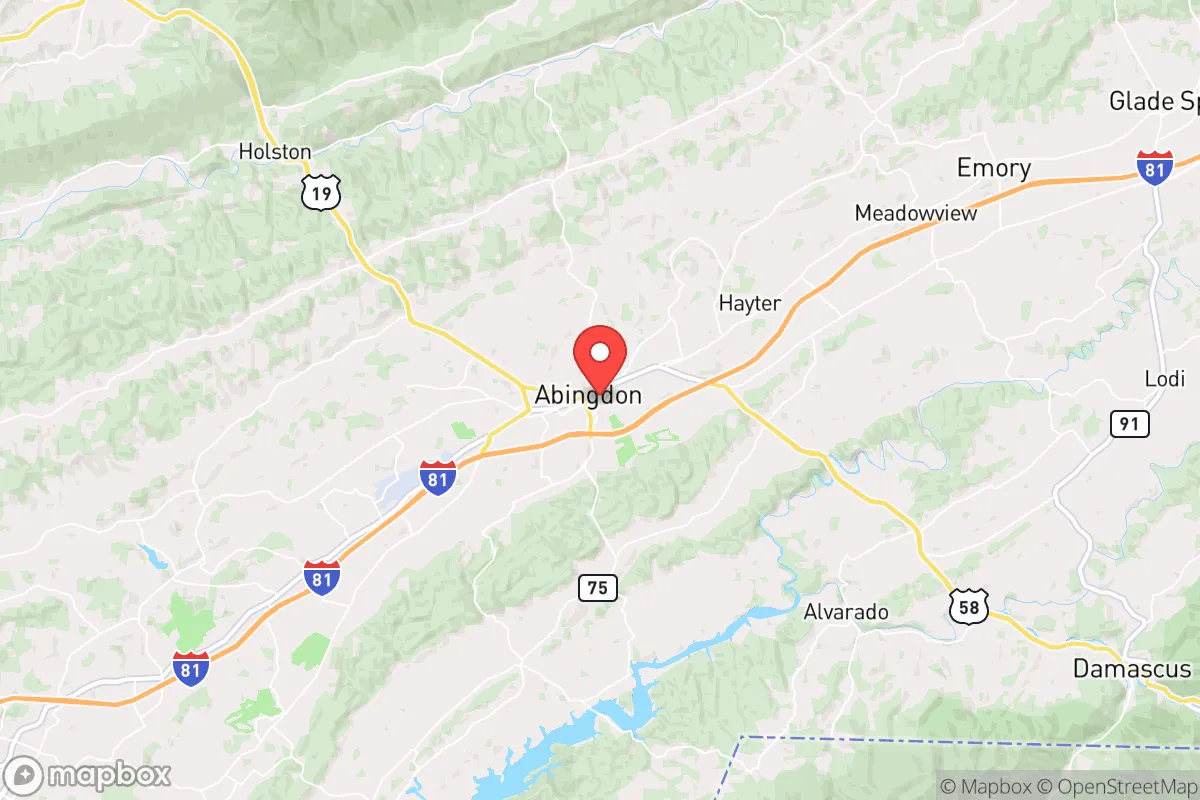
District shown is the primary district for this city’s centroid. Cities may span multiple districts.
Local Political AnalysisPolitical Analysis of Abingdon, VA
Abingdon, Virginia, sits in a deeply conservative corner of the state, with a Cook Partisan Voting Index of R+22 — meaning the district votes about 22 points more Republican than the national average. That's a stark contrast to Virginia as a whole, which has shifted to a D+4 PVI, reflecting the blue tide in the northern suburbs and urban centers. If you've been around here long enough, you've watched this gap widen: while the rest of the state has trended left over the past decade, Washington County has held steady, and if anything, gotten a little more Republican in local races. The 2024 presidential results here weren't close — Trump carried the county by a margin that would make a statewide Democrat wince.
How it compares
Drive an hour north to Bristol, and you'll find a similar red-leaning vibe, though it's a bit more purple thanks to a larger working-class base that sometimes splits tickets. Head east toward Wytheville, and the politics stay conservative but with a quieter, more establishment-Republican flavor. The real contrast comes when you cross into the New River Valley — Blacksburg and Christiansburg, home to Virginia Tech, are reliably blue, with a PVI around D+8. That's a 30-point swing in less than 90 minutes. Meanwhile, the state-level picture is dominated by the D+4 PVI, powered by Fairfax County, Arlington, and Richmond. So when you're in Abingdon, you're living in a political island relative to the state capital — the Barter Theatre crowd might lean moderate, but the county commission and school board elections are decided in Republican primaries.
What this means for residents
For conservative residents, Abingdon feels like a place where their values are reflected in local policy — lower taxes, Second Amendment protections, and a school system that hasn't been pulled into culture-war fights as aggressively as in Northern Virginia. You'll see "In God We Trust" plaques in the courthouse, and the local GOP is well-organized. For liberal residents, it can feel isolating, but not hostile — most folks are polite, and there's a live-and-let-live attitude in the coffee shops and on the Virginia Creeper Trail. Progressive candidates rarely win here, but they do run, and the local Democratic committee is active. The practical reality is that if you're left of center, you'll have to drive to Blacksburg or Roanoke for a like-minded political meetup, but you won't face the kind of friction you might in a deep-blue suburb.
Culturally, Abingdon's conservatism comes with a strong sense of tradition and community pride — the town's historic district, the Martha Washington Inn, and the annual Virginia Highlands Festival all reflect a place that values its past. There's less of the "transplant" energy you see in places like Asheville or Charlottesville, so the political climate feels more stable and less reactive to national trends. Policy-wise, you'll notice lower property taxes than in the blue parts of the state, and the local government tends to favor economic development over social spending. But don't mistake the red lean for uniformity — the town's arts scene and the college crowd at Emory & Henry College bring a quieter diversity of thought that keeps things from feeling monolithic. If you're moving here, the political climate is something you'll feel in the zoning meetings and the local paper's letters page, but it rarely dominates daily life the way it does in a swing district.

State Political ClimatePolitical Climate in Virginia
State Political AnalysisPolitical Environment in the State
Virginia has shifted from a reliably purple swing state to a solidly Democratic-leaning one over the past two decades, now carrying a Cook PVI of D+4. The transformation has been driven primarily by explosive population growth in the Washington, D.C. suburbs, which now dominate state elections and have pulled the entire commonwealth leftward on cultural and economic issues. While the state still elects Republican governors in off-years—Glenn Youngkin won in 2021—the General Assembly has been under Democratic control for most of the last decade, and the presidential vote has not gone Republican since 2004. For a conservative relocator, the reality is that Virginia is a blue state with red pockets, not a purple one.
Urban vs. rural divide
The political map of Virginia is a textbook case of the urban-rural split. The entire Democratic margin comes from a handful of densely populated jurisdictions: Fairfax County, Prince William County, Loudoun County, and the cities of Arlington and Alexandria in Northern Virginia. These five localities alone account for over a third of the state's vote and routinely deliver margins of 60-70% for Democrats. The Richmond metro area, including Henrico County and the city itself, adds another deep-blue bloc, while Hampton Roads (Norfolk, Virginia Beach, Chesapeake) is more competitive but trending blue. Meanwhile, the rest of the state—Southside Virginia, the Shenandoah Valley, Southwest Virginia, and most of the Piedmont—votes overwhelmingly Republican. Places like Roanoke, Lynchburg, and the exurbs of Fredericksburg are conservative strongholds, but they simply do not have the population to counterbalance Northern Virginia. The divide is so stark that a Republican can win statewide only by running up huge margins in the rural crescent while keeping losses in NoVA within single digits—a feat Youngkin managed in 2021 but that has proven difficult for most GOP candidates.
Policy environment
Virginia's policy environment reflects its Democratic tilt, though with moderation enforced by the state's competitive gubernatorial races. The state income tax is a flat 5.75%, with a standard deduction that has been increased in recent years. Sales tax is 5.3% statewide, with an additional 1% in most localities. Property taxes are set at the local level and vary widely—Northern Virginia rates are moderate, while rural counties tend to be lower. The regulatory posture is business-friendly in some respects—Virginia is a right-to-work state and has a relatively low corporate tax rate of 6%—but labor and environmental regulations have tightened under Democratic control. Education policy is a major flashpoint: the state has adopted expansive transgender student protections, and the debate over parental rights in schools has been intense, with Youngkin's administration pushing for more transparency and local control. Healthcare policy leans left: Virginia expanded Medicaid under the Affordable Care Act in 2018, and the state has some of the strongest insurance market regulations in the South. Election laws are moderately restrictive compared to deep-blue states: voter ID is required, but same-day registration is not available, and early voting is permitted without an excuse. The state does not have a "sanctuary city" law on the books, but several localities, including Fairfax County and Richmond, have adopted policies limiting cooperation with federal immigration enforcement.
Recent policy direction
The last five years have seen a rapid leftward shift on several fronts. In 2020, the Democratic-controlled General Assembly passed the Virginia Clean Economy Act, mandating a carbon-free electric grid by 2050 and effectively phasing out fossil fuel generation. On gun policy, the state enacted universal background checks, a red-flag law, and a one-handgun-per-month limit in 2020, though a proposed assault weapons ban failed. On education, the state adopted the "Model Policies on Ensuring Safe, Equitable, and Supportive Learning Environments" in 2021, which included transgender student accommodations—prompting a fierce backlash that helped elect Youngkin. In 2023, the state legalized recreational marijuana, though retail sales have been delayed until 2025. On abortion, Virginia remains an outlier in the South: the state allows abortion up to 26 weeks, with no major restrictions enacted after the Dobbs decision, though Youngkin's push for a 15-week ban failed in the divided legislature. On voting, the state expanded no-excuse absentee voting and automatic voter registration. Property rights have been a quieter issue, but the state has not enacted any major eminent domain or land-use reforms. For a conservative relocator, the takeaway is that Virginia's policy direction is clearly leftward, but the pace is moderated by the fact that Republicans can still win statewide and hold the legislature to account.
Civil unrest & political movements
Virginia has been a focal point for political activism on both sides. The 2017 Unite the Right rally in Charlottesville and the subsequent violence put the state on the national map for far-right organizing, but also galvanized a strong counter-movement. In 2020, the state saw massive protests in Richmond over racial justice and police reform, including the toppling of Confederate statues on Monument Avenue. The gun rights movement is particularly active: the 2020 Virginia Citizens Defense League rally at the state capitol drew tens of thousands of armed protesters, and the issue remains a top concern for rural conservatives. Immigration politics are less heated than in border states, but the debate over sanctuary policies in Northern Virginia and Richmond is ongoing. Election integrity has been a persistent issue since 2020, with Republican activists raising concerns about mail-in voting and the state's voter roll maintenance, though no major fraud has been proven. A new resident would notice the political polarization most acutely in the suburbs of Northern Virginia, where yard signs and bumper stickers are common, and in the rural areas, where "Don't Tread on Me" flags and Trump signs are still prevalent. The state is not experiencing active civil unrest, but the political temperature is high, and flashpoints like school board meetings and local elections can be surprisingly contentious.
Projection
Over the next five to ten years, Virginia is likely to continue its leftward drift, driven by the ongoing population growth in Northern Virginia and the Hampton Roads area. The state's demographics are shifting: the white, non-college-educated population that forms the Republican base is shrinking, while the diverse, college-educated population in the suburbs is growing. The 2030 redistricting cycle could further entrench Democratic control if the party controls the process. However, the state's off-year gubernatorial elections provide a check—Republicans can still win by running moderate, business-friendly candidates who appeal to the suburban swing voter. For a conservative moving in now, the realistic expectation is that Virginia will be a blue state for the foreseeable future, but one where Republican voices are still heard and where local control in rural and exurban areas can provide a buffer. The key battlegrounds will be the state legislature and the governor's mansion, not the presidential or Senate races. A decade from now, expect a state that is more diverse, more urban, and more Democratic, but with a resilient conservative minority that remains influential in local politics and in the statehouse when turnout favors them.
For a new resident, the bottom line is that Virginia offers a mix of economic opportunity and political tension. If you are conservative, you will find like-minded communities in the Shenandoah Valley, Southside, and Southwest Virginia, but you will be living in a state where the majority of your neighbors voted for the other party and where state policy will often run against your values. If you are liberal, you will find a welcoming environment in the cities and suburbs, but you will encounter sharp resistance in rural areas. The state is not a political monoculture, and that is both its strength and its challenge. Choose your locality carefully—the difference between living in Fairfax County and living in Botetourt County is the difference between two different Americas.
* Values derived from national, state, county, city and local statistics and may differ in a specific area. Last updated: 2026-10-24T15:31:27.000Z
Narrative content on this page is AI-generated and may contain mistakes. Verify any details that matter before acting on them.
ReloMaps may earn a commission from affiliate links at no extra cost to you.

