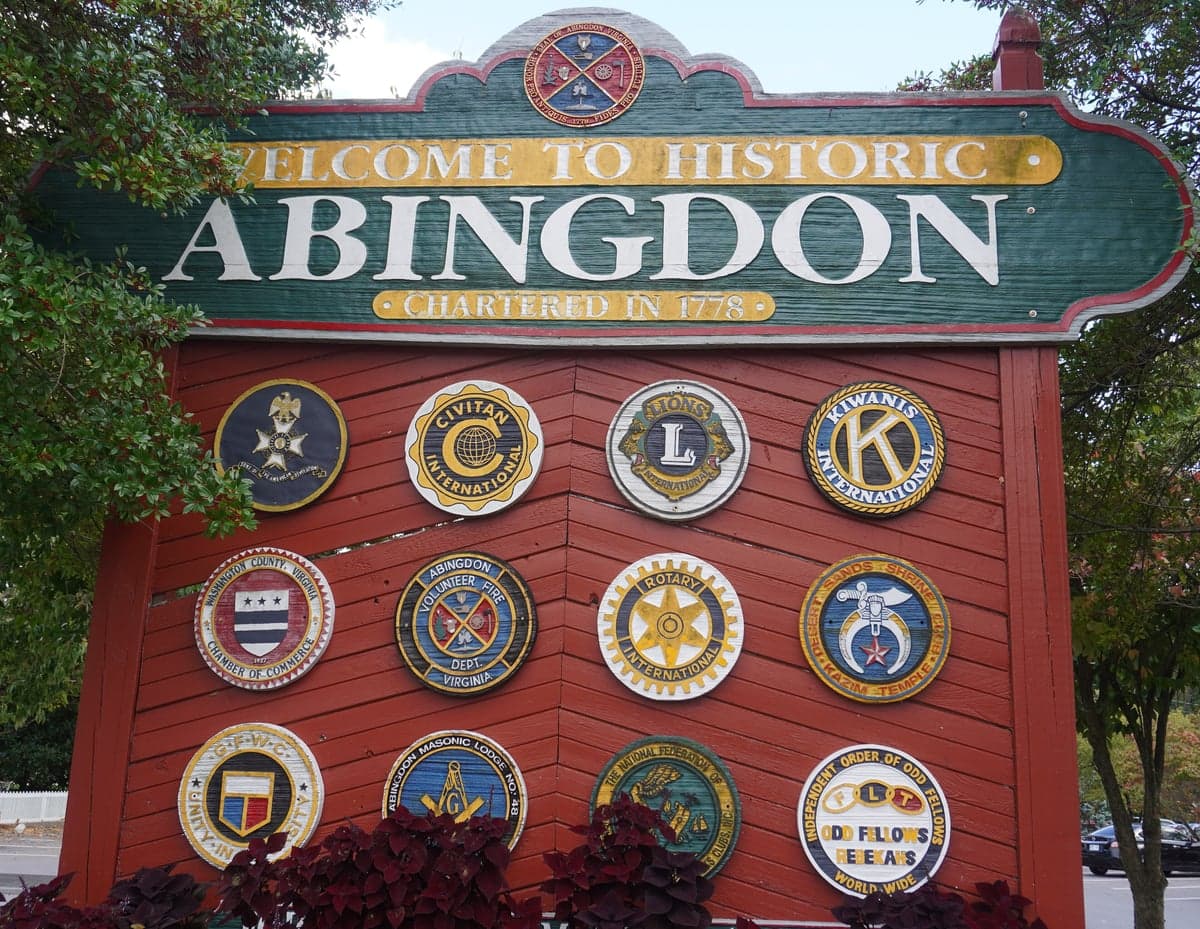
Photo: Wikipedia
Demographics of Abingdon, VA
Affluence Level in Abingdon, VA
A below-average socioeconomic profile. Incomes, home values, and educational attainment trail the U.S., with higher poverty and unemployment.
People of Abingdon, VA
The people of Abingdon, Virginia today form a community of roughly 8,300 residents that is notably more diverse than much of Southwest Virginia, with a white population of 59.0%, a Black population of 18.4%, and a Hispanic share of 10.7%. The city has a distinctly educated workforce — 41.5% of adults hold a college degree — and a foreign-born population of 5.7% that is higher than the surrounding Washington County average. Abingdon’s identity is shaped by its historic downtown, its role as a regional cultural and medical hub, and a demographic mix that reflects both deep-rooted Appalachian lineages and newer immigrant communities.
How the city was settled and grew
Abingdon was founded in 1778 as the seat of Washington County, drawing its earliest white settlers primarily from English, Scots-Irish, and German stock who moved southwest along the Great Wagon Road from Pennsylvania and the Shenandoah Valley. These families were attracted by land grants offered to veterans of the Revolutionary War and by the fertile valleys of the Holston River watershed. The town grew slowly as a stagecoach stop and later as a railroad town after the Virginia & Tennessee Railroad arrived in the 1850s, which connected Abingdon to eastern markets and brought a wave of merchants and craftsmen. The historic Meadowview neighborhood, with its late-19th-century homes, was built by the town’s merchant and professional class, while working-class families — many of them railroad laborers — settled in the Green Spring area south of the tracks. A small but established Black community formed in the West Main Street corridor and the Dogtown area, centered around churches and the segregated Douglass School, which served African American students until integration.
Modern era (post-1965)
After the 1965 Hart-Cellar Act, Abingdon saw modest but steady immigration that reshaped its ethnic composition. The most significant change has been the growth of Hispanic and East/Southeast Asian populations, driven by labor demand in the region’s poultry processing plants and furniture manufacturing. The North Cummings Street corridor and the area around Lee Highway have become informal hubs for Hispanic families, with several tiendas, churches, and community organizations serving the growing population. East/Southeast Asian residents — primarily Vietnamese and Filipino families — arrived in smaller numbers, often drawn by medical and professional jobs at Johnston Memorial Hospital and the Virginia Highlands Community College. The Indian-subcontinent population, now at 2.6%, is a more recent addition, concentrated among medical professionals and tech workers who have settled in newer subdivisions like Stone Mill and Brookside. The Black population, which was historically concentrated in West Main and Dogtown, has become more dispersed across the city, though those neighborhoods retain strong community institutions. The white population, while still the majority, has declined from over 85% in 1990 as younger families have moved to larger metro areas and been replaced by retirees and newcomers drawn to Abingdon’s quality of life.
The future
Abingdon’s population is slowly becoming more diverse, with the Hispanic and Asian shares expected to continue rising as the region’s manufacturing and healthcare sectors expand. The city’s foreign-born population, now 5.7%, is likely to grow as employers recruit internationally for specialized medical and technical roles. New residential development is concentrated in the Stone Mill and Brookside subdivisions on the city’s eastern edge, where younger families and professionals are settling, while the historic downtown is seeing an influx of retirees and remote workers. The cultural identity of Abingdon is evolving from a predominantly white Appalachian town into a more pluralistic community, though the pace of change is gradual and the city remains less diverse than Virginia as a whole. The next 10-20 years will likely see continued diversification, particularly in the Hispanic and Asian populations, while the white share continues a slow decline.
For someone moving to Abingdon now, the city offers a blend of historic small-town character and growing diversity, with a population that is more educated and more ethnically varied than most of Southwest Virginia. The community is becoming a regional hub for healthcare, arts, and education, attracting both retirees and younger professionals who value its walkable downtown and access to outdoor recreation. The demographic trends point toward a slowly more diverse and economically stable future, though the city retains a distinctly Southern Appalachian cultural foundation.

* Values derived from national, state, county, city and local statistics and may differ in a specific area. Last updated: 2026-10-24T15:31:27.000Z
Narrative content on this page is AI-generated and may contain mistakes. Verify any details that matter before acting on them.
ReloMaps may earn a commission from affiliate links at no extra cost to you.

