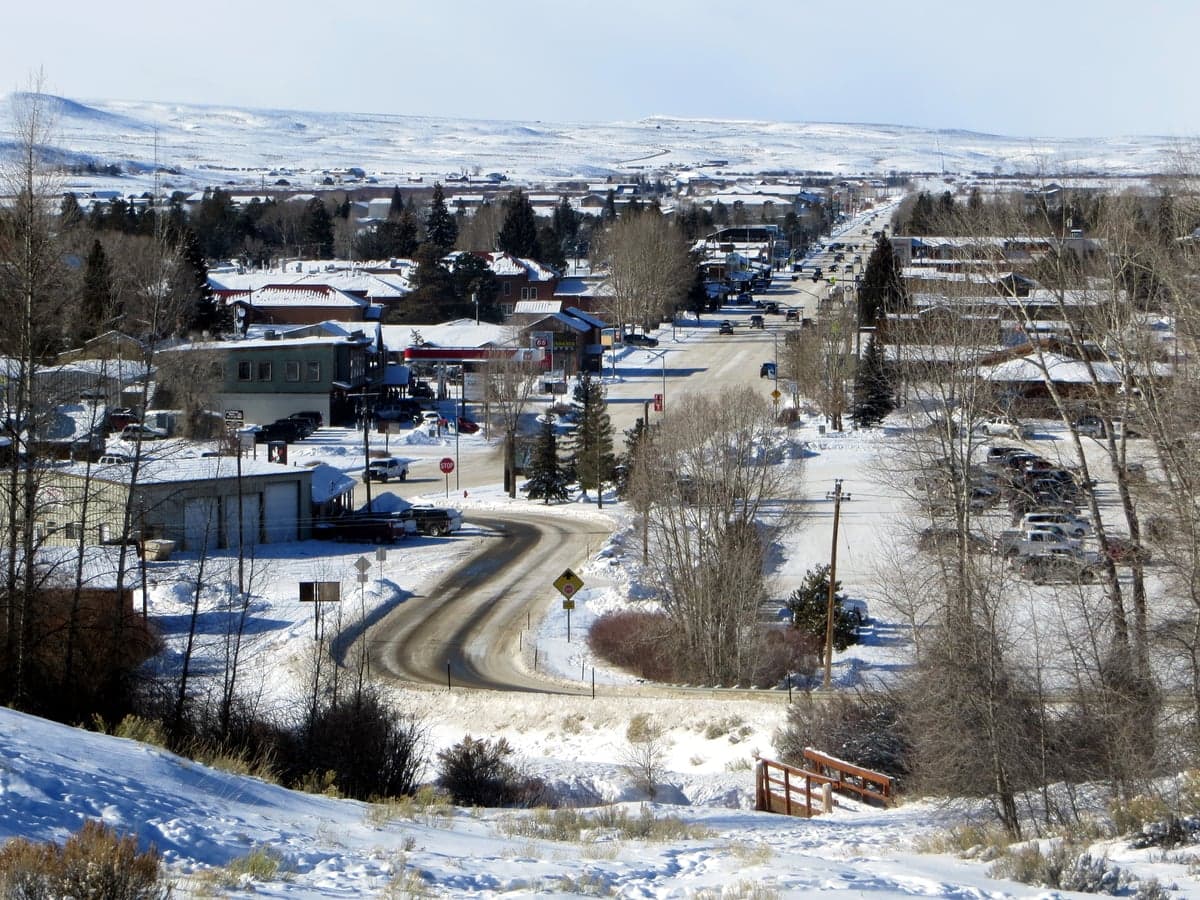
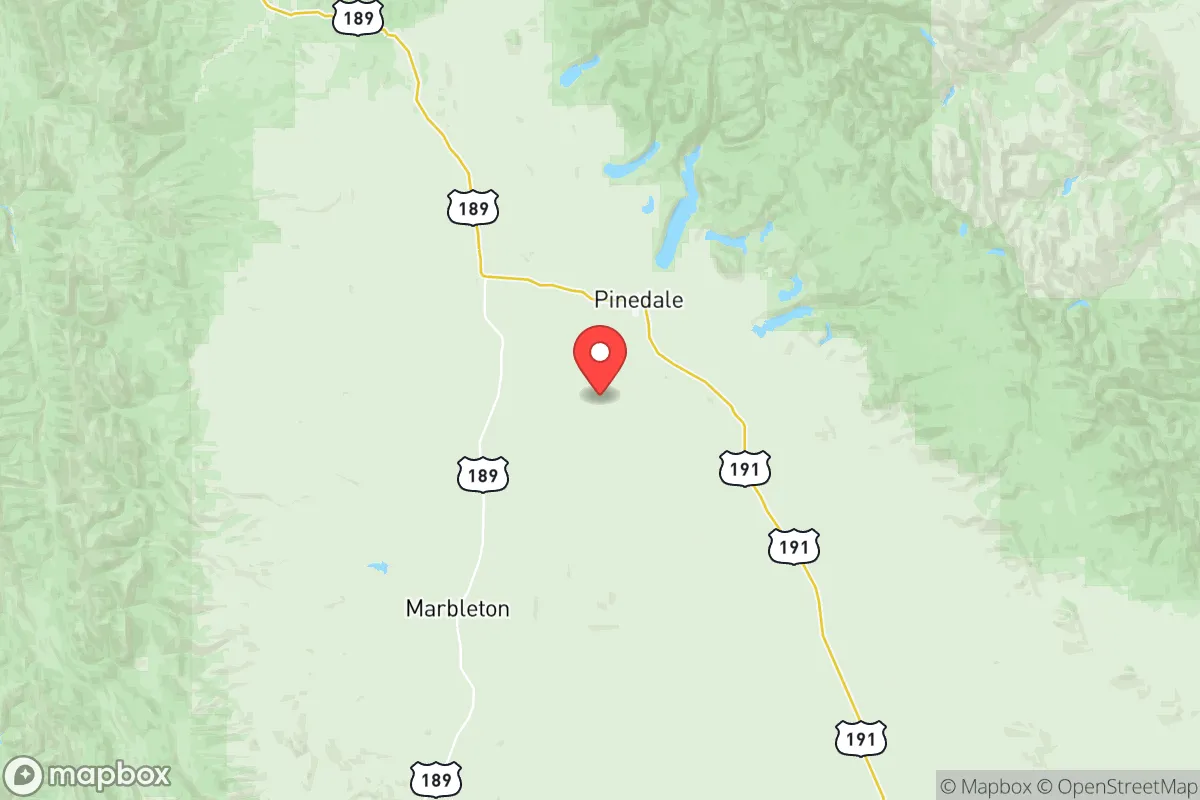
Photo: Wikipedia
Demographics of Sublette County
Affluence Level in Sublette County
A middle-class area roughly in line with national averages across income, home values, education, and employment.
People of Sublette County
The people of Sublette County, Wyoming, today number roughly 8,800, making it one of the least densely populated counties in the lower 48 states, with fewer than two people per square mile. The population is overwhelmingly white (90.0%) and native-born (97.6% U.S.-born), with a Hispanic or Latino share of 7.3% representing the largest minority group. Distinctive identity markers include a deep-rooted ranching and energy-extraction culture, a strong libertarian streak, and a population that is older and more male than the national average, reflecting the county's role as a hub for natural gas and oilfield work.
Settlement & growth (pre-1960)
Long before European settlement, the area now known as Sublette County was seasonal hunting and gathering territory for several Native nations, most notably the Shoshone, whose traditional lands extended across the Green River Basin. The U.S. government formally recognized Shoshone and Bannock claims through the 1868 Fort Bridger Treaty, but the tribes were gradually confined to the Wind River Reservation to the east, leaving Sublette County largely depopulated of Native people by the 1880s. The first sustained non-Native presence came with fur trappers and mountain men in the 1820s and 1830s, who worked the Green River and its tributaries, but no permanent settlements emerged from that era.
Permanent American settlement began in earnest only after the 1890s, driven by the expansion of the cattle industry. The county was formally created in 1923 from parts of Fremont and Lincoln counties, named for the explorer and fur trader William Sublette. The earliest towns — Pinedale, the county seat, and Big Piney — were founded as supply points for cattle ranches. Pinedale was platted in 1904 and grew slowly as a ranching center; Big Piney, incorporated in 1913, served a similar role. A third historic settlement, Bondurant, was established around 1900 as a stage stop and ranching community in the Hoback River valley. These early settlers were overwhelmingly of Northern European stock — English, Scots-Irish, and German — drawn by the promise of open range and homesteading under the 1862 Homestead Act and later the 1916 Stock-Raising Homestead Act, which allowed 640-acre claims in arid regions.
Through the 1920s and 1930s, the population remained tiny — fewer than 2,000 residents — and almost entirely dependent on cattle ranching and sheep grazing. The Dust Bowl and Great Depression brought a modest influx of displaced farmers from the Great Plains, but Sublette County never saw the kind of mass migration that transformed other Western states. The discovery of oil and natural gas in the 1950s, particularly in the La Barge field near La Barge (a town incorporated in 1922), began to shift the economic base. By 1960, the county's population had reached just over 3,000, still overwhelmingly white and native-born, with a small Hispanic population tied to seasonal sheepherding and railroad work.
Modern era (post-1965)
The 1965 Hart-Cellar Act had minimal direct effect on Sublette County, as the region never attracted significant post-1965 immigration from Asia, Africa, or Latin America. The foreign-born share today is just 2.4%, far below the national average. The county's demographic story since the 1970s is instead one of domestic migration, driven almost entirely by the boom-and-bust cycles of the energy industry. The 1970s energy crisis spurred a natural gas drilling rush in the Green River Basin, and the population surged from 3,700 in 1970 to 5,900 by 1980. New subdivisions and mobile home parks appeared around Pinedale and Big Piney, and the town of Marbleton, just south of Big Piney, grew as a bedroom community for oilfield workers.
The bust of the 1980s sent the population back down to roughly 4,500 by 1990, but the 2000s brought a second, larger boom driven by the Pinedale Anticline natural gas field, one of the most productive in the Rocky Mountain region. Between 2000 and 2010, the county's population jumped from 5,920 to 10,247 — a 73% increase, one of the fastest growth rates in the nation. This wave brought workers from across the American West and Midwest, including many from Texas, Oklahoma, and Colorado, as well as a growing number of Hispanic workers, primarily of Mexican origin, who took jobs in construction, drilling support, and service industries. The Hispanic share rose from roughly 3% in 2000 to 7.3% today, with concentrations in Pinedale and Big Piney, where seasonal and year-round workers live in rental housing and mobile home parks.
The Asian population remains negligible (0.0%), as does the Black population (0.0%), and there is no measurable Indian-subcontinent community. The county's college-educated share is 31.1%, slightly above the Wyoming average but below the national figure, reflecting the blue-collar nature of the energy economy. Suburbanization as it is understood in metropolitan America does not exist here; instead, the pattern has been one of dispersed rural housing and small-town infill, with no new incorporated places emerging since Marbleton's founding in the 1910s.
The future
Sublette County's population trajectory is tightly tied to natural gas prices and federal energy policy. The 2010s saw a decline from the 2010 peak of 10,247 to 8,806 by 2020, as the shale gas boom cooled and automation reduced the need for drilling crews. The county is likely to remain predominantly white and native-born, with the Hispanic share stabilizing or growing slowly as families of oilfield workers put down roots. No significant influx of Asian, Black, or Indian-subcontinent populations is expected, given the lack of urban amenities, ethnic enclaves, or employer-driven recruitment from those communities. The county's cultural identity — conservative, independent, resource-extraction-oriented — is unlikely to shift meaningfully. The next 10-20 years will probably see a slow population decline or stabilization, with growth limited to occasional energy price spikes, and the county will remain one of the most demographically homogeneous places in the United States.
For someone moving in now, Sublette County offers a community where the population is stable, culturally cohesive, and deeply tied to the land and its resources. The lack of diversity is a demographic reality, not a trend in flux, and newcomers should expect a social environment shaped by ranching traditions, energy-industry rhythms, and a political culture that prizes local control and limited government. The county is not becoming more diverse or more urban; it is becoming more settled, with a population that is aging in place and a younger workforce that follows the commodity cycle.

* Values derived from national, state, county, city and local statistics and may differ in a specific area. Last updated: 2026-07-08T13:23:01.000Z
Narrative content on this page is AI-generated and may contain mistakes. Verify any details that matter before acting on them.
ReloMaps may earn a commission from affiliate links at no extra cost to you.

