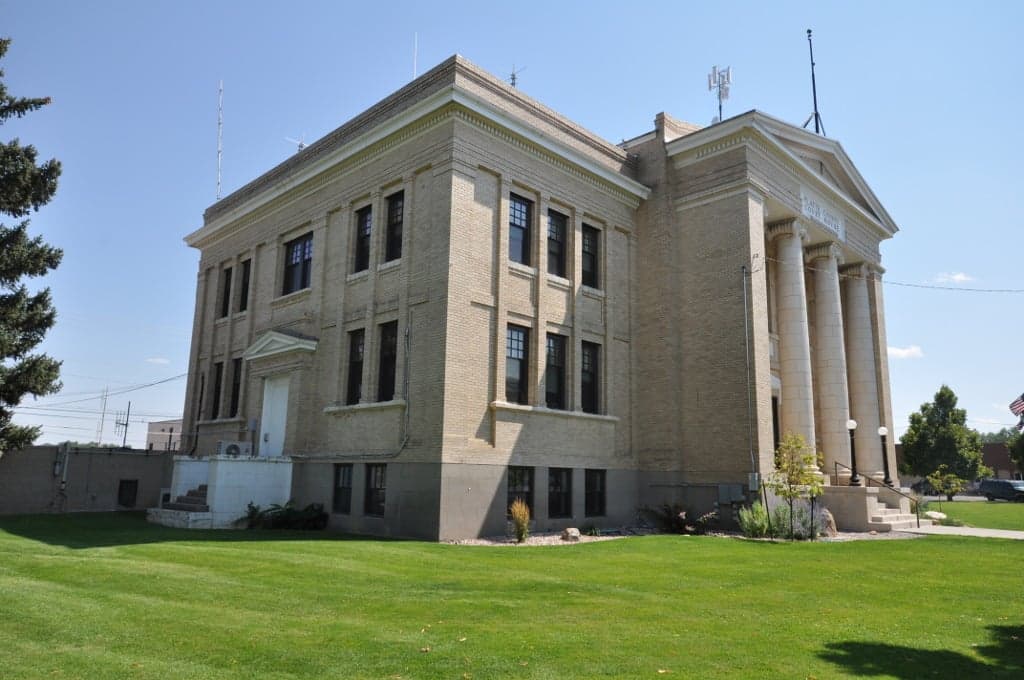
Photo: Wikipedia
Political ClimatePolitical Climate in Platte County
Showing state-level results — no local-only data available.
Local Political AnalysisPolitical Analysis of Platte County
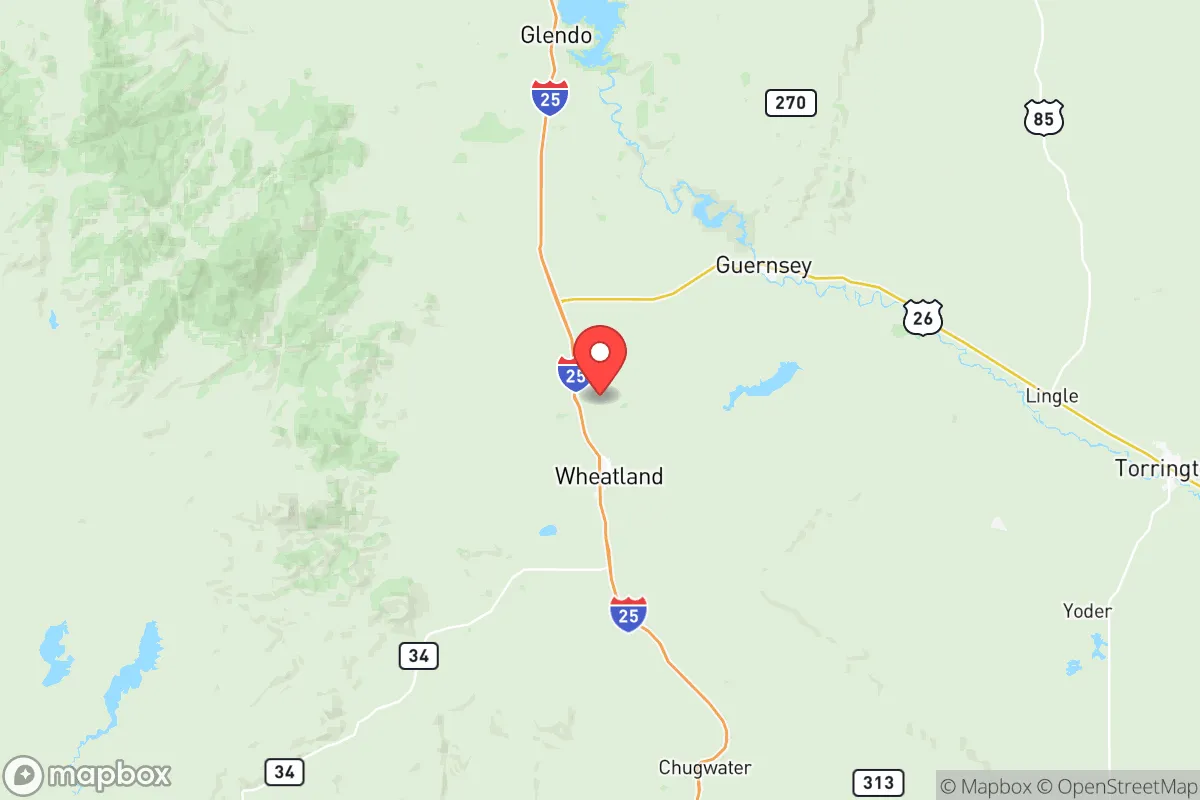
Platte County, Wyoming, is a deeply conservative area with a Cook Partisan Voting Index (PVI) of R+23, making it one of the most reliably Republican counties in the state. The county has voted for the GOP presidential candidate by margins of 30 to 40 points in recent cycles, with no signs of a shift toward the center. The political culture here is rooted in ranching, energy, and a strong independent streak, but there are subtle variations between towns like Wheatland, the county seat, and smaller communities like Chugwater and Guernsey that reflect different local priorities.
How it compares
Platte County is more conservative than the state of Wyoming as a whole, which itself is one of the most Republican states in the nation. While Wyoming's overall PVI is not officially calculated at the state level, the state has voted for the GOP by an average of 40+ points in presidential elections since 2000. Platte County's R+23 PVI actually understates its lean in practice — in 2024, the county gave the Republican candidate over 75% of the vote, while the state average was closer to 70%. The difference is driven by the county's lack of a major urban center or a large university town, which in other parts of Wyoming (like Laramie or Teton County) can produce pockets of Democratic or independent voters. Within Platte County, Wheatland is the most moderate precinct, with a small but consistent Democratic vote of around 20-25%, while Chugwater and Guernsey are more uniformly conservative, often exceeding 80% for the GOP. The swing precincts are essentially nonexistent — the county has not voted for a Democratic presidential candidate since Lyndon Johnson in 1964.
What this means for residents
For conservative residents, Platte County offers a political environment where their views are the clear majority, and local governance reflects that. The county commission, school board, and municipal councils in Wheatland and Guernsey are dominated by Republicans, and policy debates tend to focus on property rights, energy development, and limited government. For liberal or moderate residents, the reality is more isolating. There is no organized Democratic party presence in the county, and social or political events that lean left are rare. That said, the county's small population (around 8,000) means that personal relationships often transcend political differences — neighbors help each other regardless of party affiliation. The practical effect of the political climate is most visible in local tax policy (low property taxes, minimal county services) and land-use regulations (very permissive for agriculture and energy).
Culturally, Platte County is distinct from the more tourist-driven parts of Wyoming like Jackson Hole or Cody. The economy here is driven by cattle ranching, hay farming, and some oil and gas activity, which reinforces a conservative, self-reliant ethos. The county is also home to the Guernsey State Park and the Oregon Trail ruts, which draw some visitors but not enough to shift the local political culture. One notable policy distinction: Platte County has been a stronghold for Second Amendment sanctuary resolutions and has resisted state-level efforts to expand wind energy, reflecting a preference for traditional energy and local control. For anyone moving here, the political climate is straightforward — if you lean conservative, you'll feel at home; if you don't, you'll need to be comfortable being in the minority, but you won't face hostility in daily life.

State Political ClimatePolitical Climate in Wyoming
State Political AnalysisPolitical Environment in the State
Wyoming is one of the most reliably Republican states in the nation, with a partisan lean that has only deepened over the past two decades. In the 2024 presidential election, Donald Trump carried the state by roughly 46 points, a margin that has held steady or grown since 2016. The dominant political coalition is a blend of traditional Western libertarians, evangelical conservatives, and an increasingly vocal populist wing centered on energy independence and federal land management. While the state has always been red, the flavor of that red has shifted noticeably since 2010 — away from the old "live and let live" ranching conservatism toward a more assertive, culturally conservative posture that mirrors national trends.
Urban vs. rural divide
The political map of Wyoming is less about urban-versus-rural and more about degrees of rural. The largest city, Cheyenne, leans Republican but is the most moderate part of the state, with Laramie County voting about 20 points right of the national average — still solidly red, but noticeably less so than the rest. Casper in Natrona County is similar: reliably conservative but with a small but visible Democratic presence tied to the energy industry's unionized workforce. The real engine of Wyoming's deep red tilt is the vast rural expanse. Counties like Sublette, Lincoln, and Weston routinely deliver 80-85% of the vote to Republican candidates. Jackson in Teton County is the one true outlier — a wealthy resort town that votes Democratic by margins comparable to Boulder or Aspen, but its population is too small to shift the statewide balance. The divide isn't really city vs. country; it's Teton County vs. everything else.
Policy environment
Wyoming's policy environment reflects its deep Republican control. There is no state income tax, and the sales tax is a low 4% (with local options pushing it to around 6% in some towns). Property taxes are among the lowest in the nation, though a 2024 ballot initiative to further cap residential assessments failed after a contentious debate. The regulatory posture is aggressively pro-energy: the state has actively resisted EPA methane rules and sued over federal coal leasing moratoriums. Education policy is a mixed bag — the state funds schools generously through mineral royalties, but per-pupil spending has been flat since 2015 as coal revenues declined. School choice is limited; there are no private school vouchers, though a 2023 bill to create education savings accounts narrowly failed. Healthcare is a persistent challenge: Wyoming did not expand Medicaid under the ACA, leaving roughly 20,000 residents in the coverage gap. Election laws are moderately restrictive: voter ID is required, same-day registration is not available, and mail voting requires an excuse. There are no major controversies around election integrity here — the state's small population and paper ballot system have kept things quiet.
Recent policy direction
The last five years have seen Wyoming move decisively in a culturally conservative direction on several fronts. In 2023, the legislature passed a near-total abortion ban with limited exceptions, overriding the governor's veto. Gun laws remain among the most permissive in the country: permitless carry has been law since 2011, and there are no red flag laws or waiting periods. On parental rights, the 2023 "Parents' Bill of Rights" requires schools to notify parents about curriculum changes and medical services. A 2024 law banned transgender girls from female sports in K-12 and college athletics. Property rights remain a flashpoint: the state has passed multiple laws pushing back against federal land management, including a 2022 measure demanding the transfer of 30 million acres of federal land to state control — largely symbolic, but a clear statement of intent. On privacy and surveillance, Wyoming has no broad data privacy law, but a 2024 bill restricting government use of facial recognition passed with bipartisan support. The overall direction is toward expanding individual liberty on guns and property while restricting it on abortion and transgender issues — a pattern that tracks the national conservative movement closely.
Civil unrest & political movements
Wyoming is not a state known for street protests or visible civil unrest. The most politically charged moments in recent years have centered on federal land management. The 2016 occupation of the Malheur National Wildlife Refuge in neighboring Oregon had echoes in Wyoming, where the "Sagebrush Rebellion" has deep roots. In 2020, there were small Black Lives Matter protests in Cheyenne and Laramie, but they were modest by national standards and met with counter-protests. The more enduring political movement is the push for state control of federal lands, which enjoys broad bipartisan support in rural counties. Immigration politics are largely theoretical here — Wyoming has one of the smallest foreign-born populations in the country, and there are no sanctuary cities. The most visible political flashpoint for a new resident would likely be the tension between the energy industry and conservationists, particularly in the Upper Green River Valley near Pinedale, where natural gas development and wildlife habitat have been in conflict for decades. Election integrity controversies are minimal; the state's small scale and paper-based voting system have insulated it from the kind of disputes seen in larger swing states.
Projection
Over the next 5-10 years, Wyoming's political trajectory is likely to remain deeply conservative, but the character of that conservatism may shift. In-migration is accelerating, particularly to Teton County and the Laramie area, bringing more moderate and even left-leaning residents. However, the numbers are small — Wyoming's population growth has been among the slowest in the nation, and the newcomers are concentrated in a few places. The bigger demographic story is the aging of the existing population: Wyoming has one of the oldest median ages in the country, and younger residents continue to leave for better job markets. This suggests the state will become more conservative over time, not less, as the electorate skews older and more rural. The energy transition is the wild card: if coal continues to decline without a replacement, the state's budget will face serious pressure, potentially forcing tax increases or spending cuts that could reshape the political landscape. For now, the most likely scenario is more of the same — a deeply red state that occasionally surprises with a libertarian streak on issues like marijuana legalization (which failed in 2023 but came closer than expected) or land use.
For a new resident, the practical takeaway is straightforward: if you're conservative, you'll find a state that largely aligns with your values on taxes, guns, and cultural issues, but you should be prepared for a limited job market and a healthcare system that can be hard to navigate. If you're liberal, you'll be in a distinct minority, but you won't face hostility in daily life — Wyoming's conservatism is generally polite and live-and-let-live, especially outside of the most charged political moments. The key is to understand that the state's politics are driven by its geography and economy: a small, spread-out population dependent on energy extraction and federal land. That's not changing anytime soon.
* Values derived from national, state, county, city and local statistics and may differ in a specific area. Last updated: 2026-08-08T12:04:02.000Z
Narrative content on this page is AI-generated and may contain mistakes. Verify any details that matter before acting on them.
ReloMaps may earn a commission from affiliate links at no extra cost to you.

