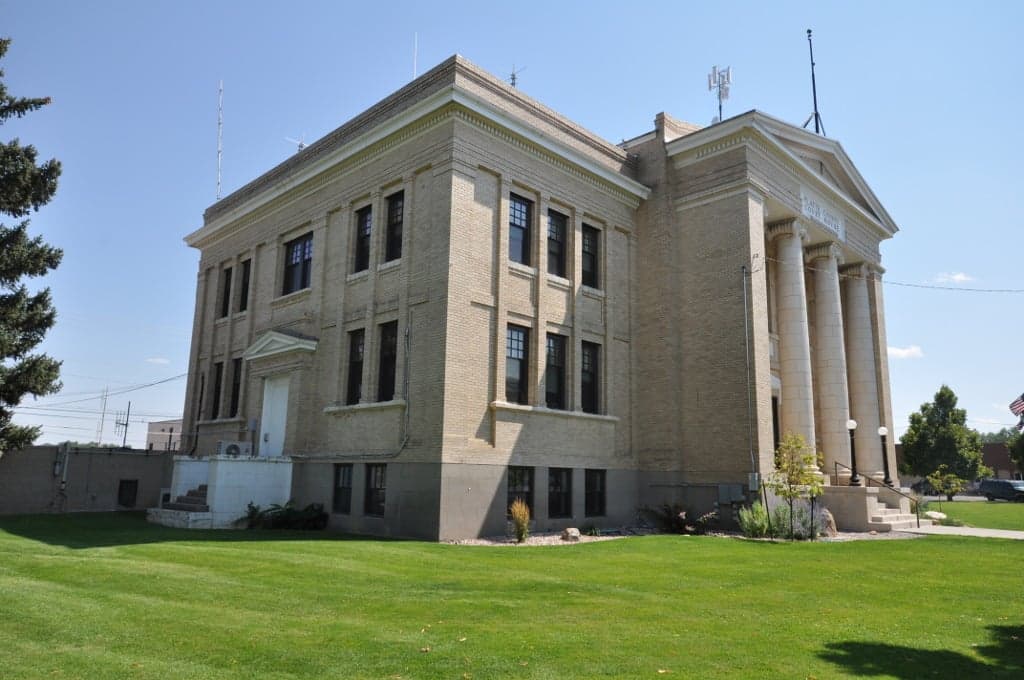
Photo: Wikipedia
Demographics of Platte County
Affluence Level in Platte County
A middle-class area roughly in line with national averages across income, home values, education, and employment.
People of Platte County
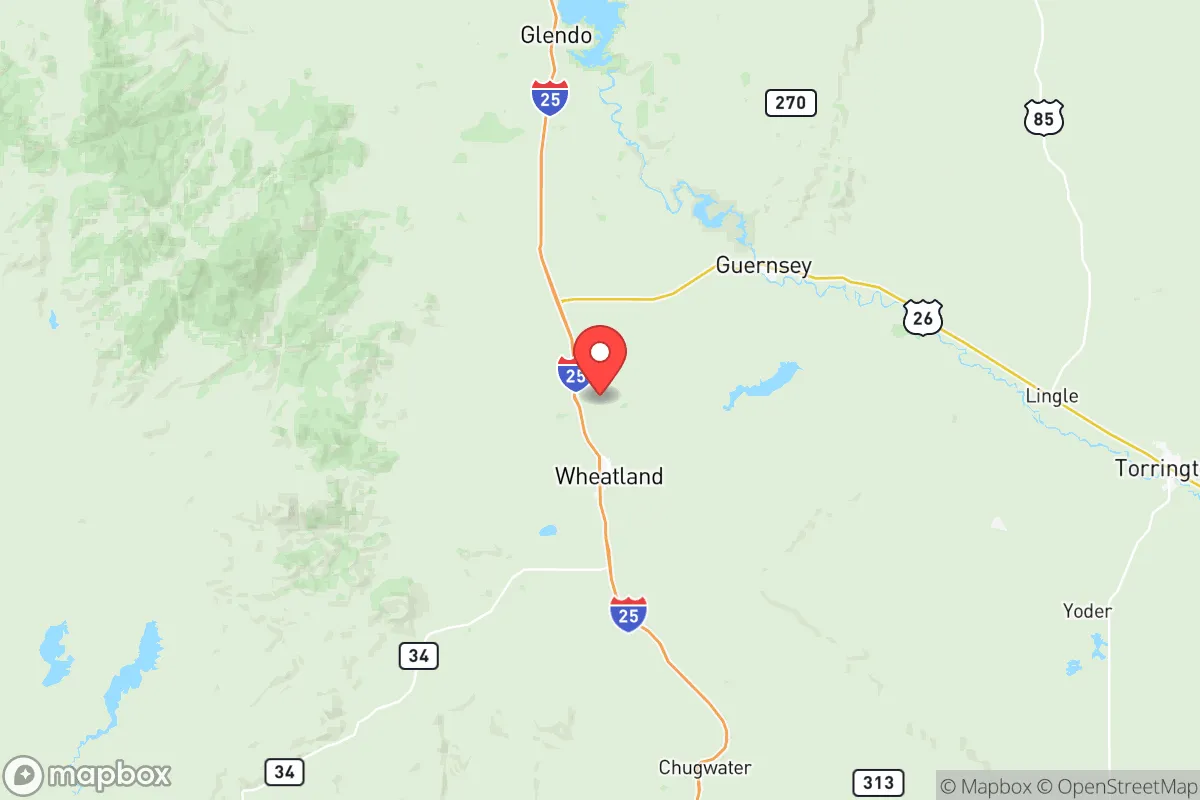
Today, Platte County, Wyoming, is home to 8,606 residents, a population that is 85.6% white and 8.5% Hispanic, with a foreign-born share of just 0.6% — one of the least diverse counties in the state. The county’s character is defined by its agricultural roots, a strong ranching and energy-sector presence, and a deeply rural, conservative identity centered on the towns of Wheatland, Guernsey, and Chugwater. With only 19.5% of adults holding a college degree, the population is practical and working-class, shaped by generations of homesteaders and railroad laborers rather than waves of urban or immigrant influx.
Settlement & growth (pre-1960)
Long before European settlement, the area now known as Platte County was part of the traditional territory of the Cheyenne, Lakota, and Arapaho nations, who followed bison herds along the North Platte River. The Oregon, Mormon, and California Trails cut directly through the region in the 1840s and 1850s, with landmarks like Register Cliff and Guernsey Ruts still visible today — evidence of the thousands of westward-bound emigrants who passed through but rarely stayed. The first permanent non-Native settlers arrived after the 1862 Homestead Act, but significant population growth did not begin until the arrival of the Union Pacific Railroad in the late 1860s, which established the town of Wheatland as a shipping point for cattle and later for irrigated crops.
The defining population wave came between 1880 and 1920, when the federal government opened former tribal lands to homesteaders under the Desert Land Act and the Carey Act. These laws attracted farmers from the Midwest — particularly German-Russian immigrants from the Dakotas and Nebraska, who brought dry-farming techniques suited to the high plains. Many of these families settled around Guernsey and Hartville, where the North Platte River provided irrigation water. At the same time, the region saw an influx of Anglo-American ranchers from Texas and the Midwest, who established cattle operations that remain central to the county’s identity. The town of Chugwater, founded in the 1880s as a stagecoach stop, became a hub for these ranching families.
By 1910, Platte County’s population had reached roughly 7,000, a figure that would remain remarkably stable for the next century. The completion of the Guernsey Dam and the North Platte Project in the 1920s brought a second wave of agricultural settlement, drawing Anglo farmers from Colorado and Nebraska to newly irrigated land around Wheatland and Slater. The Dust Bowl of the 1930s drove few new residents to Platte County — unlike the Panhandle or eastern Colorado — because the region’s irrigation systems offered relative stability. The post-World War II period saw modest growth as returning veterans took advantage of the GI Bill to purchase farms and ranches, but no major industrial or suburban boom occurred. The county’s population hovered around 7,500 through the 1950s, with Wheatland serving as the commercial and governmental center, while Guernsey and Chugwater remained small agricultural service towns.
Modern era (post-1965)
The 1965 Hart-Cellar Act, which reshaped immigration nationwide, had virtually no effect on Platte County. The foreign-born population remains at 0.6% — essentially unchanged from the 1960s — and the county saw no new immigrant enclaves form. Instead, the demographic story of the last 60 years is one of slow, steady outmigration of younger residents and a modest influx of retirees and second-home buyers drawn to the region’s low cost of living and outdoor recreation along the North Platte River. The Hispanic population grew from less than 2% in 1990 to 8.5% today, driven primarily by domestic migration of Hispanic families from Colorado and New Mexico who work in agriculture, construction, and the energy sector. These families have concentrated in Wheatland and, to a lesser extent, Guernsey, where they form a small but growing presence in the local workforce.
Domestic migration patterns since 2000 have been mixed. Platte County has attracted some retirees from Colorado and California seeking cheaper land and a slower pace, particularly around Wheatland and the Grayrocks Reservoir area. However, the county has also lost young adults to larger cities like Cheyenne, Casper, and Denver, contributing to a median age that has risen to the mid-40s. The white population share has declined slightly — from 92% in 2000 to 85.6% today — but this is almost entirely due to the growth of the Hispanic population, not the arrival of other racial or ethnic groups. The Black population remains at 0.4%, and there are no measurable East/Southeast Asian or Indian-subcontinent communities. The county’s racial and ethnic landscape remains overwhelmingly white and native-born, with a small but growing Hispanic minority concentrated in agricultural and energy-sector jobs.
The future
Platte County’s population is projected to remain stable or decline slightly over the next 10 to 20 years, as the outmigration of young adults continues to offset any in-migration of retirees or remote workers. The county’s low college-attainment rate (19.5%) and limited job base in agriculture, energy, and government mean it is unlikely to attract the kind of knowledge-economy migrants reshaping other parts of Wyoming. The Hispanic share of the population will likely continue to grow gradually, reaching perhaps 12-15% by 2040, as families already in the region have children and a small number of new arrivals come for agricultural and construction work. These families will continue to concentrate in Wheatland, which offers the county’s only significant housing stock and employment base.
The county will not become more diverse in any other dimension. The Black, Asian, and Indian populations are expected to remain negligible, and the foreign-born share will likely stay below 1%. The cultural identity of Platte County — rooted in ranching, hunting, and conservative politics — will persist, though it may soften slightly as the Hispanic population becomes a more established part of the community. New residential development will be limited to small subdivisions on the outskirts of Wheatland and a few recreational properties along the North Platte River near Guernsey and Grayrocks Reservoir. The county’s population will remain thinly spread across its 2,100 square miles, with no new towns or significant growth nodes emerging.
For someone moving to Platte County today, the bottom line is this: you are entering a stable, aging, overwhelmingly white and native-born rural community where the economy runs on cattle, crops, and natural gas. The county offers low housing costs, wide-open spaces, and a traditional way of life, but it offers little in the way of ethnic diversity, urban amenities, or a growing job market. The people here are the descendants of homesteaders and ranchers who have been on the land for over a century, and the county’s future looks much like its past — slow, steady, and deeply rooted in the high plains.

* Values derived from national, state, county, city and local statistics and may differ in a specific area. Last updated: 2026-08-08T12:04:02.000Z
Narrative content on this page is AI-generated and may contain mistakes. Verify any details that matter before acting on them.
ReloMaps may earn a commission from affiliate links at no extra cost to you.

