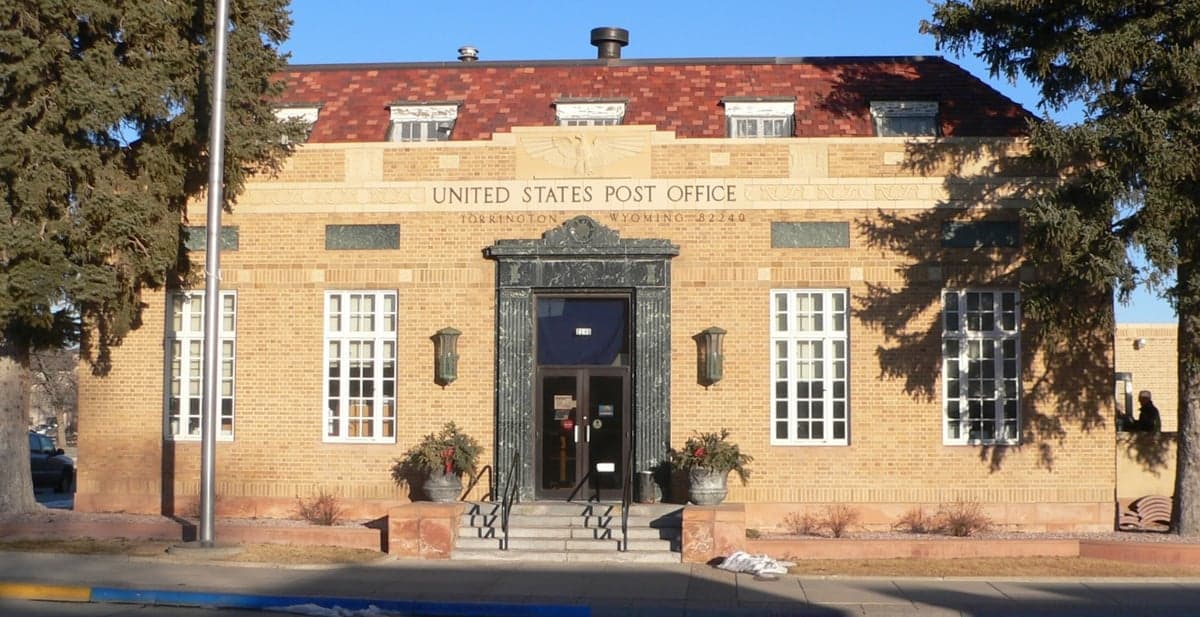
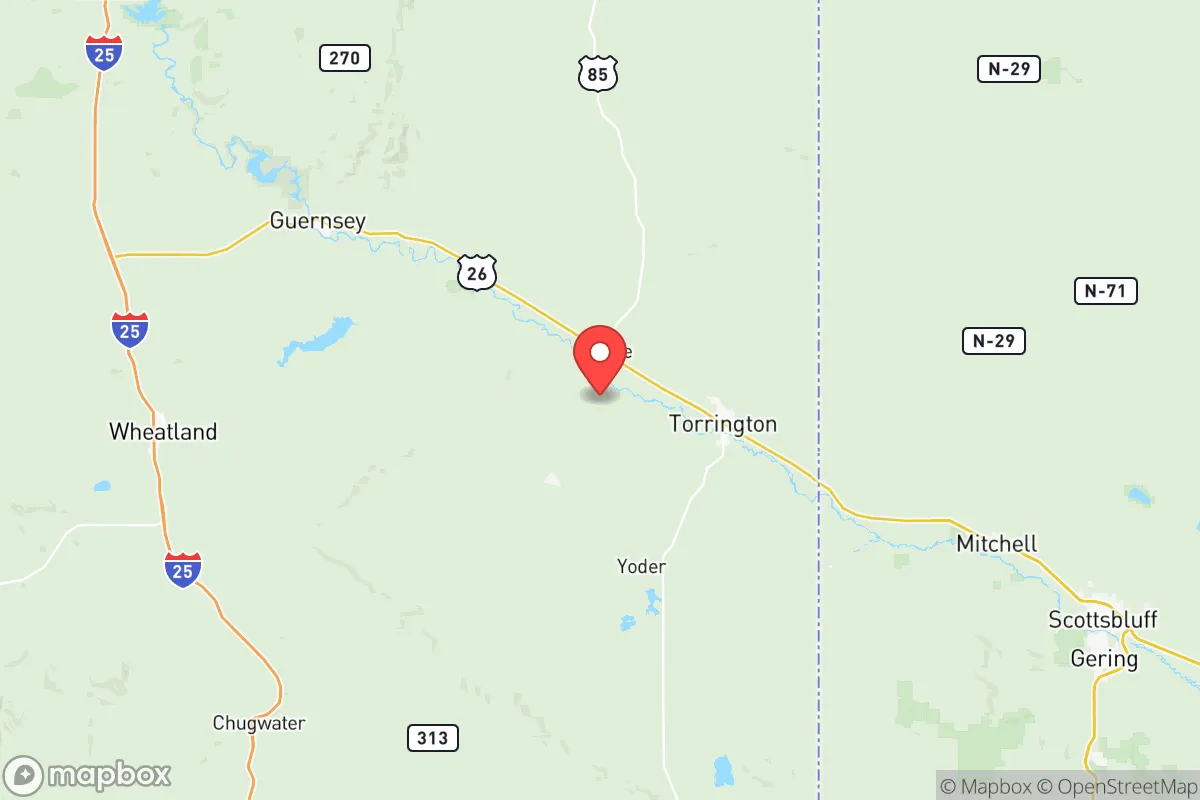
Photo: Wikipedia
Political ClimatePolitical Climate in Goshen County
Showing state-level results — no local-only data available.
Local Political AnalysisPolitical Analysis of Goshen County
Goshen County, Wyoming, is about as solidly conservative as it gets, with a Cook PVI of R+23 that mirrors the state of Wyoming as a whole. That number tells you the big picture, but the real story is in the local dynamics—how the county’s small towns and rural stretches have held the line against the progressive drift you see in other parts of the country. For a long time, this area has been a place where folks value their independence and don’t take kindly to government overreach, and that’s still the backbone of the political climate here.
How it compares
On paper, Goshen County and Wyoming state are identical at R+23, but the comparison gets interesting when you look inside the county. The county seat, Torrington, is the political anchor—it’s reliably red, with precincts like the Torrington 1 and 2 consistently voting Republican by wide margins. But there’s some variation: the town of Lingle, a smaller community just south of Torrington, has a few precincts that lean a bit more moderate, though still solidly conservative. The real contrast is with the town of Yoder, which is deep red—think 80%+ Republican in recent elections—while the area around Hawk Springs, a tiny unincorporated community, shows some swing tendencies, often breaking for conservative candidates but with a few more split-ticket votes. Compared to the state, Goshen County doesn’t have the same kind of progressive pockets you’d find in Teton County or even parts of Laramie; it’s more uniformly conservative, which is a comfort for those of us who worry about creeping government control.
What this means for residents
For folks living here, the political climate means less meddling from the state or federal government in daily life. You don’t see the same push for restrictive regulations or woke policies that you’d hear about in Cheyenne or Jackson. Local governance in Goshen County tends to focus on practical stuff—keeping taxes low, supporting agriculture, and protecting property rights. The county commission, which is all Republican, has been pretty consistent on pushing back against mandates, whether it’s COVID-era restrictions or environmental rules that would hurt farmers and ranchers. That said, there’s a growing concern among longtime residents about the influence of out-of-state money and newcomers who might not share the same values. The shift isn’t dramatic yet, but you can feel it in some of the newer subdivisions around Torrington, where a few folks have moved in from Colorado or California and brought more progressive ideas with them.
Culturally, Goshen County is still a place where the Second Amendment is a given, and the idea of government telling you what to do with your land or your business is met with serious skepticism. The county’s policy on things like zoning and land use is minimal, which is exactly how most residents want it. There’s a strong tradition of self-reliance here, and that’s reflected in the low voter turnout for anything that smacks of “big government” solutions. Looking ahead, the near-term future seems stable—the county’s demographics are aging, but the younger generation that stays tends to be just as conservative. The long-term risk is if the state or federal government starts imposing more uniform policies that override local control, but for now, Goshen County remains a bastion of common-sense, freedom-minded politics.

State Political ClimatePolitical Climate in Wyoming
State Political AnalysisPolitical Environment in the State
Wyoming is about as solidly Republican as a state gets, with a Cook PVI of R+23 that makes it the reddest state in the nation by that measure. The dominant coalition is a mix of traditional Western libertarians, ranchers, energy workers, and a growing number of conservative refugees from blue states, and the trajectory over the last 10-20 years has been a steady hardening of that red hue. While the state has always leaned right, the shift has been away from the old "live and let live" moderate Republicanism toward a more assertive, culturally conservative posture, driven by in-migration from places like Colorado and California and a backlash against federal overreach.
Urban vs. rural divide
The political map breaks down along a stark urban-rural line, but even the "urban" areas are conservative by national standards. Cheyenne, the capital and largest city, is the most moderate part of the state, with Laramie County occasionally flirting with single-digit Republican margins—but it still voted for Trump by 12 points in 2020. Casper in Natrona County is reliably red, though its energy-dependent economy makes it sensitive to federal policy on drilling and coal. The real engine of Wyoming conservatism is the vast rural expanse: Sublette County (gas fields), Campbell County (coal country around Gillette), and Fremont County (ranching and Wind River Reservation) routinely deliver 70-80% Republican votes. The only real outlier is Teton County, home to Jackson Hole, which is a deep-blue island of wealthy transplants and ski resort liberals—it went for Biden by 30 points in 2020. But Teton County's population is tiny, and its influence is limited to local land-use battles and a few statehouse seats. The rest of the state is a sea of red, with no major Democratic strongholds outside of that one wealthy enclave.
Policy environment
Wyoming's policy environment is a dream for conservatives who value low taxes and minimal regulation. There is no state income tax, and the sales tax is a low 4% (local options can push it to 6%). Property taxes are among the lowest in the nation, with no tax on retirement income. The regulatory posture is aggressively pro-energy and pro-business—permitting for oil, gas, and mining is streamlined, and the state has fought federal land-use restrictions tooth and nail. Education policy is a mixed bag: the state funds schools well through mineral revenues, but there is a strong school choice movement, and the legislature passed a school voucher-style program in 2023 (the Wyoming Freedom Scholarship Act) that allows state funds to follow students to private or homeschool settings. Healthcare is a weak spot—rural hospital closures are a constant threat, and the state has not expanded Medicaid, leaving a coverage gap for low-income adults. Election laws are solid: voter ID is required, same-day registration is not allowed, and the state has a clean voter roll maintenance process. There are no major election integrity controversies here—Wyoming runs its elections quietly and competently.
Trajectory & freedom
Wyoming is becoming more free in several key areas, particularly around gun rights and parental rights. In 2021, the legislature passed a constitutional carry law (House Bill 81), allowing concealed carry without a permit—Wyoming was already a shall-issue state, but this removed the last bureaucratic hurdle. In 2023, the "Parents' Bill of Rights" (SF 117) was enacted, requiring schools to notify parents of any medical or mental health services offered to their children and prohibiting instruction on gender identity or sexual orientation in K-3 classrooms. On medical autonomy, Wyoming passed a law in 2023 banning gender transition procedures for minors (SF 99), and the state has no vaccine mandates for adults or children beyond standard school requirements. Property rights are strong—Wyoming has a robust "right to farm" law protecting agricultural operations from nuisance lawsuits, and the state has fought federal attempts to designate large swaths of land as national monuments. The one area where freedom has contracted is on the taxation front: the state has not cut taxes further in recent years, and there is perennial debate about diversifying revenue away from the volatile mineral extraction sector. But overall, the trajectory is toward more personal liberty, not less.
Civil unrest & political movements
Wyoming is remarkably free of civil unrest compared to the rest of the country. There have been no major riots, no sustained protest movements, and no significant election integrity controversies. The most visible political activism comes from the right: the Wyoming Freedom Caucus, a hardline conservative group in the state legislature, has been increasingly influential, pushing bills on election integrity, gun rights, and education. On the left, activism is mostly confined to Jackson Hole and Laramie (home to the University of Wyoming), where you'll see the occasional climate protest or LGBTQ+ rally, but these are small and don't disrupt daily life. Immigration politics are a non-issue—Wyoming has a tiny foreign-born population (about 3%), and there are no sanctuary cities. There is a strong strain of nullification rhetoric, particularly around federal land management: the state has passed resolutions asserting state sovereignty over federal lands within its borders, and there is ongoing litigation over the Biden administration's leasing moratorium on federal oil and gas. You won't see flashpoints like Portland or Seattle here—the biggest political drama in recent years was a legislative fight over whether to allow a library in Campbell County to keep certain books on the shelves.
Projection
Over the next 5-10 years, Wyoming will likely get even redder and more culturally conservative. The in-migration pattern is clear: people are moving to Sheridan, Buffalo, and Lander from blue states like California, Colorado, and Washington, and they are not bringing progressive politics with them—they're fleeing it. This is driving a housing affordability crisis in those towns, but politically, it's reinforcing the conservative majority. The energy transition will be the wild card: if federal policy continues to suppress coal and oil production, the state's budget will take a hit, potentially forcing tax increases or spending cuts that could shift the political conversation. But the cultural and social trajectory is toward more parental rights, more gun freedom, and less government interference in daily life. The Wyoming Freedom Caucus is likely to grow in power, and the state will continue to be a laboratory for conservative policy. Someone moving in now should expect to find a state that is stable, safe, and increasingly assertive in defending its way of life.
For a new resident, the bottom line is this: Wyoming offers a high degree of personal freedom, low taxes, and a political environment that respects traditional values and individual rights. You won't find the culture wars of coastal cities here—no mask mandates, no CRT battles in schools, no homeless encampments. What you will find is a state that is serious about protecting its sovereignty, its economy, and its way of life. If you're looking for a place where the government mostly leaves you alone and your neighbors share your values, Wyoming is about as good as it gets.
* Values derived from national, state, county, city and local statistics and may differ in a specific area. Last updated: 2026-05-14T07:44:20.000Z
Narrative content on this page is AI-generated and may contain mistakes. Verify any details that matter before acting on them.
ReloMaps may earn a commission from affiliate links at no extra cost to you.

