Photo: Wikipedia
Demographics of Goshen County
Affluence Level in Goshen County
A middle-class area roughly in line with national averages across income, home values, education, and employment.
People of Goshen County
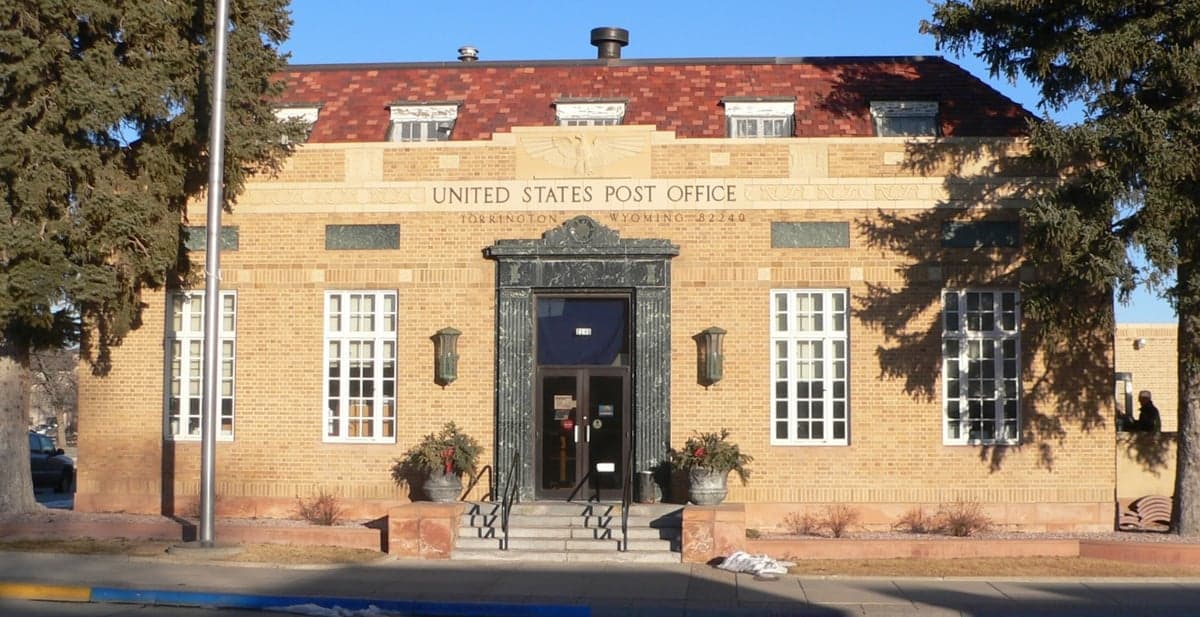
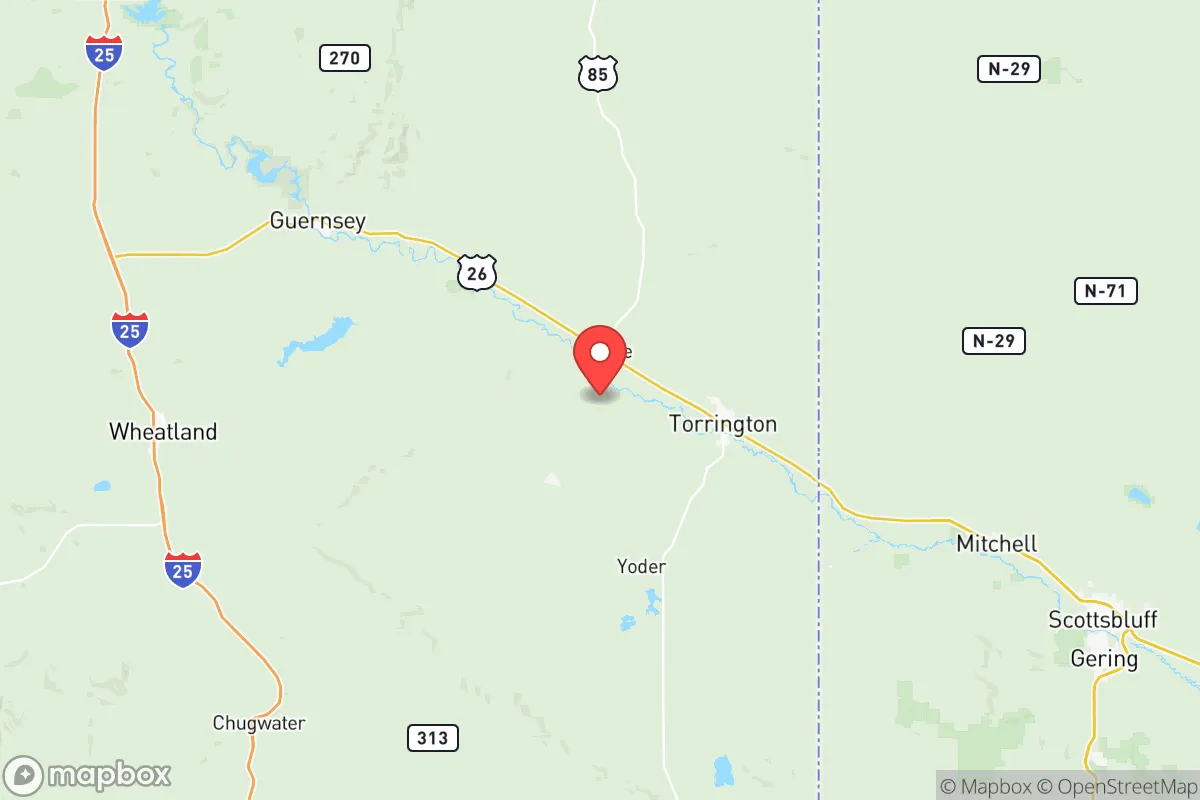
Goshen County, Wyoming, is home to 12,587 residents who are overwhelmingly white (85.0%) and native-born, with a foreign-born population of just 0.8%. The county’s people are concentrated in the agricultural hub of Torrington, the county seat, and smaller communities like Lingle, Yoder, and Hawk Springs, where a rural, conservative, and self-reliant identity prevails. With only 24.6% holding a college degree, the population is grounded in farming, ranching, and energy-sector work, and its demographic stability reflects a region that has seen little net migration for decades.
Settlement & growth (pre-1960)
Before American settlement, the area now known as Goshen County was part of the traditional territory of the Plains tribes, including the Lakota, Cheyenne, and Arapaho. These nomadic nations followed bison herds along the North Platte River, which cuts through the county’s southern edge. The first European incursion came via French fur trappers in the early 1800s, but no permanent non-Native settlements took hold until after the 1854 Fort Laramie Treaty and the subsequent opening of the region to homesteaders.
The first major wave of American settlers arrived in the 1860s and 1870s, drawn by the promise of land under the Homestead Act of 1862. These early pioneers were largely of Northern European stock—English, Scots-Irish, and German—who established farms along the North Platte River valley. The town of Torrington was founded in 1889 as a railroad stop on the Chicago, Burlington and Quincy line, and it quickly became the commercial center for surrounding agricultural communities. Nearby Lingle (founded 1900) and Yoder (founded 1910) grew as service towns for sugar beet and wheat farmers, many of whom were German-Russian immigrants who had first settled in the Dakotas and Nebraska before moving north. These German-Russian families, known for their dry-farming techniques and strong community bonds, concentrated in the eastern part of the county, particularly around Hawk Springs and Veteran.
A second wave came during the Dust Bowl era of the 1930s, when displaced farmers from Oklahoma, Kansas, and the Texas Panhandle—often called “Okies”—moved into Goshen County seeking work on sugar beet farms and in the newly expanded irrigation projects along the North Platte. This influx reinforced the county’s already rural, Protestant, and conservative character. By 1940, the population had peaked at roughly 13,000, driven by agricultural prosperity and the construction of the Kendrick Project irrigation system, which brought reliable water to thousands of acres. The post-World War II period saw a slight decline as younger generations left for urban jobs in Cheyenne and Denver, but the county’s ethnic and cultural makeup remained remarkably stable through 1960: nearly 99% white, with small pockets of Hispanic families who had worked as migrant laborers in the sugar beet fields.
Modern era (post-1965)
The 1965 Hart-Cellar Act, which dramatically expanded immigration from Asia and Latin America, had almost no effect on Goshen County. The foreign-born population today stands at just 0.8%, compared to 3.5% statewide and 13.7% nationally. The county’s isolation from major interstate highways and its lack of large employers outside of agriculture and the Wyoming Department of Corrections (which operates the Torrington prison) have made it a demographic backwater. The Hispanic share of the population has grown modestly from about 3% in 1990 to 10.1% today, but this increase is almost entirely due to natural increase among existing families, not new immigration. Most Hispanic residents are descendants of the sugar beet workers who settled in Torrington and Lingle in the 1940s and 1950s, and they are now fully integrated into the county’s social and economic fabric.
Domestic migration has been minimal. The county lost population between 2010 and 2020, dropping from 13,723 to 12,587, as young adults left for college or jobs in larger cities and were not replaced by newcomers. The Black population remains negligible at 0.7%, and there are no recorded residents of East/Southeast Asian or Indian subcontinent ancestry. The county’s racial homogeneity is a product of its geography—far from any major metropolitan area—and its economy, which offers few opportunities for professionals or immigrants. Suburbanization has not occurred in any meaningful sense; the largest town, Torrington, has only 6,500 residents, and the rest of the county is scattered farmsteads and unincorporated hamlets like Hawk Springs and Veteran, where the population has been declining for decades.
The future
Goshen County’s population is projected to continue a slow decline, with the Wyoming State Economic Analysis Division forecasting a drop to roughly 11,500 by 2040. The county is aging—the median age is 43.5, well above the national average of 38.8—and the outmigration of young adults shows no sign of reversing. The Hispanic share may rise to 12-13% through higher birth rates, but the county will remain overwhelmingly white and native-born. There is no evidence of new immigrant enclaves forming, and the small existing Hispanic community is assimilating into the broader rural culture rather than creating distinct ethnic neighborhoods.
In-migration from coastal states, which has reshaped parts of Wyoming like Teton County, has bypassed Goshen County entirely. The county lacks the scenic amenities, recreational opportunities, or remote-work infrastructure to attract urban refugees. The cultural identity—rooted in agriculture, hunting, and conservative politics—is likely to persist, but it will become thinner as the population shrinks and schools consolidate. For a newcomer, Goshen County offers a stable, predictable, and deeply traditional community, but one that is slowly contracting rather than growing.
Goshen County is becoming a quieter, older, and slightly more Hispanic version of its 1950s self, with no major demographic disruption on the horizon. For someone moving in now, the county offers a low-crime, affordable, and culturally cohesive environment, but one where economic opportunity is limited and the population is gradually declining. The people here are the descendants of homesteaders and sugar beet farmers, and they remain deeply rooted in the land and its rhythms.

* Values derived from national, state, county, city and local statistics and may differ in a specific area. Last updated: 2026-05-14T07:44:20.000Z
Narrative content on this page is AI-generated and may contain mistakes. Verify any details that matter before acting on them.
ReloMaps may earn a commission from affiliate links at no extra cost to you.

