Photo: Wikipedia
Demographics of Westmont, IL
Affluence Level in Westmont, IL
A middle-class area roughly in line with national averages across income, home values, education, and employment.
People of Westmont, IL
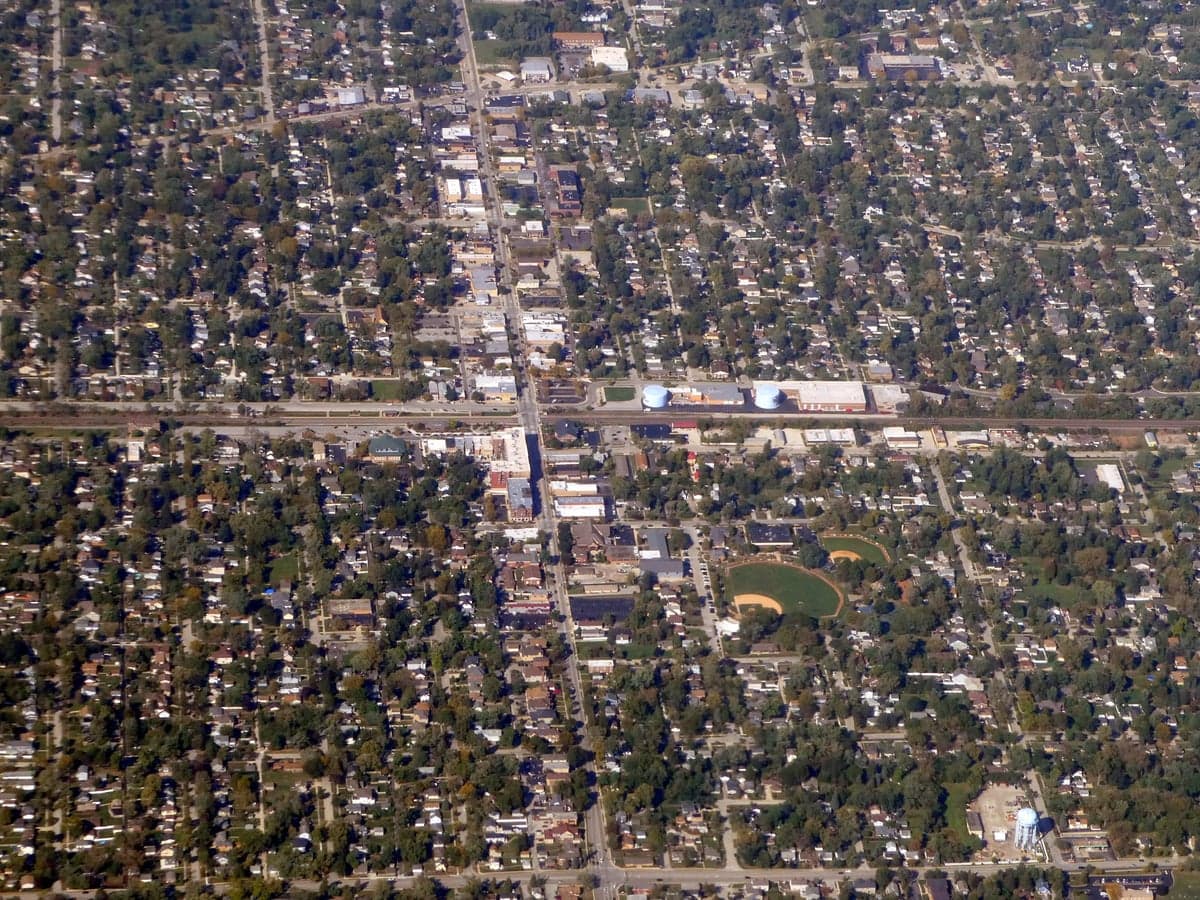
Westmont, Illinois, is a diverse, middle-class suburb of 24,201 residents that blends a historic small-town core with a modern, multiethnic population. The city is notably more diverse than many of its DuPage County neighbors, with a foreign-born population of 10.4% and a balanced mix of White (61.9%), Hispanic (14.4%), Black (6.6%), East/Southeast Asian (6.3%), and Indian-subcontinent (6.7%) communities. Nearly half of adults hold a college degree, giving the city a professional, family-oriented character that appeals to both first-time homebuyers and long-term residents.
How the city was settled and grew
Westmont was originally a farming crossroads on the Chicago, Burlington & Quincy Railroad, platted in the 1860s and incorporated in 1906. The earliest settlers were German and Irish farmers who took up land grants in the area now known as Westmont's Historic Downtown and along the railroad corridor. By the 1920s, a wave of Polish and Italian immigrants arrived to work in the region's brickyards and on the expanding rail lines, settling in the South Cass Avenue neighborhood and around Burlington Park. These groups built the city's first Catholic and Lutheran churches, which remain community anchors today. The post-World War II boom transformed Westmont from a rural hamlet into a bedroom suburb, as returning GIs and their families moved into new subdivisions like Highland Hills and Westmont Manor, drawn by affordable housing and the promise of good schools. By 1960, the population had surged past 5,000, and the city's identity shifted from agricultural to suburban.
Modern era (post-1965)
The 1965 Immigration and Nationality Act opened the door for new waves of immigration that reshaped Westmont's population. Beginning in the 1970s and accelerating through the 1990s, East/Southeast Asian families—particularly of Chinese, Korean, and Filipino descent—began settling in the Westmont Crossing and North Westmont areas, drawn by the area's proximity to Chicago and the growing tech and healthcare job markets. At the same time, Indian-subcontinent families (from India, Pakistan, and Bangladesh) established a significant presence, particularly in the Grove Estates and South Westmont neighborhoods, where larger homes and good school ratings were key draws. Hispanic residents, primarily of Mexican and Central American heritage, grew steadily through the 2000s, concentrating in the Westmont Gardens area and along the Ogden Avenue corridor. The Black population, which had been minimal through the 1980s, rose to 6.6% by the 2020s, with families dispersing across the city rather than clustering in a single neighborhood. These shifts have made Westmont one of the most racially and ethnically balanced suburbs in DuPage County.
The future
Westmont's population is projected to continue diversifying, with the White share declining gradually and Hispanic, East/Southeast Asian, and Indian-subcontinent communities all growing. The city's downtown redevelopment plan, which includes new mixed-use housing near the train station, is expected to attract younger professionals and empty-nesters, while the Westmont Park District is investing in amenities to retain families. The Indian-subcontinent population, in particular, has been growing faster than the East/Southeast Asian share, and new cultural institutions—such as Indian grocery stores and community centers—are emerging along the Cass Avenue corridor. The Hispanic population is also expanding, though more slowly, and is becoming more dispersed across the city. The overall trend is toward a more polyglot, middle-class suburb where no single group dominates, and where the historic German-Polish-Italian character is giving way to a broader American mosaic.
For someone moving to Westmont today, the city offers a stable, family-friendly environment with strong schools and a genuine mix of cultures. It is not a place of rapid gentrification or dramatic demographic upheaval, but rather a steady, organic evolution toward greater diversity. New residents will find a community where the old-timers still run the village board, but the grocery stores stock kimchi, naan, and tortillas side by side. That balance—between tradition and change—is Westmont's defining character in 2026.

* Values derived from national, state, county, city and local statistics and may differ in a specific area. Last updated: 2026-11-13T05:33:46.000Z
Narrative content on this page is AI-generated and may contain mistakes. Verify any details that matter before acting on them.
ReloMaps may earn a commission from affiliate links at no extra cost to you.

