Photo: Wikipedia
Demographics of Raleigh County
Affluence Level in Raleigh County
A below-average socioeconomic profile. Incomes, home values, and educational attainment trail the U.S., with higher poverty and unemployment.
People of Raleigh County
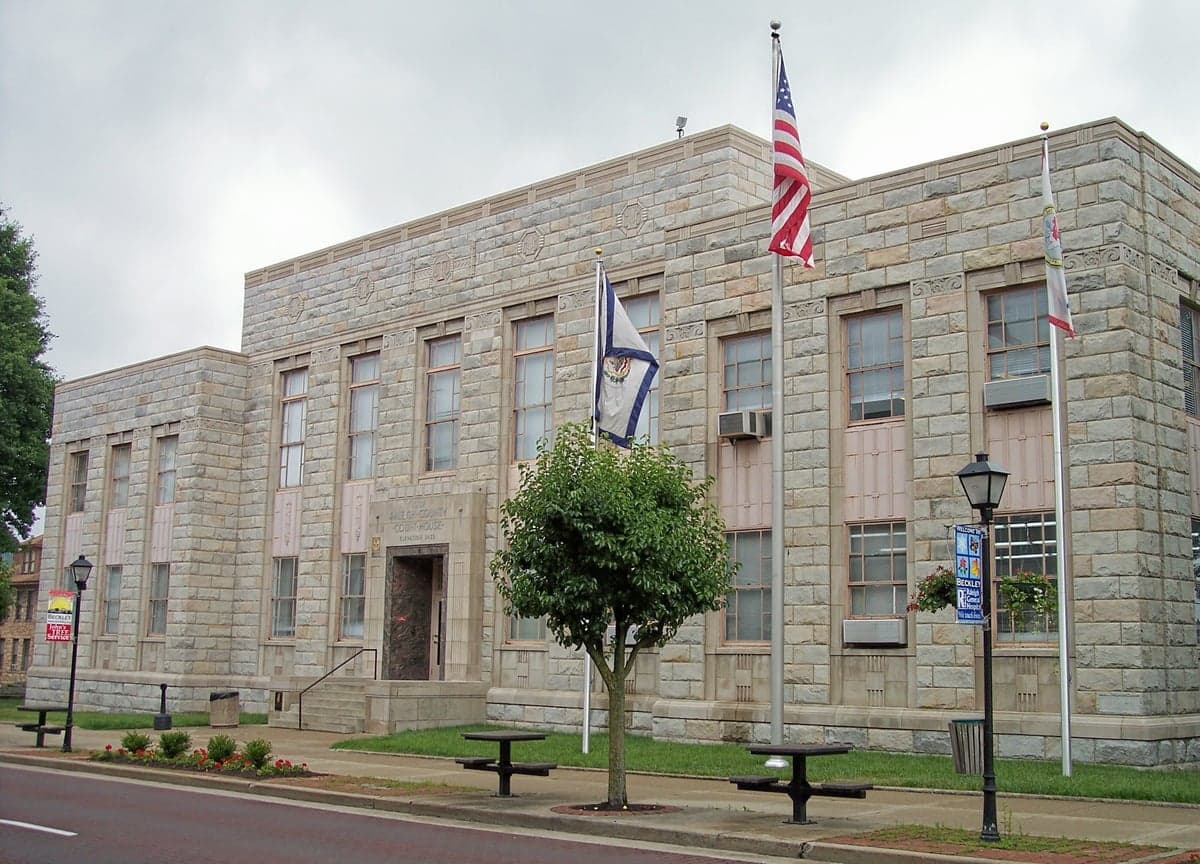
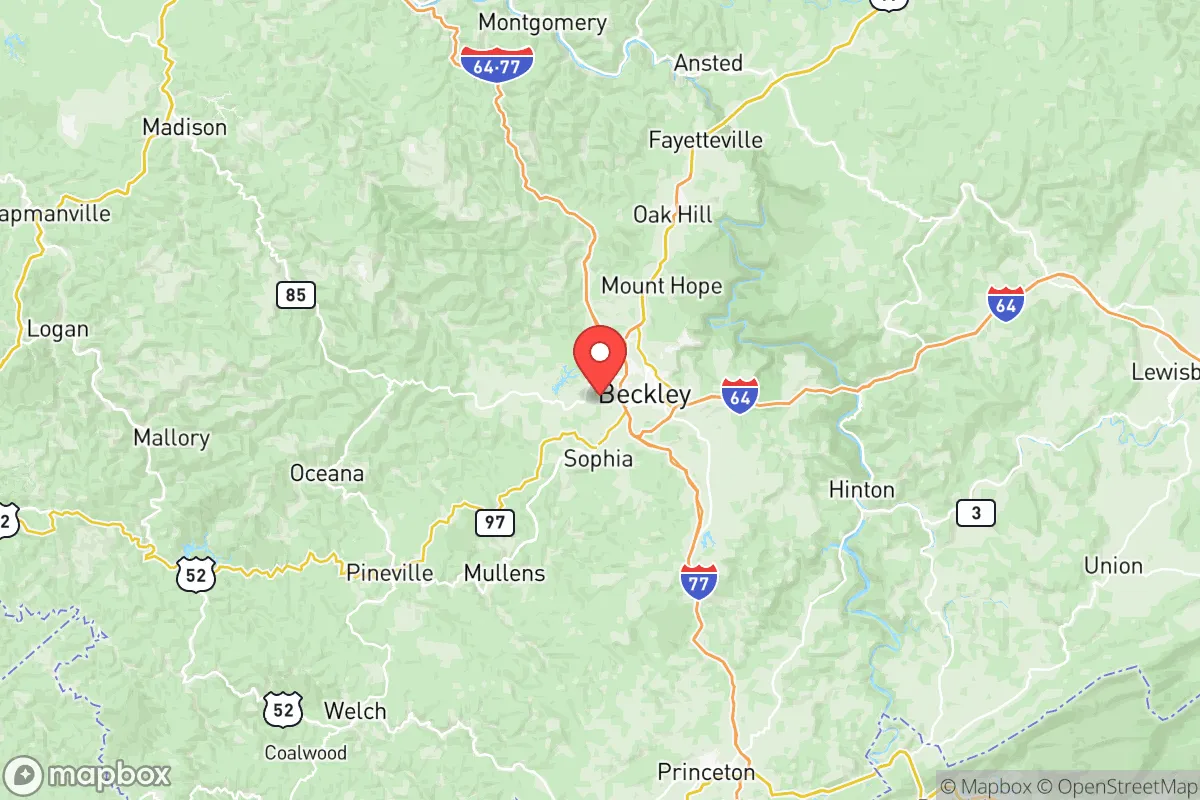
Today, the people of Raleigh County, West Virginia are predominantly white, native-born, and deeply rooted in the Appalachian coalfields, with a population of 73,666 that is 87.1% white and only 0.5% foreign-born. The county's identity is shaped by a history of coal-driven boom-and-bust cycles, a strong sense of local independence, and a population density that is spread across the county seat of Beckley and numerous smaller towns like Sophia, Mabscott, and Lester. With a college attainment rate of 21.6%, the workforce is largely blue-collar and service-oriented, and the county's demographic character remains markedly more homogeneous than the national average, reflecting its limited exposure to the large-scale immigration waves that reshaped much of the United States after 1965.
Settlement & growth (pre-1960)
Long before European settlement, the land that is now Raleigh County was part of the hunting and trading grounds of the Cherokee and Shawnee nations, who used the New River and its tributaries for travel and seasonal camps. No permanent Native American villages existed within the county's boundaries, but the region was contested territory between these tribes and later between British colonists and the French during the mid-18th century. The first European settlers, primarily of Scots-Irish and English descent, began arriving in the late 1700s, pushing up the Kanawha and New River valleys from Virginia and Pennsylvania. These early pioneers were subsistence farmers and hunters, drawn by the promise of cheap land and relative isolation from coastal authority.
The county was officially formed in 1850 from parts of Fayette and Wyoming counties, named after Sir Walter Raleigh. At that time, the population was sparse and agrarian, with small settlements clustering along waterways. The real transformation began in the 1870s and 1880s with the arrival of the Chesapeake and Ohio Railway and the subsequent discovery of rich bituminous coal seams. This triggered a massive wave of domestic migration: men from the exhausted farms of eastern Kentucky, Tennessee, and southwestern Virginia poured into the county to work the mines. Towns like Beckley, Coal City, Eccles, and Glen White were founded or rapidly expanded as company towns built around coal tipples and rail lines. The coal industry also drew a smaller but notable influx of European immigrants, particularly Italians, Poles, and Hungarians, who arrived between 1890 and 1910 to work the deeper, more dangerous seams. These immigrant communities were small and largely concentrated in specific mining camps, such as the Italian enclave in Lester and the Polish settlement around Pemberton.
By the 1920s, Raleigh County's population had surged past 50,000, making it one of the most populous counties in West Virginia. The Great Depression and the subsequent mechanization of mining slowed growth, but World War II and the post-war energy boom brought another wave of domestic migrants, this time from the rural Deep South, including a modest number of Black families moving into Beckley and Mabscott for mining and railroad work. The county's Black population peaked in the 1950s at around 10% of the total, concentrated in Beckley's "South Side" neighborhood and in the mining camps of Mount Hope and Piney View. The pre-1960 period ended with Raleigh County at its demographic and economic zenith, a classic Appalachian coal county with a diverse (by regional standards) mix of native-born whites, a small Black minority, and a tiny remnant of European immigrant families.
Modern era (post-1965)
The 1965 Hart-Cellar Act had almost no direct impact on Raleigh County, as the county's foreign-born population today stands at just 0.5%—one of the lowest rates in the entire United States. Unlike the Sun Belt or major metropolitan areas, Raleigh County did not receive significant post-1965 immigration from Asia, Latin America, or the Middle East. The county's demographic story since 1965 is instead one of domestic out-migration, aging, and a slow, modest diversification driven almost entirely by internal migration. The collapse of the coal industry in the 1980s and 1990s triggered a sustained population decline, as younger workers left for Charlotte, Columbus, and other job centers. The county's population fell from a peak of over 80,000 in 1960 to 73,666 today, with the steepest losses occurring in the unincorporated coal camps and small towns like Bradley and Prosperity.
The most notable demographic shift since 1965 has been the gradual increase in the Hispanic population, which now stands at 1.7%. This growth is largely attributable to a small but steady influx of Mexican and Central American laborers who arrived in the 2000s and 2010s, primarily working in the service industry, construction, and the region's remaining surface mines. These families have concentrated in Beckley, particularly around the city's southern and eastern edges, and in Daniels, where a handful of Hispanic-owned businesses have opened. The Asian population, at 0.6%, is almost entirely composed of East and Southeast Asian professionals—a small number of Filipino nurses, Indian doctors, and Vietnamese restaurant owners—who have settled in Beckley near the Raleigh General Hospital and the West Virginia University Institute of Technology campus. The Indian subcontinent population, at 0.2%, is a tiny but visible presence, mostly physicians and engineers working at the Beckley VA Medical Center and the local hospital system.
The Black population has declined from its mid-century peak to 6.7% today, as the children and grandchildren of the original mining-era Black families have left for larger cities with more economic opportunity. Those who remain are concentrated in Beckley's historic South Side and in Mabscott, where a small, tight-knit community persists around the Mount Zion Baptist Church and the local NAACP chapter. The county's white population, while still dominant, has aged significantly: the median age in Raleigh County is 44.8, well above the national median, and the 65-and-over cohort now makes up over 20% of residents. Suburbanization has been limited, with most new housing development occurring along the Robert C. Byrd Drive corridor between Beckley and Coal City, and in the Shady Spring area, where a small number of commuters to Beckley and the New River Gorge tourism economy have built homes.
The future
Raleigh County's population is projected to continue a slow decline over the next 10 to 20 years, driven by an aging white population and the ongoing out-migration of young adults. The county is not becoming more diverse in any rapid sense: the Hispanic share may rise to 2.5-3% by 2040, and the Asian share may tick up to 1% as the healthcare sector recruits more foreign-trained professionals, but the foreign-born population will likely remain below 2%. The Black population is expected to hold steady or decline slightly, as the community ages and younger Black residents continue to leave for larger metros. The most significant demographic trend is the concentration of the remaining population in and around Beckley, which will continue to serve as the county's commercial, medical, and educational hub, while the outlying coal towns—Lester, Eccles, Glen White—will see further depopulation and abandonment.
Culturally, Raleigh County is becoming a more service-oriented and tourism-linked economy, with the New River Gorge National Park and the Beckley Exhibition Coal Mine drawing visitors, but the county's social fabric remains deeply conservative, churchgoing, and rooted in family and local history. The county voted overwhelmingly for Donald Trump in 2020 and 2024, and the political culture is resistant to rapid demographic or cultural change. Newcomers, whether domestic or foreign-born, tend to be absorbed slowly, and the county's identity as a white, working-class Appalachian community is likely to persist for at least another generation.
For someone moving in now, Raleigh County offers a stable, low-cost, and safe environment with a strong sense of community, but it is a place where the population is shrinking, aging, and only very gradually diversifying. The county is not becoming a multicultural melting pot; it is becoming a quieter, older, and more Beckley-centric version of its former self, where the coal mines that built it are now a memory and the future depends on healthcare, education, and tourism.

* Values derived from national, state, county, city and local statistics and may differ in a specific area. Last updated: 2026-07-07T19:31:06.000Z
Narrative content on this page is AI-generated and may contain mistakes. Verify any details that matter before acting on them.
ReloMaps may earn a commission from affiliate links at no extra cost to you.

