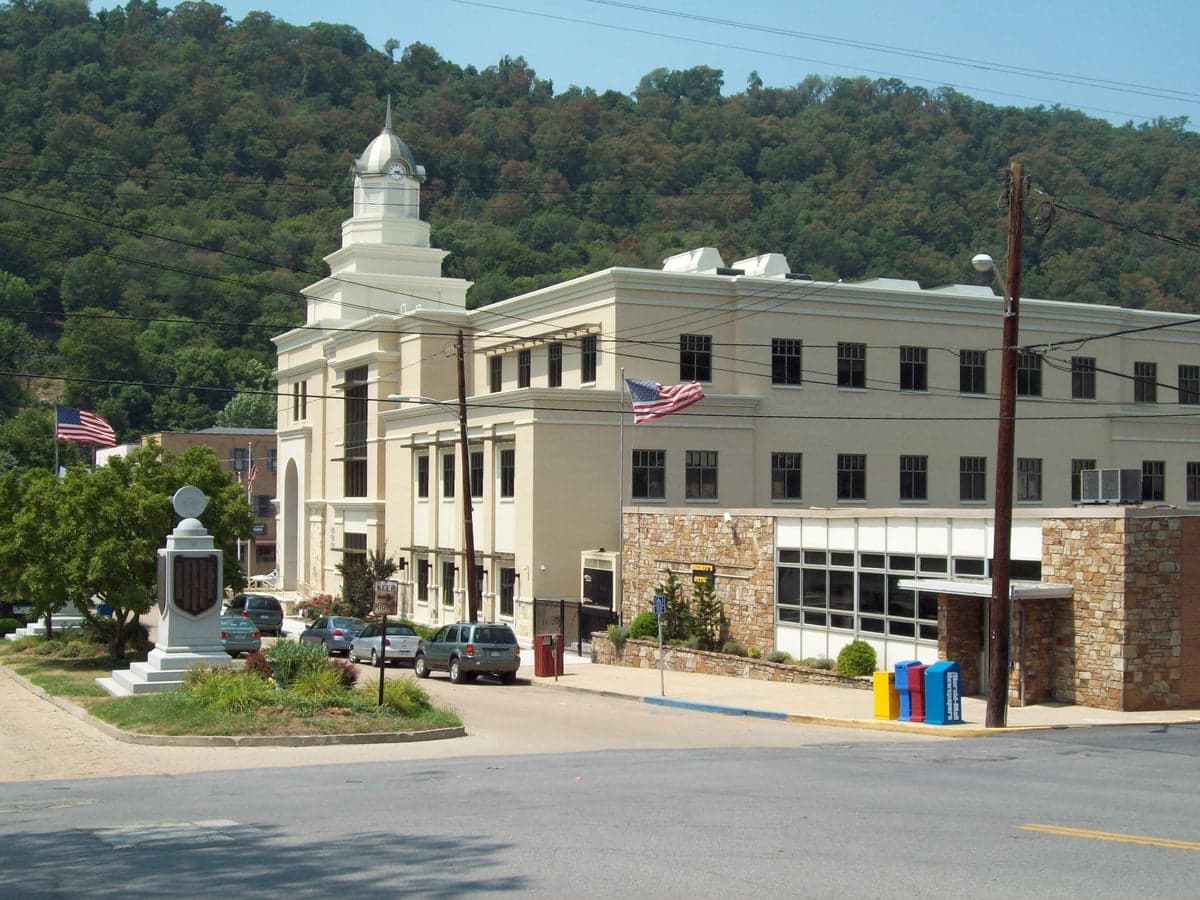
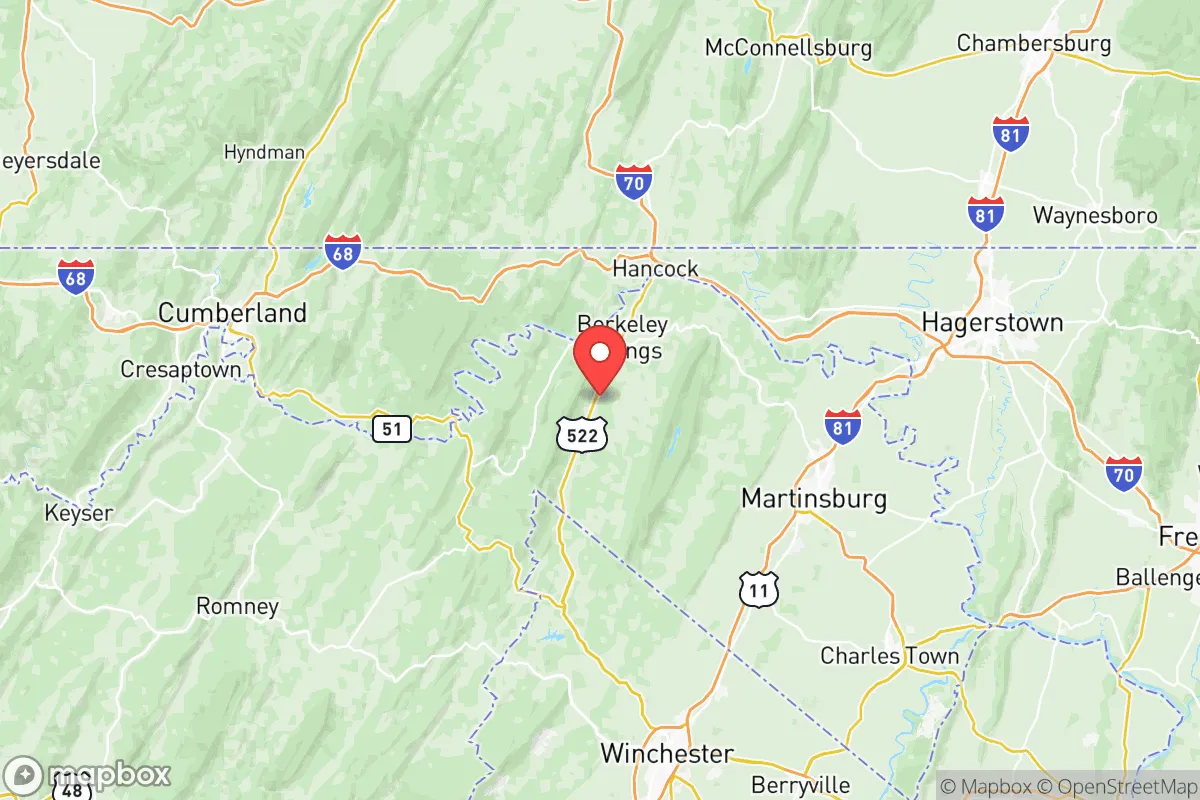
Photo: Wikipedia
Demographics of Morgan County
Affluence Level in Morgan County
A middle-class area roughly in line with national averages across income, home values, education, and employment.
People of Morgan County
Morgan County, West Virginia, is home to roughly 17,300 residents who form one of the state’s most homogenous and stable populations. With a population that is 93.9% white and only 0.7% foreign-born, the county’s character is defined by deep Appalachian roots, a strong rural identity, and a pace of life that has changed slowly over generations. The people here are predominantly native-born, with a low college attainment rate of 17.6%, and the county’s small towns—Berkeley Springs, Paw Paw, and Great Cacapon—serve as anchors for a community where family history and local ties remain central.
Settlement & growth (pre-1960)
Long before European settlers arrived, the area now known as Morgan County was part of the hunting grounds of the Shawnee and Iroquois nations, who used the Potomac River and its tributaries as travel corridors. The region saw little permanent Native settlement, but it was contested territory between these groups and, later, between British colonists and the French during the French and Indian War. The first permanent European settlers were primarily of English, Scots-Irish, and German descent, arriving in the mid-1700s after the Treaty of Lancaster (1744) opened the area to colonial expansion. These pioneers were drawn by the promise of fertile bottomlands along the Potomac and the Cacapon River, as well as by the strategic importance of the Warm Springs (now Berkeley Springs), a mineral spring that had long been a neutral gathering place for Native peoples and soon became a resort for colonial gentry.
After the American Revolution, settlement accelerated. The Virginia General Assembly created Morgan County from part of Hampshire County in 1820, named after General Daniel Morgan, a Revolutionary War hero. The county seat was established at Berkeley Springs, which had already grown into a small spa town. The primary economic drivers in the 19th century were agriculture—especially grain and livestock—and the exploitation of timber and stone. The arrival of the Baltimore and Ohio Railroad in the 1840s connected the county to eastern markets, spurring the growth of towns like Paw Paw and Great Cacapon as shipping points for timber, apples, and peaches. The railroad also brought a modest influx of Irish laborers, many of whom settled in the railroad towns and worked on maintenance crews. By the late 1800s, the county’s population had stabilized around 8,000, a figure that would remain relatively flat for decades.
The 20th century brought little demographic change. Unlike the industrial boomtowns of northern West Virginia, Morgan County remained overwhelmingly agricultural and rural. The Great Depression hit hard, but the county’s population actually grew slightly during the 1930s as displaced farmers from the Dust Bowl and the coal fields of southern West Virginia sought land and subsistence farming opportunities. After World War II, the county saw a modest influx of returning veterans and their families, but the population remained below 10,000 until the 1970s. The lack of major industry—no coal mines, no steel mills—meant that Morgan County was largely bypassed by the Great Migration of African Americans from the South, and its black population has never exceeded 1%.
Modern era (post-1965)
The 1965 Hart-Cellar Act, which reshaped American immigration, had virtually no impact on Morgan County. The foreign-born population today stands at just 0.7%, and the county’s racial composition has remained nearly static. The most significant demographic shift since the 1960s has been domestic: the gradual arrival of retirees and second-home owners from the Washington, D.C., and Baltimore metropolitan areas, drawn by the county’s low property taxes, scenic beauty, and proximity to the Cacapon State Park and Berkeley Springs State Park. This migration has been concentrated in and around Berkeley Springs, which has seen a slow but steady growth in its housing stock and a modest uptick in service-sector jobs catering to tourists and seasonal residents.
The county’s Hispanic population, at 1.6%, is small but has grown slightly since 2000, largely due to agricultural labor in the apple and peach orchards around Paw Paw and Great Cacapon. These workers are primarily of Mexican and Central American origin, and they tend to be seasonal or temporary, with few establishing permanent roots. The East/Southeast Asian population (0.6%) is almost entirely composed of a handful of families who own or work in restaurants and small businesses in Berkeley Springs. The Indian-subcontinent population is effectively zero. The Black population, at 0.3%, is the smallest of any West Virginia county and consists of a few long-standing families, mostly in Berkeley Springs.
Suburbanization has been limited. Unlike the booming exurbs of Jefferson County to the east, Morgan County has not experienced large-scale housing development. The lack of a four-lane highway connection to the D.C. metro area has kept commuting times prohibitive, and the county’s population growth has been modest—from about 14,000 in 2000 to 17,327 in 2024. The county’s college attainment rate of 17.6% is well below the state average of 21% and the national average of 34%, reflecting an economy that still relies heavily on agriculture, tourism, and small-scale manufacturing.
The future
Morgan County is likely to remain one of the whitest and least diverse counties in the United States for the foreseeable future. The foreign-born share is unlikely to rise significantly, as the county lacks the economic magnets—large employers, universities, or major transportation hubs—that attract immigrants. The Hispanic population may grow slowly as agricultural labor needs persist, but it will likely remain a small fraction of the total. The most plausible source of future growth is continued domestic migration from the D.C. and Baltimore exurbs, as housing prices in those areas push buyers farther west. However, this migration is constrained by the county’s limited infrastructure and the absence of high-paying jobs. The county’s population may reach 20,000 by 2040, but it will do so slowly and without changing its fundamental character.
Culturally, Morgan County is becoming a hybrid of its Appalachian past and a new exurban identity. Longtime residents and newcomers coexist in Berkeley Springs, but tensions are minimal, as the pace of change is slow. The county’s political leanings are solidly Republican, and its social conservatism aligns with the values of many of the retirees moving in. The next 10-20 years will likely see a gradual aging of the population, as younger residents leave for college and jobs in larger cities, while older arrivals continue to seek the county’s quiet, low-cost lifestyle.
For someone moving in now, Morgan County offers a stable, predictable community where change is measured in decades, not years. It is a place where the population is overwhelmingly native-born, white, and rooted in local history, and where the small-town character of Berkeley Springs, Paw Paw, and Great Cacapon remains intact. The county is not becoming more diverse, nor is it likely to; its appeal lies in its continuity, not its transformation.

* Values derived from national, state, county, city and local statistics and may differ in a specific area. Last updated: 2026-11-19T06:53:59.000Z
Narrative content on this page is AI-generated and may contain mistakes. Verify any details that matter before acting on them.
ReloMaps may earn a commission from affiliate links at no extra cost to you.

