Photo: Wikipedia
Demographics of Marion County
Affluence Level in Marion County
A middle-class area roughly in line with national averages across income, home values, education, and employment.
People of Marion County
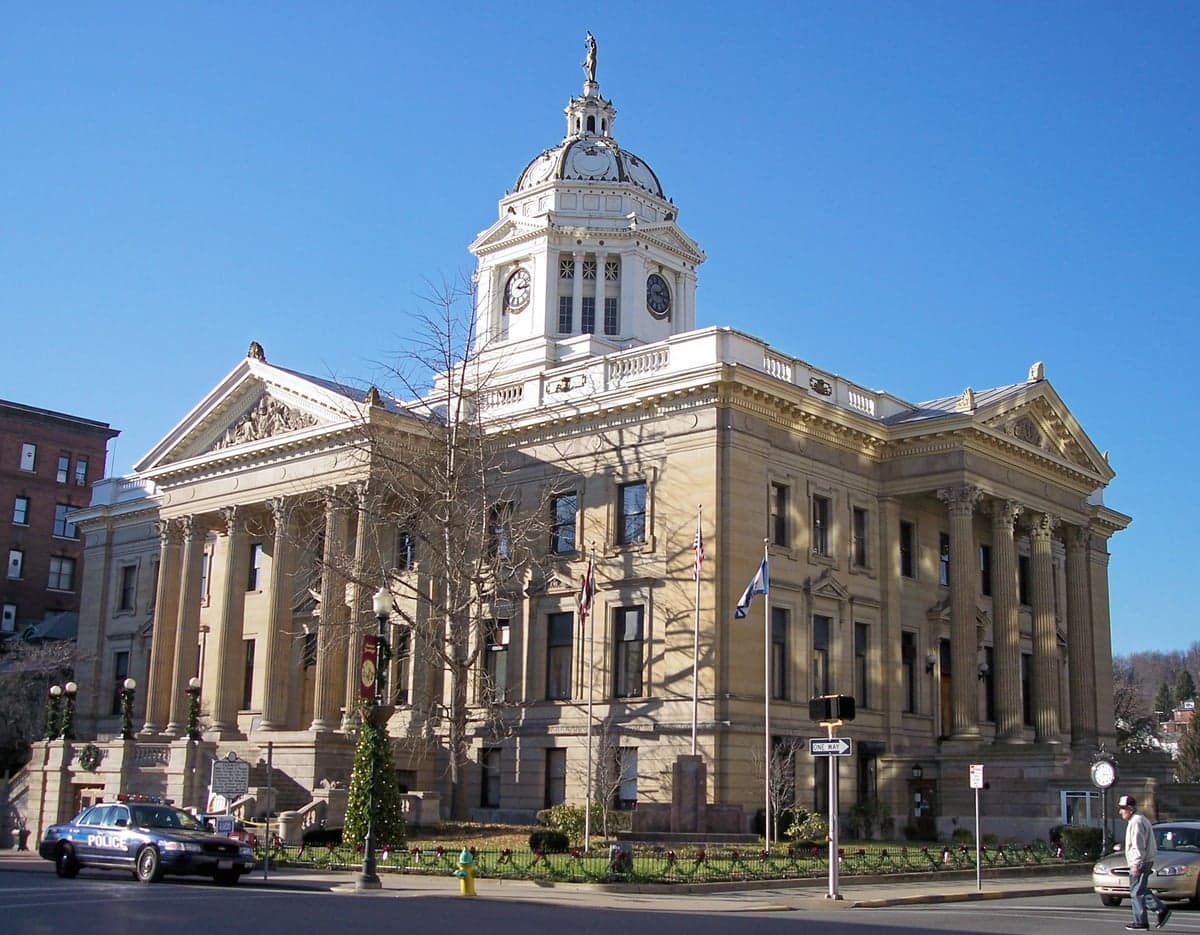
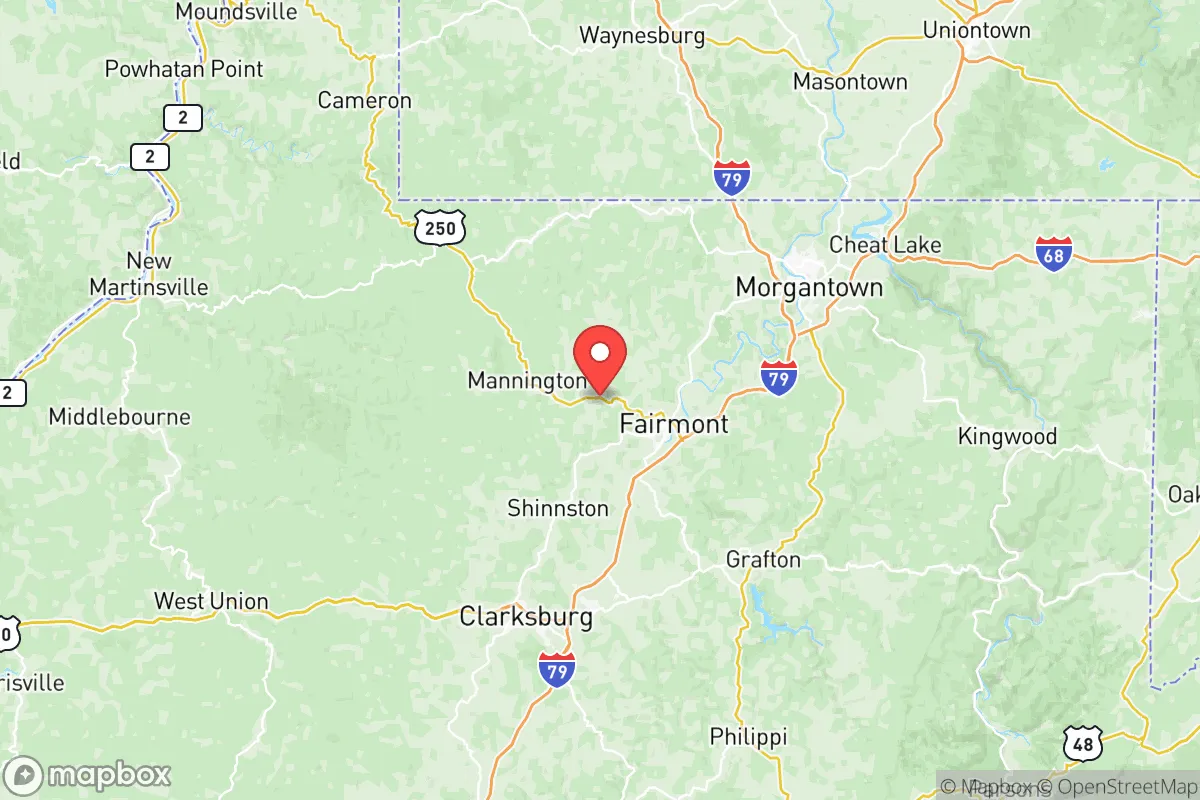
Marion County, West Virginia, is a predominantly white, working-class Appalachian community of 56,042 residents, shaped by a century of coal mining, glass manufacturing, and railroad labor. With a foreign-born population of just 0.5% and a 91.5% white share, the county remains one of the least ethnically diverse in the nation, though small Black and Hispanic communities have persisted since the early 1900s. The population is concentrated in the county seat of Fairmont (roughly 18,000), with smaller clusters in Mannington, Pleasant Valley, and the historic mining towns of Rivesville, Barrackville, and Farmington. College attainment sits at 25.8%, below the national average, reflecting an economy that has long relied on blue-collar industries rather than professional services.
Settlement & growth (pre-1960)
Long before European settlement, the area now known as Marion County was part of the hunting grounds of the Monongahela people, and later the Seneca and other Iroquoian nations who used the West Fork River valley for seasonal travel. The first permanent white settlers arrived in the 1760s and 1770s, largely Scots-Irish and English migrants pushing west from Virginia and Pennsylvania. They established homesteads along the West Fork River, with the earliest recorded settlement at what is now Fairmont (then called Middletown) around 1789. The county was formally created in 1842 from parts of Monongalia and Harrison counties, named for Revolutionary War hero Francis Marion.
The real population boom came after the Civil War, driven by the expansion of the Baltimore & Ohio Railroad and the discovery of high-quality bituminous coal seams. Between 1870 and 1920, Marion County’s population more than tripled, from roughly 12,000 to over 40,000. Immigrant labor poured in: Italians and Poles arrived in the 1880s and 1890s to work the mines and build the railroad, settling in company towns like Rivesville, Barrackville, and Farmington. Hungarians and Slovaks followed in the 1900s, forming small ethnic enclaves in Mannington and Pleasant Valley. At the same time, African Americans migrated from the rural South during the Great Migration (roughly 1910–1940), finding work in the mines and in domestic service; by 1930, Black residents made up about 5% of the county’s population, concentrated in Fairmont’s “East End” and in the mining camp of Grant Town.
The coal industry peaked in the 1940s, and Marion County became a stronghold of the United Mine Workers of America. The 1950s saw a gradual decline in mining employment as mechanization reduced labor demand, but the county’s population held steady at around 56,000 through the 1960s. The glass industry—especially the Owens-Illinois plant in Fairmont—provided an alternative industrial base, attracting a small number of German and Irish skilled workers in the early 20th century, though these groups largely assimilated into the white majority within a generation.
Modern era (post-1965)
The 1965 Hart-Cellar Act had almost no impact on Marion County. The foreign-born population today is a mere 0.5%, and the county saw no significant wave of post-1965 immigration from Asia, Latin America, or the Middle East. Instead, the demographic story of the past 60 years is one of out-migration and aging. From a peak of 57,000 in 1960, the population declined to 56,042 by 2024, with the sharpest losses occurring in the 1980s and 1990s as coal jobs disappeared and younger residents left for Charlotte, Columbus, and Pittsburgh.
The Hispanic population, now 1.6%, grew slowly after 2000, driven by a small number of Mexican and Central American workers in construction and service industries, but remains concentrated in Fairmont and White Hall. The Black population fell from its 1930s peak to 2.6% today, as many African American families left during the post-industrial decline; the remaining Black community is centered in Fairmont’s East End and in Grant Town. East/Southeast Asian residents (0.4%) are almost entirely associated with the West Virginia University system in nearby Morgantown, with a handful of faculty and medical professionals living in the eastern part of the county near Pleasant Valley. There is no measurable Indian-subcontinent population.
Suburbanization within the county has been modest. Pleasant Valley and White Hall grew as bedroom communities for Fairmont and Morgantown commuters, but the county remains largely rural and small-town in character. The closure of the Owens-Illinois glass plant in 2008 and the continued contraction of coal mining have left the economy dependent on healthcare (WVU Medicine Fairmont Medical Center), education (Fairmont State University), and a growing number of distribution centers along I-79.
The future
Marion County is likely to continue its slow population decline, with the white share remaining above 90% for the foreseeable future. The county is not experiencing the rapid diversification seen in many other parts of the U.S.; the Hispanic and Asian populations are growing only incrementally, and the Black population is stable or slightly shrinking. The biggest demographic shift is aging: the median age has risen from 38 in 2000 to over 44 today, as younger adults leave and retirees stay. In-migration is limited to a trickle of remote workers and retirees attracted by low housing costs, but these newcomers are overwhelmingly white and often from other parts of Appalachia or the Rust Belt.
Politically, the county has moved sharply rightward, mirroring West Virginia’s broader trend. Donald Trump won Marion County with 72% of the vote in 2020, up from 68% in 2016, and the county’s cultural identity remains deeply tied to coal heritage, union history, and evangelical Christianity. The small immigrant communities that do exist are largely assimilated into the white majority; there are no distinct ethnic enclaves or language-persistence neighborhoods. Over the next 10–20 years, the population will likely fall below 50,000, with the remaining residents concentrated in Fairmont and a handful of aging mining towns like Rivesville and Farmington.
For someone moving in now, Marion County offers a stable, culturally homogeneous environment with low crime, low cost of living, and strong community ties—but also limited economic opportunity and little ethnic or religious diversity. The county is becoming quieter, older, and more politically conservative, a place where the past weighs heavily on the present and the future holds more continuity than change.

* Values derived from national, state, county, city and local statistics and may differ in a specific area. Last updated: 2026-05-14T17:18:39.000Z
Narrative content on this page is AI-generated and may contain mistakes. Verify any details that matter before acting on them.
ReloMaps may earn a commission from affiliate links at no extra cost to you.

