Photo: Wikipedia
Demographics of West Liberty, IA
Affluence Level in West Liberty, IA
A middle-class area roughly in line with national averages across income, home values, education, and employment.
People of West Liberty, IA
West Liberty, Iowa, is a small city of 3,795 residents that stands out as one of the most ethnically diverse communities in the state, with a population that is 54.5% Hispanic and 41.9% White. This demographic profile, combined with a foreign-born share of 12.2% and a college attainment rate of 15.3%, creates a distinctive working-class character rooted in agriculture and food processing. The city’s identity is shaped by a long history of immigration, from its original European settlers to the Mexican and Central American families who now form the majority, making it a place where cultural traditions blend in a tight-knit, rural setting.
How the city was settled and grew
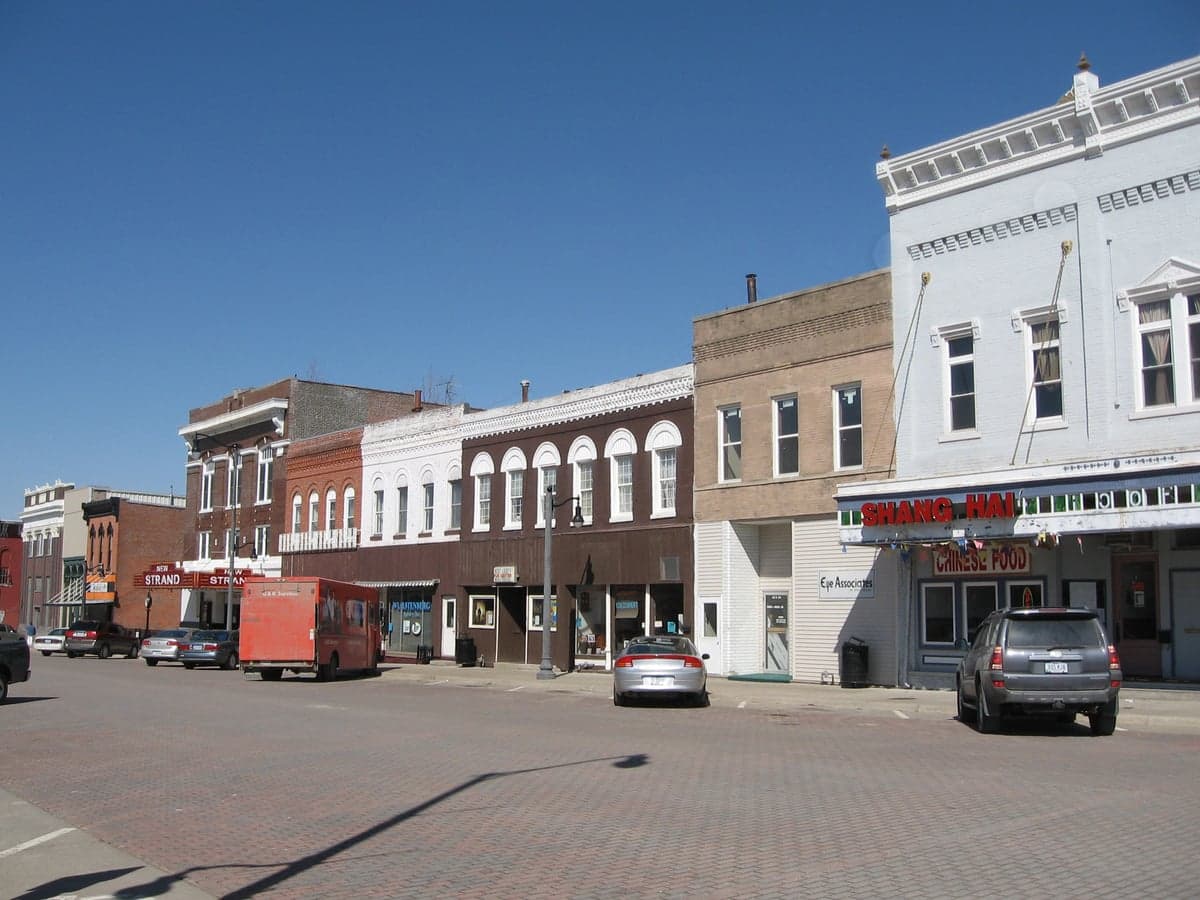
West Liberty was founded in the 1830s by Anglo-American settlers drawn to the fertile prairie land of eastern Iowa. The arrival of the railroad in the 1850s transformed the small farming hamlet into a commercial hub, with grain elevators and livestock yards anchoring the economy. The original population was overwhelmingly of German and Irish descent, with families establishing homesteads in what is now the Historic Downtown District along Main Street and the surrounding North Side neighborhoods. These early residents built the town’s first churches, schools, and businesses, creating a stable, Protestant-leaning community that remained largely homogeneous through the early 20th century. A second wave of European immigrants, including Czech and Polish families, arrived in the 1910s and 1920s, settling in the South End near the rail yards, where they worked as laborers and railroad hands.
Modern era (post-1965)
The city’s demographic transformation began in earnest after the 1965 Immigration and Nationality Act, but the real shift came in the 1980s and 1990s with the expansion of the West Liberty Foods turkey processing plant. This facility, now one of the largest employers in the region, actively recruited workers from Mexico and Central America, creating a pipeline of immigration that reshaped the town. Hispanic families initially concentrated in the East Side neighborhoods near the plant, where affordable housing and proximity to work made settlement practical. By 2000, the Hispanic share of the population had risen to over 40%, and it has continued climbing to the current 54.5%. The West Side neighborhoods, historically White and more established, have seen slower demographic change, though younger Hispanic families have begun moving into those areas as well. The Asian population, at just 0.6%, and the Black population, at 1.3%, remain very small, reflecting the plant’s specific recruitment focus and the lack of other major industries drawing diverse groups.
The future
The population of West Liberty is projected to continue its trend toward greater Hispanic majority, driven by ongoing recruitment at the processing plant and higher birth rates among Hispanic families. The White population, which has declined from over 90% in 1970 to 41.9% today, is likely to shrink further as older residents age out and younger White families leave for larger cities or college towns. New residential development is concentrated in the Prairie View Addition, a subdivision on the city’s western edge, where both Hispanic and White families are buying homes, suggesting a gradual dispersal of the Hispanic community beyond the traditional East Side enclave. The city’s cultural identity is evolving into a bilingual, binational community where Spanish is commonly heard in stores and schools, and annual events like the Fiesta de la Independencia celebrate Mexican heritage. However, the low college attainment rate (15.3%) and reliance on a single industry pose challenges for economic mobility, meaning the population may remain working-class and family-oriented for the foreseeable future.
For someone moving in now, West Liberty offers a unique blend of small-town Iowa life and Hispanic cultural vibrancy, but it is not a place of rapid upward mobility or high educational attainment. The population is becoming more uniformly Hispanic and younger, with a strong sense of community centered on family, faith, and the processing plant. New residents should expect a welcoming but economically modest environment where bilingual skills are increasingly valuable and where the town’s identity as a meatpacking hub continues to define daily life.

* Values derived from national, state, county, city and local statistics and may differ in a specific area. Last updated: 2026-11-07T02:23:49.000Z
Narrative content on this page is AI-generated and may contain mistakes. Verify any details that matter before acting on them.
ReloMaps may earn a commission from affiliate links at no extra cost to you.

