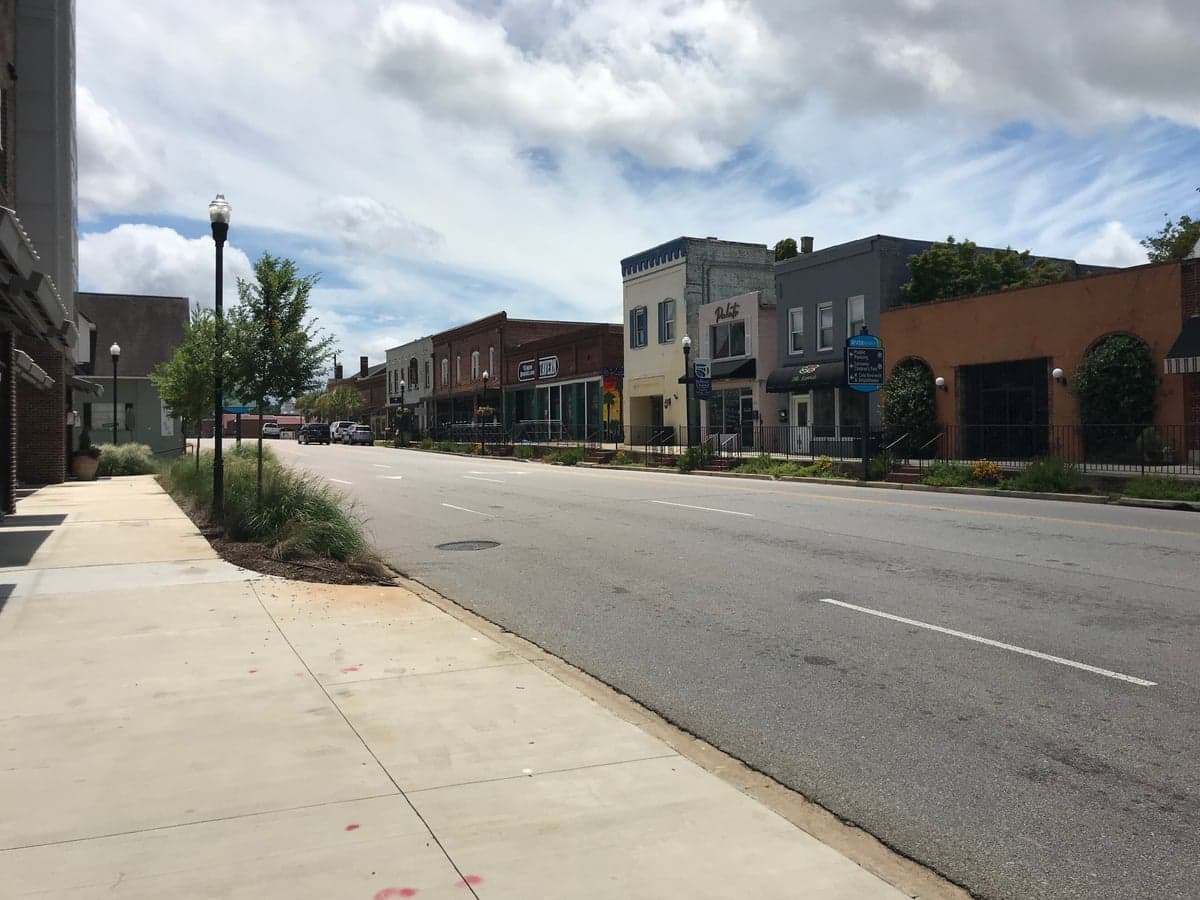

Photo: Wikipedia
Personal Sovereignty in West Columbia, SC
Viable for self-reliance. Generally workable, though some barriers may limit total independence.
What does Personal Sovereignty tell us?
Personal Sovereignty measures your capacity for self-reliance and independence with minimal government friction. Higher scores mean fewer barriers between you and the way you want to live... but it assumes you have the space you need and good neighbors.
What does this tell us?
Personal Sovereignty measures your capacity for self-reliance and independence with minimal government friction. Higher scores mean fewer barriers between you and the way you want to live... but it assumes you have the space you need and good neighbors.
State Policy
Energy independence: Importer (25% of energy produced in-state)
Personal Liberty
Homesteading

Personal Liberty Analysis
West Columbia, South Carolina, offers a notably high degree of personal sovereignty compared to many other parts of the Southeast, largely due to a state-level legal framework that prioritizes individual autonomy over government intervention. For those with a survivalist or prepper mindset, the environment here is defined by low taxes, permissive gun laws, and a general cultural expectation of self-reliance. While no location is a perfect libertarian haven, the combination of South Carolina’s constitutional carry, minimal business regulation, and a judiciary that respects property rights makes West Columbia a practical base for those seeking to minimize government overreach in their daily lives. The key is understanding where the local municipal ordinances in Lexington County intersect with state-level protections, as the city itself has a few more rules than the surrounding unincorporated areas.
Tax burden and regulatory posture: How South Carolina limits government reach
South Carolina’s tax structure is deliberately designed to keep the state’s hand out of your pocket. There is no state income tax on Social Security benefits, and the state’s top marginal income tax rate has been steadily dropping, currently sitting at a flat 6.2% on most income above a modest threshold. Property taxes in Lexington County are among the lowest in the state, with an effective rate around 0.55% of assessed value for owner-occupied homes. This means a $300,000 house carries an annual tax bill of roughly $1,650, a fraction of what you’d pay in neighboring North Carolina or Georgia. The regulatory posture is equally lean: South Carolina is a right-to-work state with minimal occupational licensing requirements for many trades, and there is no state-level business inventory tax. For a prepper looking to run a small-scale operation—say, a mobile welding service or a remote IT consultancy—the lack of red tape is a genuine advantage. The state also has no annual vehicle property tax on the first $500 of value, and the sales tax on unprepared food is capped at 3%, which helps stretch a fixed budget. The trade-off is that local services like road maintenance and public schools are funded at lower levels, but for someone prioritizing self-reliance, that’s often a feature, not a bug.
Self-defense and gun law specifics: Constitutional carry and castle doctrine
South Carolina is a constitutional carry state as of 2024, meaning any law-abiding adult 18 or older can carry a concealed firearm without a permit. This is a foundational element of personal sovereignty here. The state also has a strong castle doctrine with no duty to retreat, both inside your home and in your vehicle. If someone unlawfully enters your residence or occupied vehicle, you are legally presumed to have a reasonable fear of imminent death or great bodily injury, and you may use deadly force. Stand-your-ground protections extend to any place you have a legal right to be. For the survivalist, this means your defensive posture is legally robust: you don’t have to worry about a prosecutor second-guessing your decision to defend your family in a home invasion. The only local wrinkle is that West Columbia city ordinances prohibit discharging a firearm within city limits except at a licensed range or in lawful self-defense, so you cannot simply pop off rounds on your half-acre lot for practice. However, Lexington County has multiple outdoor ranges within a 20-minute drive, and the state allows open carry without a permit as well. Magazine capacity is not restricted, and there is no state-level registry for long guns or handguns. For those concerned about federal overreach, South Carolina has passed a Second Amendment Sanctuary resolution, though its enforceability is symbolic rather than absolute.
Self-reliance and homesteading viability: Lot sizes, zoning, and off-grid feasibility
West Columbia itself is a suburban city with typical zoning restrictions, but the surrounding unincorporated areas of Lexington County offer significant homesteading potential. Within the city limits, standard residential lots range from 0.25 to 0.5 acres, and chickens are allowed with a permit, but livestock like goats or pigs are generally prohibited. The real opportunity lies just outside town, in areas like Pine Ridge or Gaston, where you can find 1-to-5-acre parcels zoned for agricultural use. On those properties, you can keep chickens, goats, and even a few head of cattle without special permits. Off-grid feasibility is moderate: South Carolina has no state law prohibiting rainwater collection, and many rural properties already rely on well water and septic systems. Solar panels are permitted statewide, and net metering is available through Dominion Energy and SCE&G, though the rates are not as favorable as in some western states. The biggest regulatory hurdle for a full off-grid setup is that Lexington County requires a building permit for any permanent structure, and they enforce the International Residential Code, so you cannot simply throw up a shipping container cabin without inspections. However, there is no county-level ban on tiny houses or RVs as permanent dwellings, provided they meet minimum square footage and septic requirements. For the serious prepper, the recommendation is to buy land in unincorporated Lexington County, outside any town limits, where zoning is loosest and the county sheriff’s office is generally hands-off regarding what you do on your own property.
Personal liberties: Parental rights, medical autonomy, speech, and property
South Carolina has a strong track record on parental rights. The state passed a Parents’ Bill of Rights in 2023, which requires school districts to notify parents of any medical or mental health services offered to their children and to obtain parental consent before administering any survey or questionnaire about sexual behavior or family beliefs. This law also explicitly affirms that parents have the fundamental right to direct the upbringing, education, and care of their children. In practice, this means West Columbia’s Lexington County School District is more transparent than many districts in blue states, and parents can opt their children out of any curriculum they find objectionable without bureaucratic pushback. Medical autonomy is more mixed: South Carolina has not expanded Medicaid, which keeps the state’s healthcare system lean but also means fewer government-funded clinics. There is no state vaccine mandate for adults, and COVID-era mandates were struck down early. However, the state does require certain childhood immunizations for school attendance, with only religious exemptions available (no philosophical exemption). On free speech, South Carolina has no state-level hate speech law that could be used to chill political expression, and the state’s courts have generally been protective of First Amendment rights. Property rights are robust: there is no state-level rent control, no inclusionary zoning mandates, and eminent domain is rarely used for private development. For the prepper, the key takeaway is that your ability to live according to your own values—whether that means homeschooling, refusing medical treatments, or storing bulk supplies—is legally protected to a degree that is increasingly rare in the United States.
Overall, West Columbia and its surrounding areas offer a sovereignty profile that ranks well above the national average, particularly for those willing to live just outside the city limits. The combination of constitutional carry, low taxes, strong parental rights, and minimal business regulation creates an environment where a self-reliant individual can operate with relatively little government interference. The main compromises are the suburban zoning within the city itself and the state’s adherence to building codes, which prevent truly unregulated homesteading. Compared to a place like Portland, Oregon, or even Austin, Texas, the regulatory burden here is dramatically lower. For a single person or a family with a survivalist mindset, West Columbia represents a solid middle ground: close enough to a metro area for supply runs and medical care, but embedded in a state legal framework that still respects the idea that you are the ultimate authority over your own life.

* Values derived from national, state, county, city and local statistics and may differ in a specific area. Last updated: 2026-04-30T02:47:49.000Z
Narrative content on this page is AI-generated and may contain mistakes. Verify any details that matter before acting on them.
ReloMaps may earn a commission from affiliate links at no extra cost to you.

