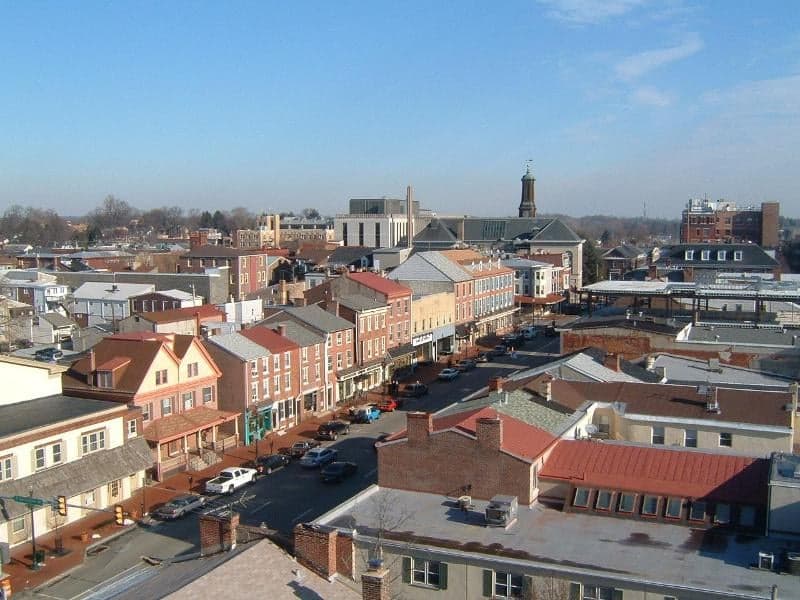
Photo: Wikipedia
Political ClimatePolitical Climate in West Chester, PA
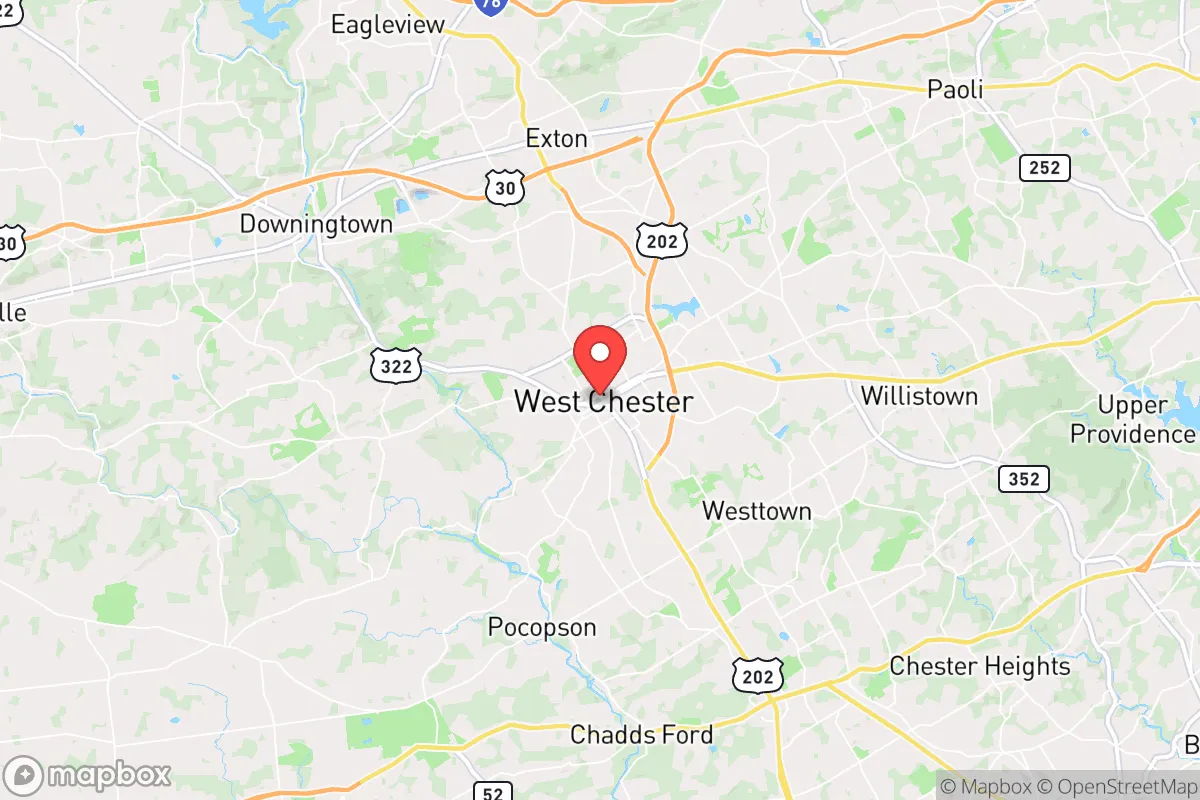
District shown is the primary district for this city’s centroid. Cities may span multiple districts.
Local Political AnalysisPolitical Analysis of West Chester, PA
West Chester, PA, leans solidly Democratic, with a Cook PVI of D+6 that has only gotten bluer in recent years. It wasn't always this way—I remember when this town had a much more balanced, live-and-let-live vibe, where your politics were your own business. Now, the local government and many of the newer residents seem to be pushing a progressive agenda that feels less like community consensus and more like top-down social engineering. The trajectory is clear: what was once a moderate, pragmatic town is becoming a one-party enclave where dissenting views are increasingly unwelcome.
How it compares
To understand West Chester's shift, you have to look at the surrounding areas. Drive 15 minutes north to Exton or Downingtown, and you'll find a more mixed political landscape—still some blue, but with a strong conservative undercurrent, especially in the rural pockets. Head south to Kennett Square, and you're in another deep-blue bubble, fueled by the mushroom industry's labor politics and wealthy transplants from the Main Line. The real contrast is just 20 minutes west to Oxford or the rural townships of southern Chester County, where you'll find gun shops, Trump signs, and a fierce independence that West Chester seems to have traded for trendy coffee shops and bike lanes. The borough itself is an island of progressive governance in a county that, outside of its urban centers, still values personal liberty and limited government.
What this means for residents
For those of us who value personal freedoms, the changes are tangible. The borough council has been aggressive with zoning ordinances that dictate what you can do with your own property, from short-term rental bans to strict historic district rules that make simple home repairs a bureaucratic nightmare. There's a growing push for higher taxes to fund social programs and "equity" initiatives that many residents never voted for. The school board has become a battleground over curriculum transparency and parental rights, with progressive members pushing for policies that prioritize ideology over academics. If you're a small business owner, you'll face increasing regulations on everything from signage to waste disposal. The unspoken rule is: if you don't align with the progressive consensus, you keep your head down or you move out.
What daily life is like for families
On the surface, West Chester is still a charming, walkable town with a great farmers market and solid schools. But the political climate seeps into daily life in subtle ways. Neighborhood social circles often form around political alignment, and it's not uncommon to feel like an outsider if you don't share the dominant views. The local paper and social media groups are heavily slanted, making it hard to get balanced information. For families, the biggest concern is the direction of the schools—there's a real fear that the focus on "social-emotional learning" and DEI training is crowding out core subjects and critical thinking. Long-term, I worry that the constant push for progressive policies will drive out the middle-ground families and small business owners who made this town great, leaving behind a homogeneous, high-cost, low-freedom borough that's more about virtue signaling than genuine community.

State Political ClimatePolitical Climate in Pennsylvania
State Political AnalysisPolitical Environment in the State
Pennsylvania is a true battleground state, and if you’re looking at it through a conservative lens, the picture is complicated. Over the past 20 years, the state has shifted from a reliably blue-leaning swing state to a dead-even toss-up, with Donald Trump winning it in 2016 and Joe Biden narrowly flipping it back in 2020. The 2024 race was again decided by less than two points. The dominant coalitions are a shrinking but still potent Democratic machine in the southeast and southwest, versus a growing, energized Republican base in the central, northern, and western rural regions. The long-term trajectory is a slow reddening of the map, but it’s being held in check by the massive, unyielding blue vote in Philadelphia and its collar counties.
Urban vs. rural divide
If you color a map of Pennsylvania by county, it looks like a sea of red with two massive blue islands. Philadelphia County delivers about 600,000 Democratic votes every cycle, more than enough to cancel out the entire Republican vote in dozens of rural counties combined. The Pittsburgh metro area (Allegheny County) is another deep blue anchor, though it’s been drifting rightward in the suburbs. The real story is the Philadelphia collar counties—Bucks, Montgomery, Chester, and Delaware—which were once Republican strongholds but have flipped hard blue over the past 15 years due to an influx of professionals and out-of-state transplants. Meanwhile, the Lancaster and York areas remain reliably red, with Lancaster County growing as a conservative hub. The Scranton/Wilkes-Barre region (Lackawanna and Luzerne counties) is the classic bellwether: historically blue-collar Democratic, it swung hard for Trump in 2016 and 2020, and now leans Republican. The Erie and Allentown metros are also competitive, with Erie County flipping back and forth. The rural north-central region—counties like Tioga, Potter, and Bradford—votes 70%+ Republican, and those numbers are only growing as the population ages and new conservative residents move in.
Policy environment
Pennsylvania’s policy environment is a mixed bag for conservatives. The state has a flat income tax rate of 3.07%, which is relatively low and hasn’t been raised in decades—a rare bright spot. However, property taxes are among the highest in the nation, especially in the Philadelphia suburbs and Pittsburgh, where school district taxes can crush homeowners. The state’s regulatory posture is moderate but trending worse: the Department of Environmental Protection (DEP) has become increasingly aggressive under Governor Josh Shapiro, particularly on natural gas drilling and agriculture. On education, Pennsylvania has a massive school funding lawsuit that could force the state to pour billions more into urban districts, which would likely mean higher taxes statewide. Election laws are a flashpoint: no-excuse mail-in voting was expanded in 2019 under Act 77, and while it’s popular with both parties, conservatives view it as a vulnerability. There’s no voter ID requirement for mail ballots, though in-person voting still requires ID. Gun laws are relatively good—Pennsylvania is a “shall issue” state for concealed carry, and there’s no permit required for open carry. However, Philadelphia and Pittsburgh have their own local restrictions that preemption laws haven’t fully stopped. Healthcare is dominated by massive systems like UPMC and Jefferson, and the state expanded Medicaid under the ACA, which conservatives see as a long-term fiscal drag.
Trajectory & freedom
On personal freedom, Pennsylvania is a state in flux. The good news: gun rights have been protected. In 2022, the state Supreme Court struck down Philadelphia’s attempt to ban “ghost guns,” and preemption laws remain strong. Parental rights are a battleground: in 2023, a bill requiring schools to notify parents of curriculum changes (including LGBTQ+ content) passed the Republican-controlled House but died in the Senate. Governor Shapiro has vetoed several school choice expansion bills, keeping the state’s charter school cap in place. Medical autonomy took a hit during COVID: Pennsylvania had some of the longest-lasting school closures in the nation, and the state’s emergency powers were used to shut down businesses for over a year. A 2021 constitutional amendment limiting the governor’s emergency powers passed with bipartisan support, but the damage to trust is done. Property rights are under pressure from the DEP’s new “Environmental Justice” policies, which give local communities more say over permits—a tool activists are using to block natural gas pipelines and farms. Taxation is a concern: while the income tax is flat, the state’s unfunded pension liabilities (over $60 billion) and the school funding lawsuit mean a tax hike is likely in the next 5 years. The freedom index from the Cato Institute ranks Pennsylvania 30th overall—middling, but trending down due to regulatory creep and fiscal instability.
Civil unrest & political movements
Pennsylvania has seen its share of political flashpoints. The 2020 election integrity controversy was intense: the state’s Supreme Court extended the mail ballot deadline, and the legislature’s Republican majority held multiple hearings on irregularities, though no widespread fraud was proven. The “Stop the Steal” movement had a strong presence in rural counties, with rallies in Harrisburg and Gettysburg. On the left, Black Lives Matter protests in Philadelphia and Pittsburgh in 2020 were large and occasionally violent, with looting in Center City. Immigration politics are a growing issue: Philadelphia is a self-declared “sanctuary city,” and the state’s lack of cooperation with ICE has frustrated conservatives. In 2023, a bus of migrants sent from Texas to Philadelphia sparked a political firestorm. Activist movements on the right are organized around Second Amendment advocacy (the Pennsylvania Firearm Owners Association is very active) and school board battles over curriculum transparency. The “Moms for Liberty” chapter in York County has been particularly effective. There’s also a small but vocal secessionist movement in the northern tier, where some counties have passed resolutions calling for a “State of Northern Pennsylvania” to break away from the Philadelphia-dominated legislature. It’s mostly symbolic, but it reflects real frustration.
Projection
Over the next 5-10 years, Pennsylvania is likely to get more competitive, not less. The demographic trends favor Republicans: the Philadelphia suburbs are aging and becoming less affordable, while the rural and exurban areas are growing as remote workers and retirees move in from New York and New Jersey. The Lancaster-York-Harrisburg corridor is the fastest-growing region in the state, and it’s solidly red. However, the Democratic stronghold in Philadelphia is not shrinking—it’s actually densifying with new high-rise apartments. The wild card is in-migration: Pennsylvania is seeing a net inflow from New York and New Jersey, but those transplants often bring their blue-state voting habits with them. If the state can hold the line on taxes and regulations, it could become a conservative magnet. If the school funding lawsuit forces a massive tax hike, the exodus to Florida and Texas will accelerate. The 2026 gubernatorial election will be critical: if a Republican wins, expect a push for school choice, permitless carry, and election integrity reforms. If Shapiro wins reelection, expect more of the same—a slow drift toward progressive policies, especially on energy and education.
Bottom line for a new resident: Pennsylvania offers a decent mix of low income taxes, strong gun rights, and a competitive political environment where your vote actually matters. But you need to pick your location carefully. If you want a conservative community with good schools and low crime, look at Lancaster County, York County, or the Poconos (Monroe County is purple but trending red). Avoid Philadelphia and Pittsburgh unless you’re prepared for high property taxes, sanctuary city policies, and a local government that leans hard left. The state’s trajectory is uncertain, but if you’re willing to get involved in local politics—school boards, county commissions, and the legislature—you can help steer it in the right direction. Just be ready for a fight, because the other side isn’t going anywhere.
* Values derived from national, state, county, city and local statistics and may differ in a specific area. Last updated: 2026-04-24T15:46:51.000Z
Narrative content on this page is AI-generated and may contain mistakes. Verify any details that matter before acting on them.
ReloMaps may earn a commission from affiliate links at no extra cost to you.

