Photo: Wikipedia
Demographics of West Chester, PA
Affluence Level in West Chester, PA
A middle-class area roughly in line with national averages across income, home values, education, and employment.
People of West Chester, PA
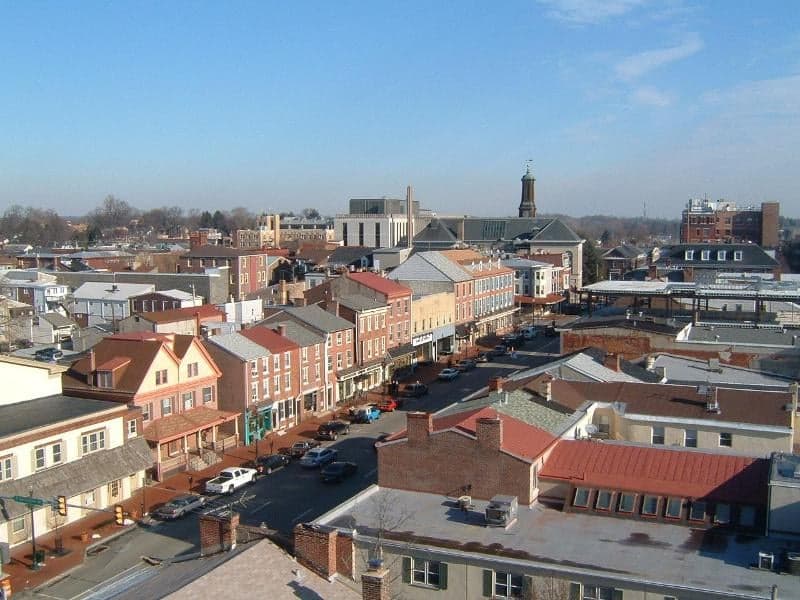
West Chester, Pennsylvania, is a compact borough of 19,235 residents that functions as both a historic county seat and a modern college town, anchored by West Chester University. The population is predominantly white (71.4%) but includes notable Black (12.4%) and Hispanic (10.9%) communities, with a small East/Southeast Asian presence (1.4%) and an even smaller Indian-subcontinent share (0.5%). Only 2.6% of residents are foreign-born, giving the borough a largely native-born character that contrasts with nearby Philadelphia suburbs. The high college-educated rate of 60.1% reflects the university's gravitational pull on faculty, staff, and professionals who work in education, healthcare, and law.
How the city was settled and grew
West Chester was laid out in 1786 as the seat of Chester County, drawing its first wave of settlers from English, Welsh, and Scots-Irish farmers who had already populated the surrounding countryside. The borough's early economy centered on the county courthouse, law offices, and small-scale manufacturing—tanneries, carriage works, and later cigar factories. The original residential core, now the West Chester Historic District, was built by these Anglo-Protestant families, who erected the Federal and Victorian row houses that still line High and Church Streets. A second wave arrived in the late 19th and early 20th centuries: Irish immigrants fleeing the famine and later Italian immigrants seeking work in the borough's growing construction and service trades. These groups settled in the South Side neighborhood, south of Market Street, where modest worker cottages and rowhomes remain today. By 1900, West Chester had become a small manufacturing and commercial hub, but its population remained overwhelmingly white and native-born through the mid-20th century.
Modern era (post-1965)
The post-1965 period brought two major demographic shifts. First, the expansion of West Chester University from a teachers' college into a comprehensive university drew faculty and staff from across the country, many of whom settled in the North Campus area and the East End around Sharpless Street. This influx raised the college-educated share dramatically and gave the borough a more transient, rental-heavy character. Second, the borough saw modest Black in-migration from Philadelphia and the surrounding region, with Black residents concentrating in the West End neighborhoods west of Darlington Street and in the South Side near the university. Hispanic growth began later, in the 1990s and 2000s, driven by Mexican and Central American immigrants working in landscaping, construction, and restaurants; they settled primarily in the South Side and along the Gay Street corridor. The Asian population has remained small and dispersed, with East/Southeast Asian families concentrated near the university and in the North Campus area. The Indian-subcontinent community is tiny (0.5%) and largely composed of university-affiliated professionals living near campus. The foreign-born share has never exceeded 5%, reflecting the borough's limited industrial base and high housing costs.
The future
West Chester's population is likely to remain stable or grow slowly, constrained by its small geographic footprint (1.8 square miles) and strict historic preservation rules. The university will continue to drive turnover, with students and young professionals replacing older residents. The Hispanic share is the fastest-growing segment, projected to reach 14-16% by 2035, as families move into the South Side and West End. The Black population is plateauing, with younger Black residents moving to newer suburbs like Exton and Downingtown. The white share will continue a gradual decline, but the borough will remain majority-white for the foreseeable future. The East/Southeast Asian and Indian communities are likely to remain small, as most Asian professionals in Chester County prefer larger-lot suburbs like East Goshen and Westtown. The foreign-born share may rise to 4-5% but will stay well below the national average. The borough is not tribalizing into distinct enclaves; rather, it is slowly diversifying within its existing neighborhoods, with the South Side becoming the most mixed area.
For a conservative-leaning mover, West Chester offers a stable, historically rooted community with a strong sense of place, low crime relative to nearby cities, and a university that provides cultural amenities without overwhelming the town. The demographic trajectory is one of gradual, moderate diversification rather than rapid change, and the borough's small size and walkable core attract those who value tradition and local identity. The key trade-off is high housing costs and limited space for families seeking large lots or new construction.

* Values derived from national, state, county, city and local statistics and may differ in a specific area. Last updated: 2026-04-24T15:46:51.000Z
Narrative content on this page is AI-generated and may contain mistakes. Verify any details that matter before acting on them.
ReloMaps may earn a commission from affiliate links at no extra cost to you.

