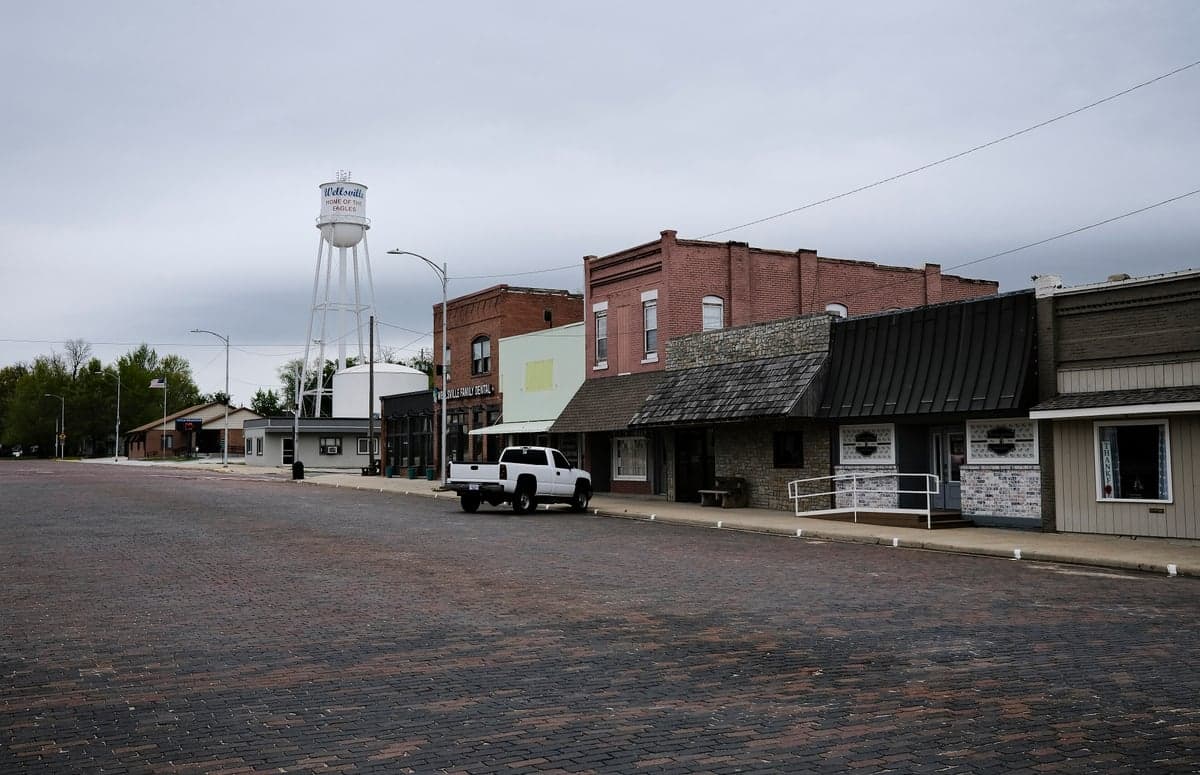
Photo: Wikipedia
Political ClimatePolitical Climate in Wellsville, KS
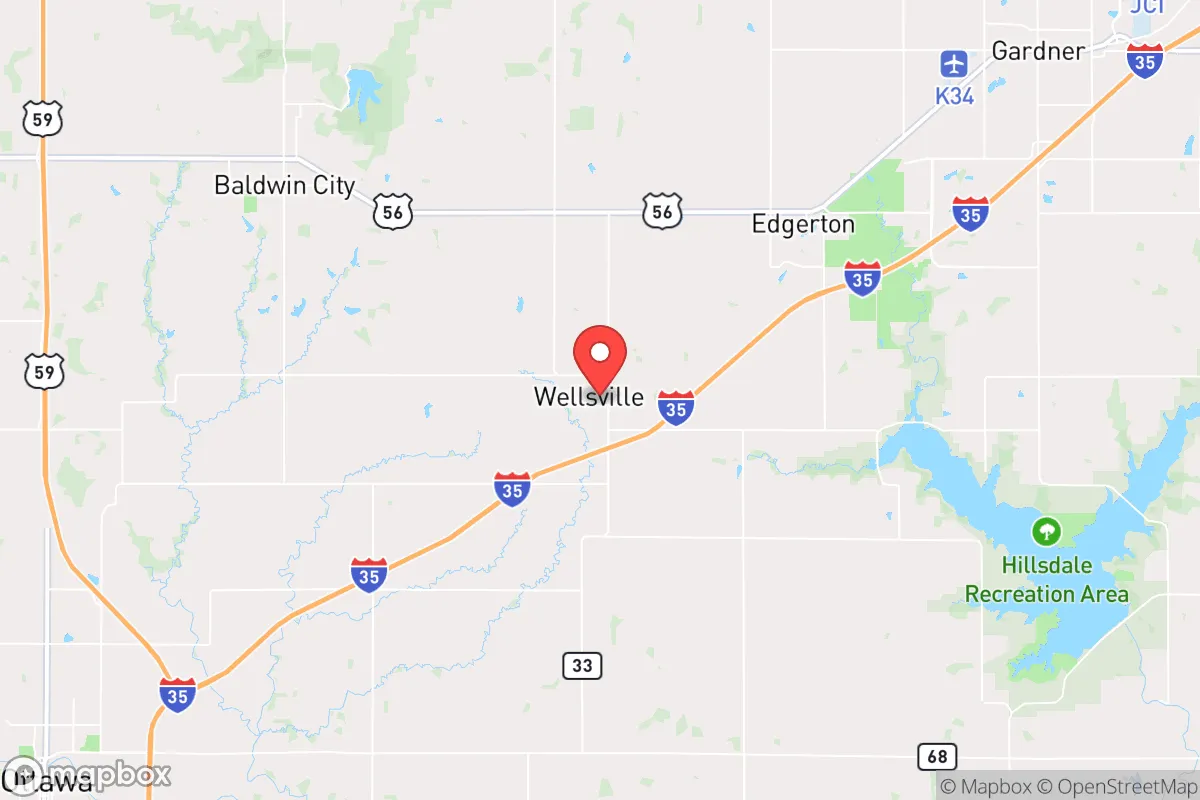
District shown is the primary district for this city’s centroid. Cities may span multiple districts.
Local Political AnalysisPolitical Analysis of Wellsville, KS
Wellsville, Kansas, is a bit of a political outlier in the state, leaning Democratic in a way that stands out against the deep red backdrop of the surrounding region. With a Cook Partisan Voting Index (PVI) of D+2, the town and its immediate area have a slight but persistent Democratic tilt, a legacy of its working-class roots and a more diverse economic base than many of the neighboring farm communities. This is a far cry from the state of Kansas as a whole, which carries a solid R+9 PVI, meaning the rest of the state is, on average, about 11 points more Republican than Wellsville. It’s a pocket of blue in a sea of red, and that creates a unique local dynamic.
How it compares
The contrast between Wellsville and the rest of Kansas is stark. Drive 20 miles west to Ottawa, and you’re in a county that votes reliably Republican, often by double-digit margins. Head south to Iola, and the pattern holds. Even nearby Lawrence, a liberal stronghold thanks to the University of Kansas, is only about 30 miles away, but it feels like a different world politically. Wellsville’s D+2 rating means it’s one of the few places in eastern Kansas outside of Lawrence or Kansas City’s suburbs where Democrats can consistently win local races. The state’s R+9 rating, by contrast, reflects the dominance of rural, agricultural, and conservative values that shape most of Kansas’s politics, from the statehouse to the governor’s mansion. This isn’t a recent shift, either—Wellsville has held this lean for decades, even as the state has moved rightward.
What this means for residents
For a conservative resident, living in a D+2 area means you’re in the minority locally, but you’re still part of the overwhelming majority statewide. You’ll likely find your views reflected in state-level policies—like tax cuts or gun laws—but you might feel out of step at a city council meeting or a school board election. For a liberal resident, the reverse is true: you can win local offices and feel your voice is heard in town, but you’ll often be frustrated by state laws that override local preferences. In practice, this creates a community where people tend to be more pragmatic than ideological. Local issues—like the condition of Main Street, the school budget, or the new water tower—often take precedence over national partisan fights. It’s not uncommon to see a Democrat and a Republican working together on the city council, because everyone knows each other and has to live with the results.
Looking ahead, the trajectory seems stable. Wellsville isn’t likely to flip to R+9 anytime soon, but it’s also not becoming a progressive hub. The town’s economy is tied to manufacturing and small businesses, not the tech or academic sectors that drive liberal growth in places like Lawrence. The real tension comes from state-level policies—like abortion restrictions or school funding formulas—that can feel imposed from Topeka. For both sides, the takeaway is that Wellsville is a place where you can be politically active without being consumed by politics. It’s a small town where neighborliness still matters more than party affiliation, even if the voting booth tells a different story.

State Political ClimatePolitical Climate in Kansas
State Political AnalysisPolitical Environment in the State
Kansas is a solidly Republican state with a Cook PVI of R+9, but that number masks a deeply divided political landscape that has grown more polarized over the past 20 years. The state has shifted rightward in presidential elections—voting for Trump by 15 points in 2020 and 16 in 2024—while simultaneously electing Democratic governors in three of the last five cycles, a split that reflects a suburban-versus-rural tug-of-war over taxes, education, and social policy. For a relocator, this means the political reality you experience depends heavily on whether you settle in the Kansas City suburbs, the Wichita metro, or a small town like Hays or Garden City.
Urban vs. rural divide
The political map of Kansas is a study in contrasts. The eastern third of the state, anchored by the Kansas City metro area, is the Democratic stronghold. Johnson County—home to Overland Park, Olathe, and Lenexa—has been the epicenter of the state’s political shift: it voted for Trump by 8 points in 2016, then flipped to Biden by 6 points in 2020, and backed Harris by 5 points in 2024. This suburban realignment, driven by college-educated voters and a growing professional class, is the single biggest factor keeping Kansas competitive at the state level. Wyandotte County (Kansas City, Kansas) and Douglas County (Lawrence) are deep blue, routinely delivering 65-75% Democratic margins. In contrast, the rest of the state is overwhelmingly Republican. Western Kansas counties like Sherman and Greeley routinely vote 80-85% Republican. The Wichita metro (Sedgwick County) is a bellwether: it voted for Trump by 12 points in 2024, but its suburban precincts in places like Andover and Derby are more moderate, while the city itself leans Democratic. The rural-urban split is so stark that a resident of Lawrence and a resident of Dodge City live in effectively different political countries, despite being in the same state.
Policy environment
Kansas’s policy environment is defined by a low-tax, low-regulation posture that has been in place for over a decade. The state has a flat income tax rate of 5.7% (down from a progressive top rate of 6.45% in 2012), and the sales tax is 6.5% at the state level, with local add-ons that can push it over 10% in some cities. Property taxes are moderate but vary widely by county. The state is a “right-to-work” state and has some of the weakest labor union protections in the country. On education, Kansas has a mixed record: per-pupil spending is below the national average, but the state Supreme Court has repeatedly forced the legislature to increase funding for K-12 schools, creating a perennial tension between the Republican-controlled legislature and the judiciary. Healthcare policy is similarly divided: the state has not expanded Medicaid under the Affordable Care Act, leaving roughly 150,000 low-income adults in a coverage gap, despite repeated bipartisan attempts to pass expansion. Election laws are moderately restrictive: Kansas requires a photo ID to vote, and same-day voter registration is not available. The state also has a voter registration deadline 21 days before an election, which is earlier than many states.
Recent policy direction
The last five years have seen Kansas move decisively to the right on several fronts, while remaining more moderate on others. On gun rights, Kansas is a constitutional carry state (permitless carry for adults 21 and older, passed in 2015) and has a “Stand Your Ground” law. In 2023, the legislature passed a bill allowing concealed carry on public college campuses, which was signed into law. On abortion, Kansas is a national outlier: after the 2022 Dobbs decision, voters overwhelmingly rejected a proposed constitutional amendment that would have removed the right to abortion, making Kansas a regional haven for abortion access. The state currently allows abortion up to 22 weeks, and there are no mandatory waiting periods or ultrasound requirements. On parental rights and education, the legislature passed a “Parents’ Bill of Rights” in 2023 that requires schools to notify parents about curriculum changes and allows them to opt their children out of certain materials. The state also expanded school choice in 2024, creating a tax-credit scholarship program for private school tuition. On transgender issues, the legislature overrode Governor Laura Kelly’s veto in 2023 to ban transgender athletes from girls’ sports, and in 2024 passed a ban on gender-affirming care for minors. On voting, the state tightened ballot access in 2021 by requiring a signature match for mail-in ballots and limiting drop box locations, though it stopped short of the more restrictive measures seen in states like Texas or Georgia. On property rights, Kansas has no statewide rent control and relatively weak eminent domain protections, though a 2023 law did increase compensation for landowners in pipeline cases.
Civil unrest & political movements
Kansas has not seen the large-scale civil unrest of coastal states, but it has its share of organized political movements. The most visible flashpoint in recent years was the 2022 abortion referendum, which drew massive turnout and saw coordinated campaigns from both sides, with national money pouring in. The result—a 59-41 vote to protect abortion rights—was a shock to the state’s Republican establishment and energized progressive activism, particularly in Johnson County and Lawrence. On the right, the Kansas Republican Party has been split between a more traditional, business-friendly wing and a populist, grassroots faction aligned with the Kansas Policy Institute and the Kansas chapter of Moms for Liberty. The latter has been particularly active in school board races in suburbs like Olathe and Shawnee, where debates over library books and curriculum have been heated. Immigration politics are less visible than in border states, but the issue flares up periodically: in 2024, the legislature passed a bill requiring local law enforcement to cooperate with federal immigration authorities, which was vetoed by Governor Kelly. There is no sanctuary city movement of note; even liberal Lawrence has not declared itself a sanctuary city. Election integrity controversies have been relatively muted compared to states like Arizona or Georgia, though the 2020 and 2024 elections saw some localized disputes in rural counties over voting machine security. Overall, the political temperature is high but not boiling—a new resident is unlikely to encounter street protests or visible political conflict in daily life, except during election season.
Projection
Over the next 5-10 years, Kansas is likely to continue its slow drift rightward at the state level, even as its urban and suburban areas become more Democratic. The key demographic trend is the growth of Johnson County, which is now the state’s largest county and is becoming more diverse and more liberal with each election cycle. If this trend continues, Kansas could become a genuine swing state in presidential elections within a decade, much like Arizona or Georgia did in the 2010s. However, the rural and exurban parts of the state are also growing more conservative, and the state’s legislative districts are heavily gerrymandered in favor of Republicans, meaning the state legislature will likely remain under GOP control for the foreseeable future. The biggest wild card is in-migration: Kansas is attracting new residents from California and Colorado, many of whom are drawn by lower housing costs and a more conservative political environment. If these newcomers lean Republican, the state’s rightward tilt could accelerate. For a relocator, the bottom line is that Kansas offers a genuinely mixed political environment: you can live in a deep-blue suburb like Prairie Village or a deep-red small town like Colby, and your experience of state politics will be filtered through that local lens. The state government will remain conservative on taxes, guns, and education, but the culture wars will continue to play out at the local level, especially in school boards and county commissions.
For a new resident, the practical takeaway is that Kansas is a state where your political experience is highly localized. If you’re a conservative, you’ll find a welcoming policy environment and a state government that shares your values on most issues. If you’re a liberal, you’ll find safe havens in Lawrence, Kansas City, and the Johnson County suburbs, but you’ll be living under a state government that is often hostile to your priorities. The state’s low cost of living and relatively stable economy are the main draws for both sides, but the political climate is something you’ll need to navigate based on where you choose to put down roots.
* Values derived from national, state, county, city and local statistics and may differ in a specific area. Last updated: 2026-10-06T17:35:13.000Z
Narrative content on this page is AI-generated and may contain mistakes. Verify any details that matter before acting on them.
ReloMaps may earn a commission from affiliate links at no extra cost to you.

