Photo: Wikipedia
Demographics of Weirton, WV
Affluence Level in Weirton, WV
A low-income area with significant economic hardship. Household wealth and educational attainment are well below national averages.
People of Weirton, WV
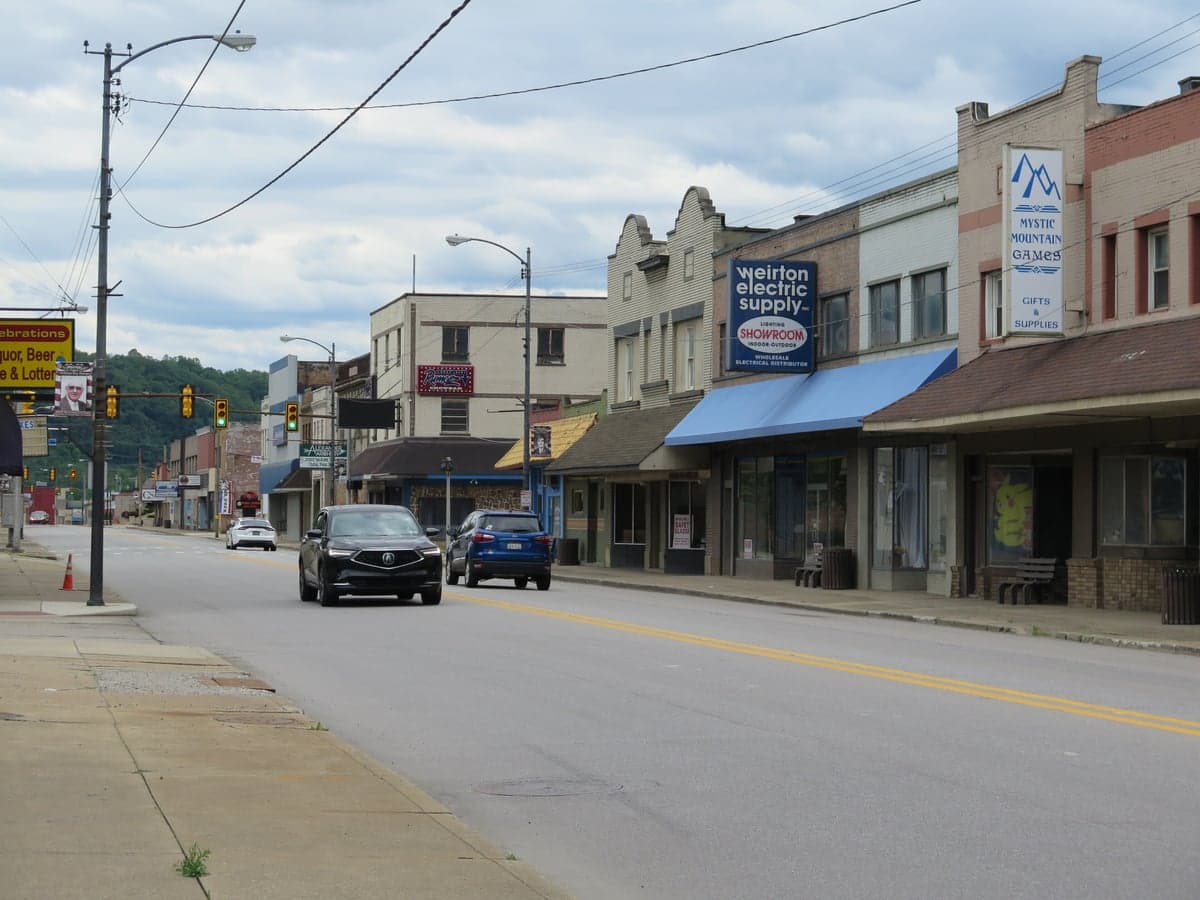
The people of Weirton, West Virginia today number 18,785, forming a predominantly white (90.6%) and older community with a strong industrial identity rooted in steel. The city is notably less diverse than the national average, with a foreign-born population of just 0.9%, and its residents are concentrated in distinct neighborhoods that trace their origins to specific waves of European immigration. Weirton’s character remains that of a tight-knit, blue-collar town where family ties to the mill run deep, though population decline and an aging demographic signal a community in transition.
How the city was settled and grew
Weirton’s population history is almost entirely tied to the steel industry, with no significant settlement before the late 19th century. The city was founded in 1909 by Ernest T. Weir, who established Weirton Steel along the Ohio River. The first major wave of workers came from the surrounding Appalachian region—native-born whites from rural West Virginia, Ohio, and Pennsylvania—who built the North Weirton and Weirton Heights neighborhoods as company housing. These areas remain the historic core of the city’s working-class identity.
Between 1910 and 1930, the mill’s expansion drew a second wave: Southern and Eastern European immigrants, primarily Italians, Poles, and Slovaks. These groups settled in Marland Heights and the Downtown district near the mill, establishing ethnic clubs and Catholic parishes that still anchor those neighborhoods. A smaller wave of Greek and Lebanese immigrants arrived in the 1920s, concentrating in the Three Springs Drive corridor. By 1950, Weirton’s population peaked near 24,000, with the mill employing over 12,000 workers and the city’s ethnic enclaves largely assimilated into a unified steel-town culture.
Modern era (post-1965)
After the 1965 Hart-Cellar Act, Weirton saw almost no new immigration—its foreign-born share today is 0.9%, far below the national average. The city’s demographic story since 1965 is one of domestic out-migration and aging. The steel industry’s decline, culminating in the 1980s layoffs, triggered a steady population loss of roughly 25% from its peak. Younger residents left for larger cities, leaving behind an older, predominantly white population. The Weirton Heights and North Weirton neighborhoods, once filled with young families, now have a median age well above 45.
Modest diversification has occurred, but from a very low base. The Black population stands at 2.7%, concentrated in scattered pockets in Downtown and Marland Heights. Hispanic residents (2.1%) and East/Southeast Asian communities (0.8%) are small and dispersed, with no distinct ethnic enclave. The Indian subcontinent population is negligible at 0.1%. The college-educated share is 22.8%, below the national average, reflecting the city’s enduring blue-collar character. No single neighborhood has experienced rapid ethnic turnover; instead, the city has slowly homogenized as older white residents age in place.
The future
Weirton’s population is heading toward further decline and homogenization. The city lost roughly 1,000 residents between 2010 and 2020, and projections suggest continued shrinkage to around 16,000 by 2040. The foreign-born population is unlikely to grow significantly, as the area lacks the job diversity or housing stock to attract new immigrants. The Hispanic and Asian shares may inch upward slowly, but from such low bases that they will remain small minorities. The city is not tribalizing into distinct enclaves; rather, it is becoming more uniformly older and whiter, with Weirton Heights and North Weirton likely to see the most pronounced aging.
One potential counterweight is the planned development of a new industrial park near the former mill site, which could attract some younger workers from outside the region. However, without a significant shift in economic opportunity, the demographic trajectory points to a smaller, older, and less diverse community.
For someone moving in now, Weirton offers a stable, low-cost environment with strong community bonds, but it is a place where the population is contracting and diversifying only at a glacial pace. New residents—especially those from outside the region—will find a city that is welcoming but insular, where the past still shapes daily life more than the future.

* Values derived from national, state, county, city and local statistics and may differ in a specific area. Last updated: 2026-05-02T02:24:03.000Z
Narrative content on this page is AI-generated and may contain mistakes. Verify any details that matter before acting on them.
ReloMaps may earn a commission from affiliate links at no extra cost to you.

