
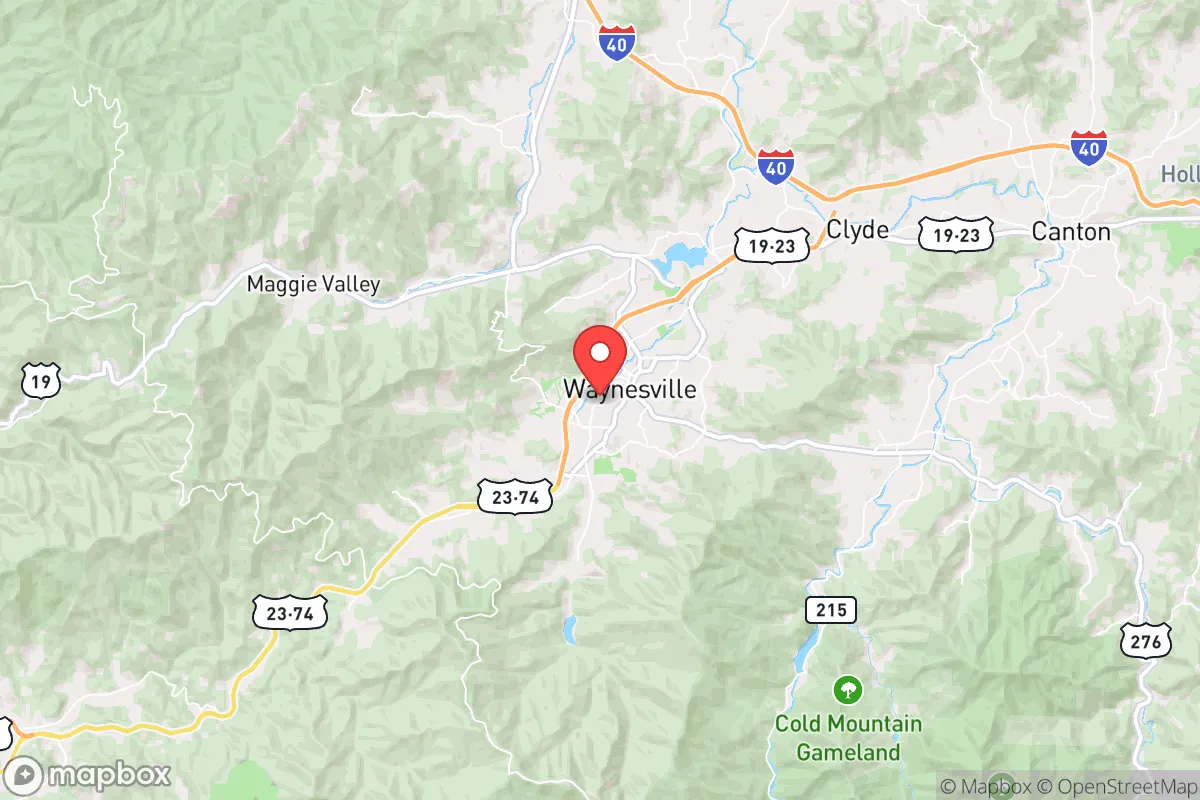
Photo: Wikipedia
Personal Sovereignty in Waynesville, NC
Viable for self-reliance. Generally workable, though some barriers may limit total independence.
What does Personal Sovereignty tell us?
Personal Sovereignty measures your capacity for self-reliance and independence with minimal government friction. Higher scores mean fewer barriers between you and the way you want to live... but it assumes you have the space you need and good neighbors.
What does this tell us?
Personal Sovereignty measures your capacity for self-reliance and independence with minimal government friction. Higher scores mean fewer barriers between you and the way you want to live... but it assumes you have the space you need and good neighbors.
State Policy
Energy independence: Importer (15% of energy produced in-state)
Personal Liberty
Homesteading

Personal Liberty Analysis
Waynesville, North Carolina, offers a notably high degree of personal sovereignty relative to many other parts of the Southeast, driven largely by North Carolina’s status as a Dillon’s Rule state with a strong tradition of county-level home rule. While the town itself operates under a council-manager government with standard municipal codes, the surrounding Haywood County and the broader state legal framework provide residents with significant latitude in areas of taxation, self-defense, property use, and personal lifestyle choices. For individuals and families prioritizing autonomy, the balance between local ordinances and state-level protections creates an environment where self-reliance is both feasible and culturally supported, though not without specific regulatory constraints that require attention.
Tax burden and regulatory posture in Haywood County
North Carolina imposes a flat state income tax rate of 4.75% as of 2025, with scheduled reductions toward 3.99% by 2027, which is competitive for the region. Haywood County’s property tax rate is approximately $0.54 per $100 of assessed value, placing it in the middle range among Western North Carolina counties. There is no county-level sales tax surcharge beyond the state’s 4.75% rate, though local municipalities like Waynesville add an additional 2.25%, bringing the total to 7% — moderate by national standards. The regulatory environment is generally light-touch for small businesses and landowners. Haywood County does not impose countywide zoning in unincorporated areas, which means property owners outside town limits face fewer restrictions on land use, building placement, and home-based enterprises. However, Waynesville’s municipal zoning code is more prescriptive, particularly in historic districts and along commercial corridors. For those seeking minimal regulatory interference, purchasing land in the county’s unincorporated areas is a deliberate strategy that many local residents pursue. The state’s lack of a personal property tax on vehicles or business equipment further reduces annual carrying costs for self-employed individuals and families.
Self-defense and gun law specifics in North Carolina
North Carolina is a shall-issue state for concealed handgun permits, meaning that if an applicant meets statutory requirements — including a background check, fingerprinting, and an 8-hour training course — the sheriff’s office must issue the permit. Haywood County’s sheriff has a reputation for efficient processing, with typical turnaround times of 45 to 60 days. The state allows open carry of handguns without a permit for individuals legally allowed to possess a firearm, though local ordinances in Waynesville do not restrict this practice. Stand-your-ground laws are codified in North Carolina statute, removing any duty to retreat before using deadly force in self-defense when lawfully present. Castle doctrine protections extend to occupied vehicles and workplaces, not just residences. There is no state-level red flag law, no firearm registration requirement, and no waiting period for long gun purchases. Magazine capacity is not restricted. For residents of Waynesville, access to firearms for self-defense is straightforward and legally protected, with the primary limitation being federal prohibitions on firearm possession in certain public buildings and schools. The cultural environment in Haywood County is strongly supportive of Second Amendment rights, and local gun shops, ranges, and training facilities are readily available within a 20-minute drive.
Self-reliance and homesteading viability: lot sizes, zoning, and off-grid feasibility
Haywood County’s unincorporated areas offer substantial opportunities for self-reliant living. Minimum lot sizes in the county’s agricultural and rural zoning districts start at 1 acre, though many parcels available for purchase range from 3 to 20 acres, providing ample space for gardens, small livestock, and timber management. The county does not prohibit rainwater collection, and there are no restrictions on composting toilets or graywater systems for properties with approved septic permits. Solar panel installation is permitted without special county-level permitting, though interconnection with Duke Energy’s grid requires standard utility approval. Off-grid living is legally feasible in unincorporated areas, provided the property meets state health department requirements for wastewater treatment — typically a conventional septic system or an approved alternative. The county’s building code enforcement is limited to structural safety and does not mandate specific aesthetic standards outside municipal limits. Raising chickens, goats, and up to two cows per acre is generally permitted without a special use permit in agricultural zones. For families pursuing a homesteading lifestyle, the primary regulatory hurdle is the state’s requirement for a permitted septic system, which can cost $5,000 to $15,000 depending on soil conditions. Otherwise, the regulatory posture is permissive, and the local culture values self-sufficiency, with active 4-H programs, extension service workshops, and a robust farmers market ecosystem.
Personal liberties: parental rights, medical autonomy, speech, and property
North Carolina law provides strong protections for parental rights in education and healthcare decisions. Parents have statutory authority to direct the upbringing, education, and medical care of their children, including the right to opt out of public school curricula and to homeschool without excessive bureaucratic burden. Haywood County has a well-established homeschooling community, with multiple support groups and cooperative learning programs operating without significant county interference. Medical autonomy is generally respected, though North Carolina has not expanded Medicaid under the Affordable Care Act, which limits healthcare access for low-income self-employed individuals. Vaccine mandates are not enforced at the state or county level for general employment or public accommodation, and COVID-19-era restrictions were lifted early compared to many states. Free speech protections align with First Amendment jurisprudence, and Haywood County has no local ordinances restricting political speech, signage, or assembly beyond standard time-place-manner regulations. Property rights are robust, with North Carolina’s eminent domain laws strictly limited to public use projects, and the state’s right-to-farm law protects agricultural operations from nuisance lawsuits. For property owners, the ability to build fences, post no-trespassing signs, and exclude unwanted activity is legally unambiguous and culturally enforced.
Overall, Waynesville and Haywood County present a sovereignty profile that is strong by Southeastern standards, particularly for those willing to locate outside municipal zoning jurisdiction. The combination of low flat-rate income tax, permissive gun laws, minimal restrictions on rural land use, and strong parental and property rights creates an environment where self-reliant individuals and families can operate with relatively little government friction. The primary trade-offs are the moderate sales tax rate in town and the need to navigate state-level septic and building codes, which are not onerous but do require planning. For a relocation audience that values personal freedom over convenience, Waynesville offers a credible and livable balance of liberty and community infrastructure.

* Values derived from national, state, county, city and local statistics and may differ in a specific area. Last updated: 2026-10-20T17:11:34.000Z
Narrative content on this page is AI-generated and may contain mistakes. Verify any details that matter before acting on them.
ReloMaps may earn a commission from affiliate links at no extra cost to you.

