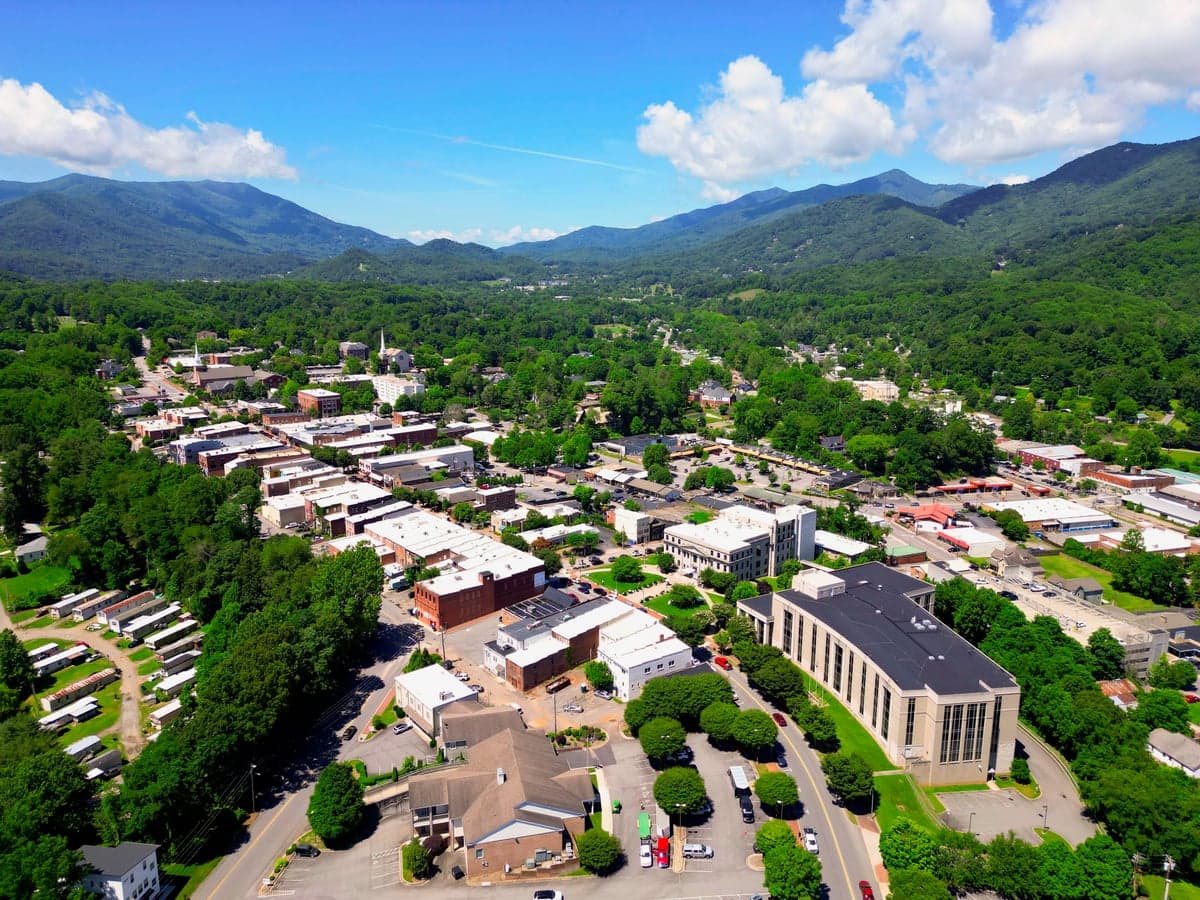
Photo: Wikipedia
Demographics of Waynesville, NC
Affluence Level in Waynesville, NC
A middle-class area roughly in line with national averages across income, home values, education, and employment.
People of Waynesville, NC
The people of Waynesville, North Carolina, today number roughly 10,400, forming a predominantly white (88.7%) community with a small but established Hispanic population (5.3%) and a very low foreign-born share of 3.5%. The city retains a distinctly Appalachian character—rooted in Scots-Irish and German settlement—while serving as the commercial and cultural hub for Haywood County. With 31.3% of adults holding a college degree, the population skews slightly more educated than the surrounding rural areas, reflecting an influx of retirees, remote workers, and second-home owners drawn to the Blue Ridge Mountains.
How the city was settled and grew
Waynesville was originally inhabited by the Cherokee people, who ceded the land through the 1819 Treaty of Washington. European-American settlement began in earnest in the 1810s, with Scots-Irish and German families migrating from Pennsylvania and Virginia via the Great Wagon Road. These early settlers were primarily subsistence farmers and small-scale traders, drawn by the fertile valleys and abundant timber. The town was formally incorporated in 1810 and named after General "Mad" Anthony Wayne. The arrival of the Western North Carolina Railroad in 1884 transformed Waynesville from a remote farming hamlet into a regional market and tourist destination. The historic Frog Level district, located along Richland Creek, became the commercial and industrial heart of the town, housing warehouses, tanneries, and the train depot that connected local farmers to outside markets. Meanwhile, the Main Street district developed as the civic and retail core, with brick storefronts and hotels catering to summer visitors escaping lowland heat. By the early 20th century, Waynesville had also become a haven for tuberculosis patients seeking the mountain air, with sanatoriums and boarding houses concentrated in the Hazelwood area (then a separate town, annexed in 1995). The population remained overwhelmingly white and native-born through the mid-20th century, with African Americans making up a small fraction—many employed as domestic workers or railroad laborers—and living primarily in the South Main Street corridor near the railroad tracks.
Modern era (post-1965)
The post-1965 period saw Waynesville's population stabilize and then slowly diversify, though the changes were modest compared to larger Southern cities. The Hispanic population began to grow in the 1990s, driven by labor demand in construction, landscaping, and the region's expanding hospitality sector. Today, the 5.3% Hispanic share is concentrated in the Hazelwood neighborhood and along the Russ Avenue corridor, where affordable rental housing and proximity to service jobs anchor the community. The Black population, at just 1.8%, remains small and is largely composed of long-standing families in the South Main Street area, with little new in-migration. East and Southeast Asian residents (0.4%) are a tiny but visible presence, often connected to the medical and educational sectors, and tend to live in newer subdivisions on the town's periphery. The Indian-subcontinent population is effectively zero. The most significant demographic shift since 1965 has been domestic in-migration: retirees from Florida and the Northeast, second-home buyers, and, more recently, remote workers seeking lower costs and mountain scenery. These newcomers have gravitated toward the Balsam Ridge and Lake Junaluska areas (the latter technically a separate census-designated place but functionally part of Waynesville's orbit), where newer single-family homes and golf-course communities have been built. The town's white share has declined slightly from over 95% in 1980 to 88.7% today, driven almost entirely by Hispanic growth and the retirement of older white residents.
The future
Waynesville's population is projected to grow slowly, likely reaching 11,000–11,500 by 2040, driven by continued domestic in-migration rather than international immigration. The Hispanic share is expected to rise gradually, possibly to 8–10%, as families already in the area grow and new workers arrive for service and construction jobs. The white population will remain the overwhelming majority, though its share may edge down to the mid-80% range. The Black and Asian shares are unlikely to change significantly, given the lack of major employers or universities that attract diverse talent. New development is concentrating in the Hazelwood area, where annexation and zoning changes have allowed for townhomes and apartment complexes, and along the Russ Avenue corridor, where big-box retail and chain restaurants have expanded. The historic Frog Level district is seeing a revival as a walkable arts and dining destination, attracting younger professionals and empty-nesters. The cultural identity of Waynesville is evolving from a quiet, insular mountain town into a more outward-facing community that balances tourism, retirement, and remote work—but it remains overwhelmingly white, native-born, and politically conservative, with a strong attachment to Appalachian traditions.
For someone moving in now, Waynesville offers a stable, low-crime community with a strong sense of place, but little racial or ethnic diversity. The population is aging slightly, with a median age around 45, and the social fabric is shaped by churches, civic clubs, and outdoor recreation. Newcomers will find a welcoming but insular environment, where integration requires active participation in local life. The town is becoming more connected to the broader Asheville economy, but it retains a distinct identity as a smaller, quieter, and more affordable alternative.

* Values derived from national, state, county, city and local statistics and may differ in a specific area. Last updated: 2026-10-20T17:11:34.000Z
Narrative content on this page is AI-generated and may contain mistakes. Verify any details that matter before acting on them.
ReloMaps may earn a commission from affiliate links at no extra cost to you.

