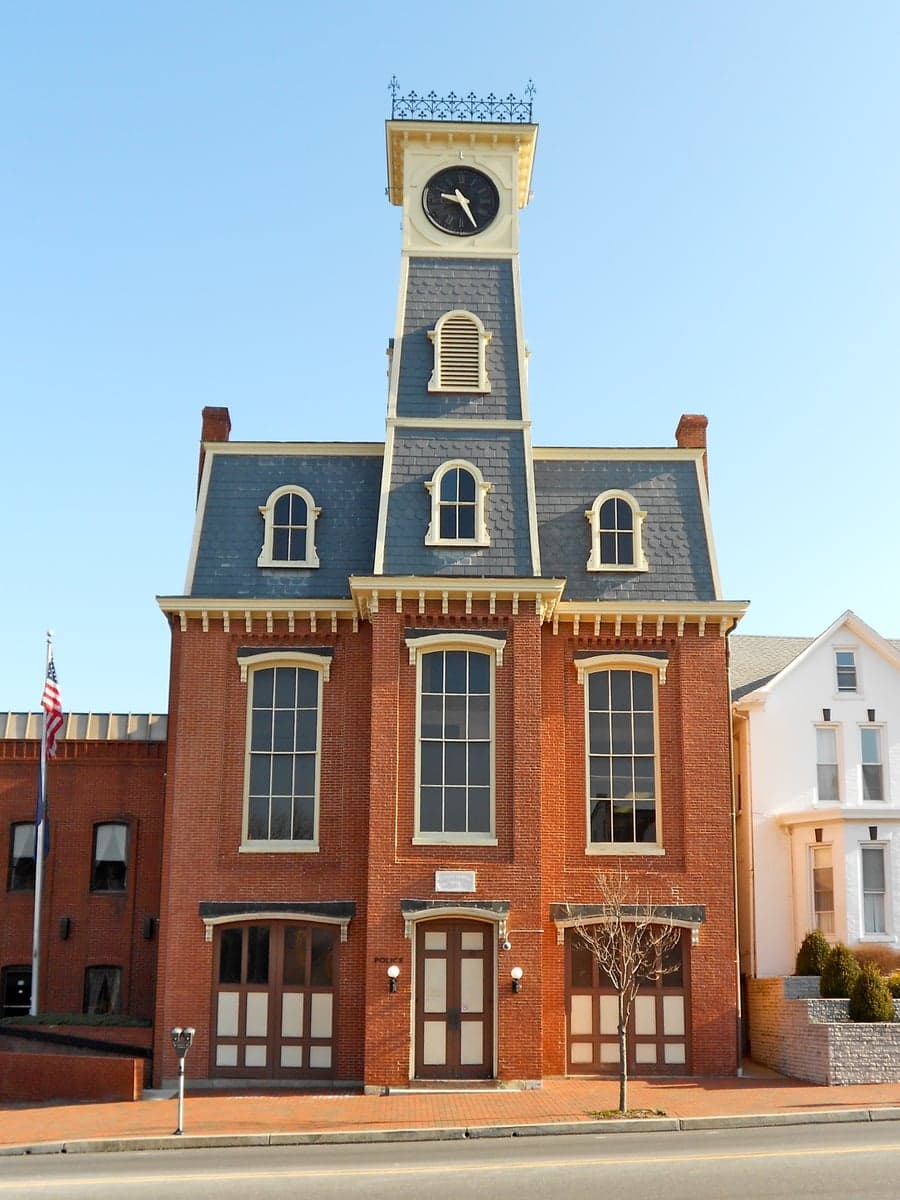
Photo: Wikipedia
Personal Sovereignty in Waynesboro, PA
Strong independent fundamentals that actively favor personal liberty and low regulation.
What does Personal Sovereignty tell us?
Personal Sovereignty measures your capacity for self-reliance and independence with minimal government friction. Higher scores mean fewer barriers between you and the way you want to live... but it assumes you have the space you need and good neighbors.
What does this tell us?
Personal Sovereignty measures your capacity for self-reliance and independence with minimal government friction. Higher scores mean fewer barriers between you and the way you want to live... but it assumes you have the space you need and good neighbors.
State Policy
Energy independence: Net exporter (150% of energy produced in-state)
Personal Liberty
Homesteading

Personal Liberty Analysis
Waynesboro, Pennsylvania, offers a notably high degree of personal sovereignty, rooted in the Commonwealth's strong tradition of local control and a legal framework that generally favors individual autonomy. For those prioritizing independence, the area presents a balanced environment where state-level protections for self-defense and property rights coexist with a moderately low tax burden and a regulatory posture that, while not libertarian, is far from the heavy-handed oversight found in neighboring states like Maryland or New Jersey. The key for a relocating individual or family is understanding that Pennsylvania's "hands-off" approach in several critical areas—from gun laws to land use—creates a practical foundation for self-reliant living, provided one respects the existing community norms and local ordinances.
Tax burden and regulatory posture in Franklin County
Pennsylvania's overall tax burden is a mixed bag, but for a sovereignty-minded individual, the structure is generally favorable. The state levies a flat 3.07% personal income tax on all earned income, with no graduated brackets, which is a straightforward and predictable system. There is no state tax on retirement income, including Social Security, pensions, and 401(k) withdrawals, a significant advantage for retirees or those planning for financial independence. The state sales tax is 6%, but it does not apply to most groceries, clothing, or prescription drugs. At the local level, Waynesboro Borough imposes a 1.5% earned income tax (EIT) on residents, and Franklin County adds a separate 0.5% EIT, bringing the combined local earned income tax to 2.0%. Property taxes in the Waynesboro Area School District are moderate for Pennsylvania, typically ranging from 1.2% to 1.5% of assessed value, though assessments are not always current. The regulatory environment in Franklin County is notably light-touch compared to the urban centers to the east. There are no county-level building codes for most rural residential construction (though the borough and township have their own), and the state's Uniform Construction Code is enforced locally with varying rigor. For a small business owner or someone wanting to operate a home-based enterprise, the lack of a county business privilege tax and relatively simple licensing requirements are tangible benefits. The overall posture is one of "permissionless" activity unless a specific harm is demonstrated, a contrast to the more preemptive regulation found in nearby Maryland.
Self-defense and gun law specifics in Pennsylvania
Pennsylvania is a shall-issue state for concealed carry permits, meaning that if you meet the basic criteria (age 21, no disqualifying criminal record, no involuntary mental health commitment), the county sheriff must issue a License to Carry Firearms (LTCF). Franklin County's sheriff's office is known for efficient processing, with applications typically approved within the statutory 45-day window, often faster. The state has preemption of firearm laws, meaning local municipalities like Waynesboro Borough cannot enact their own gun control ordinances that are stricter than state law. This is a critical protection for gun owners. Open carry is legal without a permit for anyone who can legally possess a firearm, though it becomes illegal in a vehicle without an LTCF. Stand-your-ground laws are not codified in statute, but Pennsylvania case law has long recognized the Castle Doctrine, which creates a presumption of reasonable fear of death or serious bodily injury if an intruder unlawfully enters your home, vehicle, or occupied structure. There is no duty to retreat in one's dwelling. For self-defense outside the home, the law is less clear-cut, but the Castle Doctrine provides strong protection for defending one's property. Magazine capacity is not restricted, and there is no state-level assault weapons ban. For a family prioritizing self-reliance, the legal framework is straightforward: you can own, carry, and use firearms for self-defense with minimal bureaucratic hurdles, and local authorities are generally supportive of Second Amendment rights.
Self-reliance and homesteading viability: lot sizes, zoning, and off-grid feasibility
The viability of a self-reliant lifestyle in the Waynesboro area depends heavily on whether you are inside the borough limits or in the surrounding townships. Within Waynesboro Borough, lot sizes are typically small (under a quarter-acre), and zoning is more restrictive, with regulations on livestock, accessory structures, and home businesses. However, the surrounding townships—Washington Township, Quincy Township, and Guilford Township—offer significantly more freedom. Here, minimum lot sizes for agricultural or rural residential zoning often start at 1 to 2 acres, and many parcels of 5 to 10 acres are available at reasonable prices (often $10,000–$20,000 per acre). These townships generally allow for keeping chickens, goats, and even a horse or two as an accessory use, though a formal agricultural zoning designation may be needed for larger livestock operations. Off-grid feasibility is moderate. Pennsylvania has no state law prohibiting rainwater collection, and many rural properties rely on private wells. However, the state's Uniform Construction Code requires that any dwelling be connected to an approved sewage system (either public sewer or a permitted on-lot septic system), which effectively prohibits true "off-grid" composting toilets without a variance. Solar panels are permitted and even encouraged by net metering policies, but a grid connection is typically required for financing and resale. The regulatory sweet spot for homesteading is a property in a township with agricultural zoning and a private well and septic, where you can raise food, generate power, and live with minimal interference from local government, provided you comply with basic health and safety codes.
Personal liberties: parental rights, medical autonomy, speech, and property
Pennsylvania law provides a strong baseline for several key personal liberties. Parental rights are explicitly protected under state statute, giving parents the authority to direct the education, upbringing, and medical care of their children. The state has a robust charter school and cyber-charter school system, and homeschooling is legal with a relatively simple affidavit process and annual portfolio review. Medical autonomy is a mixed landscape. Pennsylvania has no state-level vaccine mandate for adults, and while school vaccine requirements exist, medical and religious exemptions are available. The state does not have a "Right to Try" law for terminally ill patients, but it does allow for the use of medical marijuana. For property rights, Pennsylvania is an eminent domain state that follows the "public use" requirement of the Fifth Amendment, and local governments must provide just compensation. There is no state-level rent control, and property taxes are based on assessed value, which can be appealed. Free speech is protected under the Pennsylvania Constitution, which has its own free expression clause that has been interpreted as at least as protective as the First Amendment. The state does not have a "bubble zone" law around abortion clinics that restricts speech on public sidewalks, and there are no state-level hate speech laws that criminalize protected expression. For a family, the practical effect is that you can raise your children according to your values, speak your mind on public issues, and use your property as you see fit, within the bounds of nuisance and safety laws.
Overall, Waynesboro and its surrounding townships offer a level of personal sovereignty that is notably higher than what you would find in most of the Northeast Corridor. The combination of a flat income tax, no tax on retirement income, strong Castle Doctrine protections, permissive gun laws, and the ability to pursue a semi-homesteading lifestyle on affordable land creates a practical environment for self-reliance. The trade-offs are the moderate property taxes and the need to navigate local zoning if you want to push the boundaries of off-grid living. For a conservative-leaning individual or family who values autonomy over convenience, Franklin County represents a solid middle ground—free enough to live by your own rules, but structured enough to maintain community standards and property values.

* Values derived from national, state, county, city and local statistics and may differ in a specific area. Last updated: 2026-08-24T22:36:30.000Z
Narrative content on this page is AI-generated and may contain mistakes. Verify any details that matter before acting on them.
ReloMaps may earn a commission from affiliate links at no extra cost to you.

