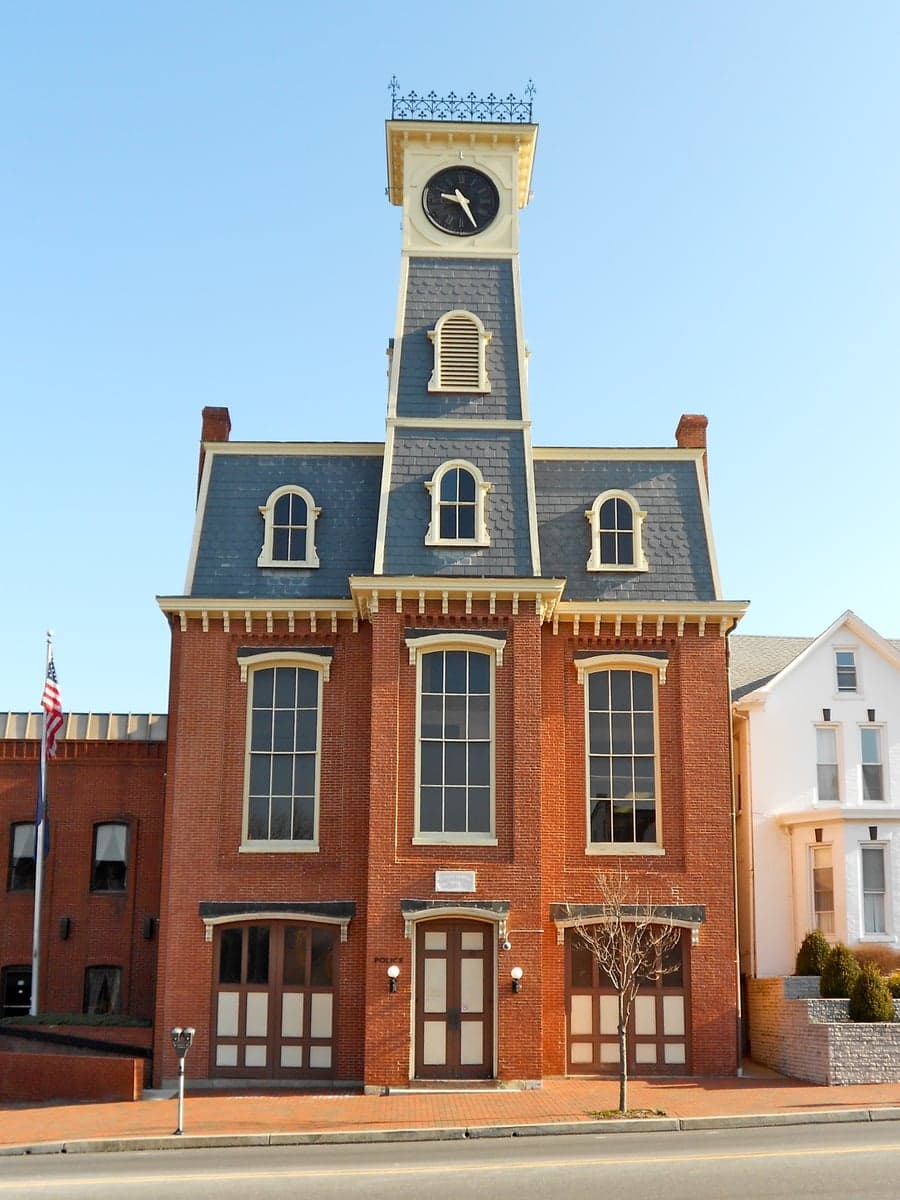
Photo: Wikipedia
Demographics of Waynesboro, PA
Affluence Level in Waynesboro, PA
A middle-class area roughly in line with national averages across income, home values, education, and employment.
People of Waynesboro, PA
The people of Waynesboro, Pennsylvania, today form a small, predominantly white community of 11,044 residents, characterized by a strong sense of local heritage and a notably low foreign-born population of just 0.5%. With 83.4% of residents identifying as white and a Hispanic population of 6.1%, the city is less diverse than the national average, and its identity remains closely tied to its industrial roots and rural Pennsylvania Dutch surroundings. The population is older and less formally educated than state averages, with only 17.9% holding a college degree, reflecting a community built on blue-collar trades and manufacturing rather than a knowledge economy.
How the city was settled and grew
Waynesboro’s population history begins with its founding in 1749 by John Wallace, a Scotch-Irish settler who established a mill along the Antietam Creek. The town was formally laid out in 1795 and named after General Anthony Wayne. The first major population wave came from German and Scotch-Irish farmers, who were drawn by the fertile Cumberland Valley land and the water power of the creek. These early settlers built the core of what is now Center Square, the historic downtown district, where the original stone and brick structures still stand. The second and largest wave arrived in the late 19th and early 20th centuries, driven by the rise of manufacturing, particularly the Frick Company (later York International) and the Landis Tool Company. These factories attracted a mix of German, Irish, and Italian immigrants, who settled in working-class neighborhoods like East Side, near the industrial plants, and West End, a grid of modest row homes built for factory workers. By 1900, the population had swelled past 5,000, and the city became a classic Pennsylvania mill town, with ethnic clubs and churches—such as St. Andrew's Catholic Church—anchoring each group's community.
Modern era (post-1965)
After the 1965 Hart-Cellar Act, Waynesboro saw very little new immigration. The foreign-born share remains negligible at 0.5%, and the city did not experience the waves of Asian or Latin American migration that reshaped larger Pennsylvania cities. Instead, the modern era has been defined by domestic out-migration and suburbanization. As manufacturing declined in the 1980s and 1990s, younger residents left for jobs in Harrisburg, Baltimore, or Washington, D.C., while the remaining population aged in place. The modest Hispanic population of 6.1% is largely concentrated in the North End neighborhood, near the newer apartment complexes and mobile home parks along Route 316, where lower housing costs attracted some Latino families working in agriculture and light industry. The Black population, at 4.2%, is dispersed across the city but has a small historic cluster in the South Potomac Street area, near the former railroad depot. The Asian population (East/Southeast Asian) is minimal at 0.6%, and there is no measurable Indian-subcontinent population. The city's racial and ethnic makeup has remained remarkably stable since 1990, with white share declining only slightly from 90% to 83.4%, mostly due to an aging white population and a small influx of Hispanic families.
The future
Waynesboro’s population is projected to remain flat or decline slightly over the next decade, mirroring trends across rural Pennsylvania. The city is not attracting significant international migration, and domestic in-migration is limited to a trickle of retirees and remote workers seeking lower housing costs. The Hispanic share may grow slowly, from 6.1% toward perhaps 10% by 2040, as families are drawn by affordable housing in the Marion Avenue corridor and the Brimstone Hill area, where newer subdivisions are being built. However, the overall cultural identity is likely to remain predominantly white and locally rooted, with little pressure toward the kind of diversity seen in larger metro areas. The city's character is evolving from a declining industrial town into a quiet, low-cost bedroom community for commuters willing to drive an hour to Hagerstown, Frederick, or even the northern Baltimore suburbs. For a new resident, this means joining a community where neighborly familiarity is high, but where the social and economic opportunities of a diverse, growing city are absent.
Waynesboro is becoming a stable, slow-moving community where the population is aging and the demographic profile is shifting only at the margins. For someone moving in now, the city offers affordability and a strong sense of local history, but little of the cultural dynamism or career growth found in larger, more diverse cities. It is a place best suited for those seeking a quiet, low-cost lifestyle in a predominantly white, blue-collar setting, rather than for those looking for rapid change or broad demographic variety.

* Values derived from national, state, county, city and local statistics and may differ in a specific area. Last updated: 2026-08-24T22:36:30.000Z
Narrative content on this page is AI-generated and may contain mistakes. Verify any details that matter before acting on them.
ReloMaps may earn a commission from affiliate links at no extra cost to you.

