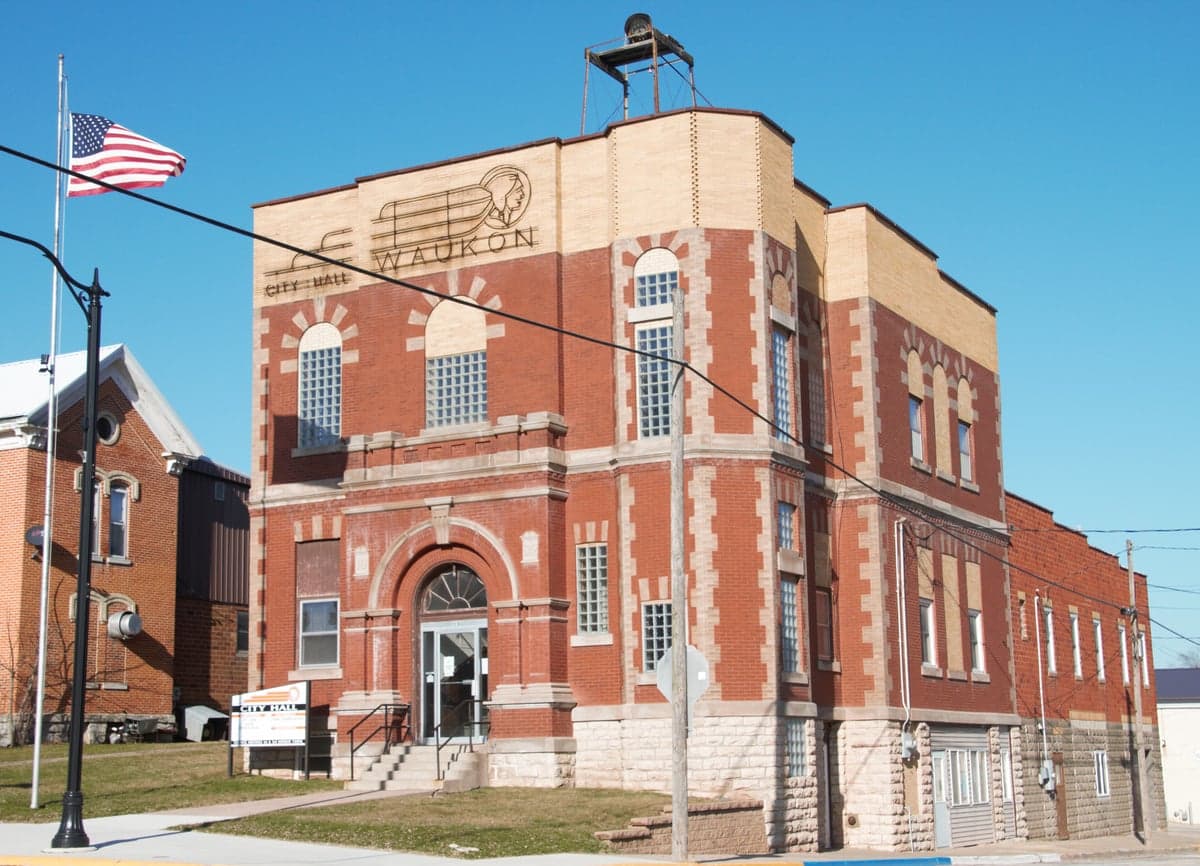
Photo: Wikipedia
Political ClimatePolitical Climate in Waukon, IA
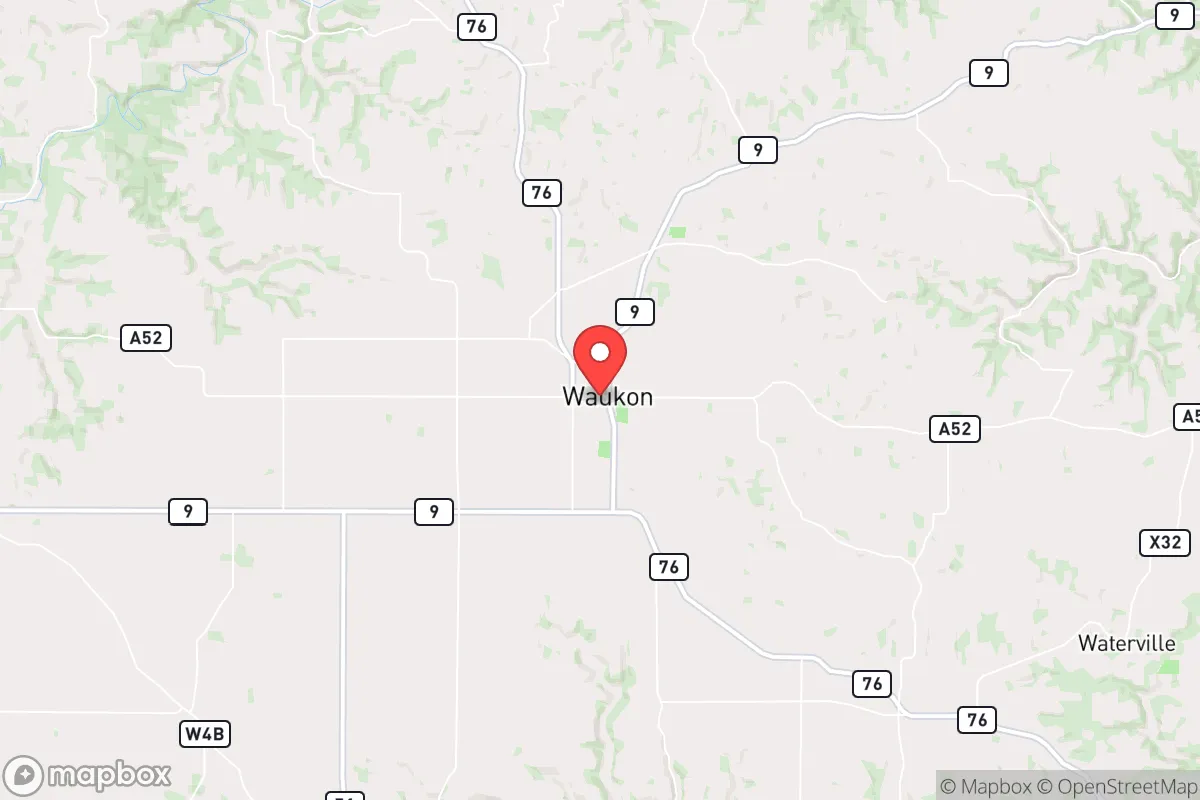
District shown is the primary district for this city’s centroid. Cities may span multiple districts.
Local Political AnalysisPolitical Analysis of Waukon, IA
Waukon leans reliably Republican, but it’s a bit more of a mixed bag than the surrounding countryside. The town sits in Allamakee County, which has a Cook PVI of R+4, making it slightly less conservative than the state of Iowa as a whole, which sits at R+6. That two-point gap might not sound like much, but it reflects a real difference in local voting patterns—Waukon itself has a history of occasionally backing a Democrat for county office, especially when the candidate is a known local figure, while the rural townships around it are deeper red. Over the past decade, the trend has been a slow drift rightward, mirroring the state’s broader shift, but the drift here is gentler than in places like Decorah to the north or Postville to the south, both of which have seen sharper polarization.
How it compares
Compared to the rest of Iowa, Waukon’s political climate is a little more tempered. The state’s R+6 PVI means that statewide races—like the 2024 Senate contest—typically favor Republicans by a wider margin than what you’d see in Allamakee County. For example, in the 2020 presidential election, Donald Trump won Iowa by about 8 points, but he carried Allamakee County by only 4 points. That’s a small but meaningful difference. Nearby towns like Lansing and New Albin, both along the Mississippi, tend to vote similarly to Waukon, while the more agricultural hamlets like Harpers Ferry and Waterville are reliably deeper red. On the flip side, Decorah, home to Luther College, is a notable blue dot in the region, often voting Democratic by double digits. So if you’re a liberal moving to Waukon, you’ll find yourself in a conservative area, but not an overwhelmingly hostile one—there’s a pragmatic streak here that values community over party loyalty.
What this means for residents
For conservative residents, the political climate is comfortable but not complacent. Local government tends to lean right, with the county board of supervisors and school board often dominated by Republicans, but there’s little of the hardline activism you’d see in more suburban or exurban parts of Iowa. Taxes are moderate, and the local economy—rooted in agriculture, small manufacturing, and tourism along the Upper Iowa River—gets more attention than culture-war issues. For liberal residents, life here means being in the minority, but not an isolated one. You’ll find like-minded folks at the farmers’ market or the public library, and the local Democratic party chapter is small but active. The real friction point tends to be around gun rights and environmental regulations, especially concerning water quality from farm runoff, but these debates are usually civil. In practice, the R+4 lean means that policy decisions—like zoning or school funding—are made with a conservative tilt, but there’s room for compromise on local matters.
Culturally, Waukon stands apart from the rest of Iowa in a few ways. The town has a strong Norwegian and German heritage that shapes its social calendar—think lutefisk dinners and Syttende Mai celebrations—and that ethnic identity sometimes blunts the sharper edges of national politics. There’s also a noticeable libertarian streak here: people generally want the government to stay out of their lives, whether that’s on taxes or personal choices. That’s different from the more evangelical conservative tone you’d find in places like Sioux County out west. Looking ahead, the trajectory is likely to stay R+4 to R+5, as younger residents move to cities like La Crosse or Rochester for work, leaving an older, more conservative base. But the town’s small size and tight-knit character mean that political labels don’t define daily life as much as they do in bigger Iowa cities like Des Moines or Cedar Rapids. You’re more likely to be judged by how you show up at the county fair than by your yard sign.

State Political ClimatePolitical Climate in Iowa
State Political AnalysisPolitical Environment in the State
Iowa has shifted from a classic purple swing state to a solidly Republican one, carrying a Cook PVI of R+6 after trending rightward for over a decade. The state backed Donald Trump by roughly 8 points in both 2016 and 2020, and in 2024, that margin widened to about 13 points, cementing a realignment that began with the 2014 midterms. The dominant coalition is a mix of rural and small-town conservatives, evangelical voters, and older suburbanites, while Democrats now hold their strongest ground in a handful of college towns and the state’s two largest urban counties.
Urban vs. rural divide
The political map of Iowa is a textbook study in the urban-rural split. The state’s two biggest population centers—Polk County (Des Moines) and Johnson County (Iowa City)—are Democratic strongholds. Polk County went for Joe Biden by 14 points in 2020, while Johnson County, home to the University of Iowa, delivered a 35-point margin for Democrats. These two counties alone account for roughly a quarter of the state’s vote, but they’re increasingly isolated. The rest of the state has moved decisively red. The once-competitive “Iowa 3rd” congressional district, which includes Des Moines’ suburbs and rural areas to the south and west, flipped back to Republicans in 2022 and stayed red in 2024. Suburbs like Ankeny and Waukee, which were trending purple a decade ago, have shifted rightward as new residents and families prioritize lower taxes and school choice. Meanwhile, rural counties like Sioux, Lyon, and Plymouth in the northwest routinely vote 70-80% Republican. The Mississippi River counties in the east, once a Democratic stronghold due to unionized manufacturing, have swung hard right on cultural and economic issues, with places like Dubuque and Clinton County flipping from blue to red over the past three cycles.
Policy environment
Iowa’s policy environment is defined by a low-tax, limited-government approach that has accelerated under unified Republican control since 2017. The state has a flat income tax rate of 3.8% as of 2025, down from a top rate of 8.98% in 2021, with a path to a flat 3.5% by 2027. Property taxes are relatively low, with a median effective rate of about 1.5% of home value. There is no state estate or inheritance tax. The regulatory posture is business-friendly, with a right-to-work law on the books and no state-level minimum wage above the federal $7.25. Education policy has been a flashpoint: in 2023, the state passed a universal school choice program allowing any family to use public funds for private or homeschool expenses, a move that has drawn both praise from conservatives and lawsuits from rural school districts. Healthcare policy is mixed—Iowa expanded Medicaid under the Affordable Care Act, but the state has also imposed work requirements for able-bodied adults on the program, a policy that has been challenged in court. Election laws tightened in 2021 with a law reducing early voting days, requiring stricter voter ID, and banning most ballot drop boxes. The state also passed a “fetal heartbeat” abortion ban in 2018, which was blocked in court but ultimately upheld by the Iowa Supreme Court in 2024, effectively banning abortion after about six weeks of pregnancy.
Recent policy direction
The last five years have seen Iowa move aggressively on a broad front of conservative priorities. On gun rights, the state enacted permitless carry in 2021, allowing any legal adult to carry a concealed firearm without a permit. On parental rights and education, the 2023 “Students First” Act created Education Savings Accounts worth roughly $7,600 per student for private or homeschool use, and a 2024 law banned the teaching of “divisive concepts” related to race and gender in K-12 schools. Speech and privacy issues have surfaced around library books and transgender youth: a 2023 law banned gender-affirming care for minors, and several school districts have faced lawsuits over book removal policies. On property rights, Iowa has a strong “right to farm” law that shields agricultural operations from nuisance lawsuits, and the state has resisted most forms of rent control or land-use regulation outside of a few cities. Medical and bodily autonomy is sharply restricted: the 2024 abortion ban has no exceptions for rape or incest, only for medical emergencies, making Iowa one of the most restrictive states in the Midwest. On voting and ballot access, the 2021 law shortened the early voting window from 29 days to 20, eliminated straight-ticket voting, and required absentee ballot applications to be returned by mail or in person—no online requests. The overall direction is toward a more traditional, culturally conservative state with a smaller government footprint, though the pace of change has created friction in the more liberal urban pockets.
Civil unrest & political movements
Iowa has seen its share of political flashpoints, though large-scale civil unrest is rare. The most visible protests in recent years have centered on abortion rights: after the 2024 abortion ban took effect, demonstrations in Des Moines and Iowa City drew hundreds, with activists organizing clinic escorts and out-of-state travel networks. On the right, the “Parents’ Rights” movement has been highly organized, with groups like “Iowa Parents for Education” successfully pushing for school board majorities in suburban districts like Ankeny and Waukee. Immigration politics have been relatively quiet compared to border states, but a 2024 law making it a state crime to be in Iowa illegally—modeled after Texas’s SB 4—has drawn legal challenges and some localized protests in meatpacking towns like Storm Lake and Postville, which have significant immigrant populations. There is no serious secession or nullification movement in Iowa, though some rural county supervisors have passed symbolic “Second Amendment sanctuary” resolutions. Election integrity controversies flared after 2020, with Republican Secretary of State Paul Pate conducting a limited audit that found no widespread fraud, but the 2021 voting law was passed in direct response to those concerns. A new resident would notice the political divide most in yard signs and bumper stickers—Trump flags are common in rural areas, while “Harris” and “Biden” signs cluster in college neighborhoods—but the state is generally civil, with little of the street-level tension seen in larger coastal cities.
Projection
Over the next 5-10 years, Iowa is likely to become more Republican, not less. In-migration patterns favor the right: the state is attracting conservative-leaning families from Illinois, Minnesota, and California, drawn by lower taxes, school choice, and housing costs. The Des Moines metro is growing, but the new suburbs—like Grimes, Johnston, and Norwalk—are voting more Republican than the older inner-ring suburbs. The Democratic base is shrinking as rural counties depopulate and union membership declines. The University of Iowa and Iowa State University will continue to anchor liberal pockets in Iowa City and Ames, but these are small islands in a red sea. The state’s congressional delegation is likely to remain all-Republican after 2026, and the governorship will stay in GOP hands for the foreseeable future. The biggest wildcard is the abortion issue: if the 2024 ban proves unpopular with suburban women, it could moderate the GOP’s margin in some districts, but the overall trend is toward a solidly red state. A relocator moving in now should expect a decade from now to find a state that is culturally conservative, low-tax, and increasingly homogeneous in its politics, with the urban-rural divide deepening rather than healing.
For a new resident, the bottom line is straightforward: if you lean conservative, Iowa offers a policy environment that aligns with your values—low taxes, school choice, gun rights, and a government that is generally hands-off on business and property. If you lean liberal, you’ll find strong communities in Des Moines, Iowa City, and Ames, but you’ll be living in a state where your vote has limited impact on statewide races and where state policy will often run counter to your preferences. Either way, the state is safe, affordable, and politically stable, with a culture that values neighborliness over confrontation. The key is knowing which part of the state you’re moving to—and being realistic about what that means for your daily life and your vote.
* Values derived from national, state, county, city and local statistics and may differ in a specific area. Last updated: 2026-10-08T00:56:20.000Z
Narrative content on this page is AI-generated and may contain mistakes. Verify any details that matter before acting on them.
ReloMaps may earn a commission from affiliate links at no extra cost to you.

